

The Complete Student Guide to Mastering IGCSE Trigonometry and Scoring Higher Marks(Struggling with IGCSE Trigonometry? Master the Sine Rule & Cosine Rule with clear examples, formula guides, exam tips, and common mistakes to avoid. Score higher in IGCSE Maths.)
Introduction: Why Mastering IGCSE Trigonometry Matters?
If there is one topic that causes stress for many IGCSE Maths students, it is Trigonometry. The moment students see a triangle with missing sides and angles, they often wonder:
- Should I use SOHCAHTOA?
- Is this a Sine Rule question?
- Do I need the Cosine Rule?
- Why am I getting the wrong answer?
Key Insight: Most students do not lose marks because trigonometry is difficult. They lose marks because they choose the wrong method or make simple calculator mistakes.
The good news is that once you understand a few simple rules, IGCSE Trigonometry becomes one of the most predictable and scoring topics in the syllabus.
In this guide, we’ll explain the Sine Rule, Cosine Rule, common exam mistakes, revision strategies, and expert tips used by high-scoring students to achieve top grades in IGCSE Mathematics.
What is Trigonometry IGCSE Maths?
Trigonometry is the branch of mathematics that studies the relationships between the sides and angles of triangles.
In IGCSE Maths, students first learn:
- Pythagoras’ Theorem
- SOHCAHTOA
- Right-angled triangle calculations
However, not all triangles contain a right angle.
This is where the Sine Rule and Cosine Rule become important.
These formulas help us solve problems involving non-right-angled triangles, allowing us to calculate unknown sides and angles accurately a skill that is tested frequently in both Cambridge IGCSE and Edexcel IGCSE examinations.
Why is Trigonometry Important in IGCSE Maths?
Trigonometry appears regularly in:
- Cambridge IGCSE Mathematics
- Edexcel IGCSE Mathematics
- International GCSE examinations
It is also one of the topics that frequently appears in higher-mark questions.
Beyond examinations, trigonometry is used in:
- Engineering
- Architecture
- Surveying
- Navigation
- Aviation
- Physics
- Construction
- Computer graphics
Learning trigonometry develops logical thinking and problem-solving skills that are useful in many careers.
Why Do Students Struggle with IGCSE Trigonometry?
Many students believe trigonometry is difficult because there are multiple formulas to remember.
However, the real challenge is usually deciding:
“Which formula should I use?”
Most exam mistakes happen because students:
- Choose the wrong formula
- Misidentify opposite sides
- Use radians instead of degrees
- Round answers too early
- Forget calculator functions
Once you learn how to identify the correct method, trigonometry becomes much easier.
Understanding Triangle Labelling – The Foundation of IGCSE Trigonometry
Before using any trigonometric formula, you must label the triangle correctly.
In every triangle:
- Angle A is opposite side a
- Angle B is opposite side b
- Angle C is opposite side c
Key Insight: Most students do not lose marks because trigonometry is difficult. They lose marks because they choose the wrong method or make simple calculator mistakes.
What Are Sin, Cos, and Tan?(SOHCAHTOA)
Before learning the Sine Rule and Cosine Rule, you must fully understand what sine, cosine,and tangent actually mean. These three ratios are the building blocks of all trigonometry.
In a right-angled triangle, every angle (other than the right angle) has three sides associated
with it:
- Opposite — the side directly across from the angle you are working with
- Adjacent — the side next to the angle (but not the hypotenuse)
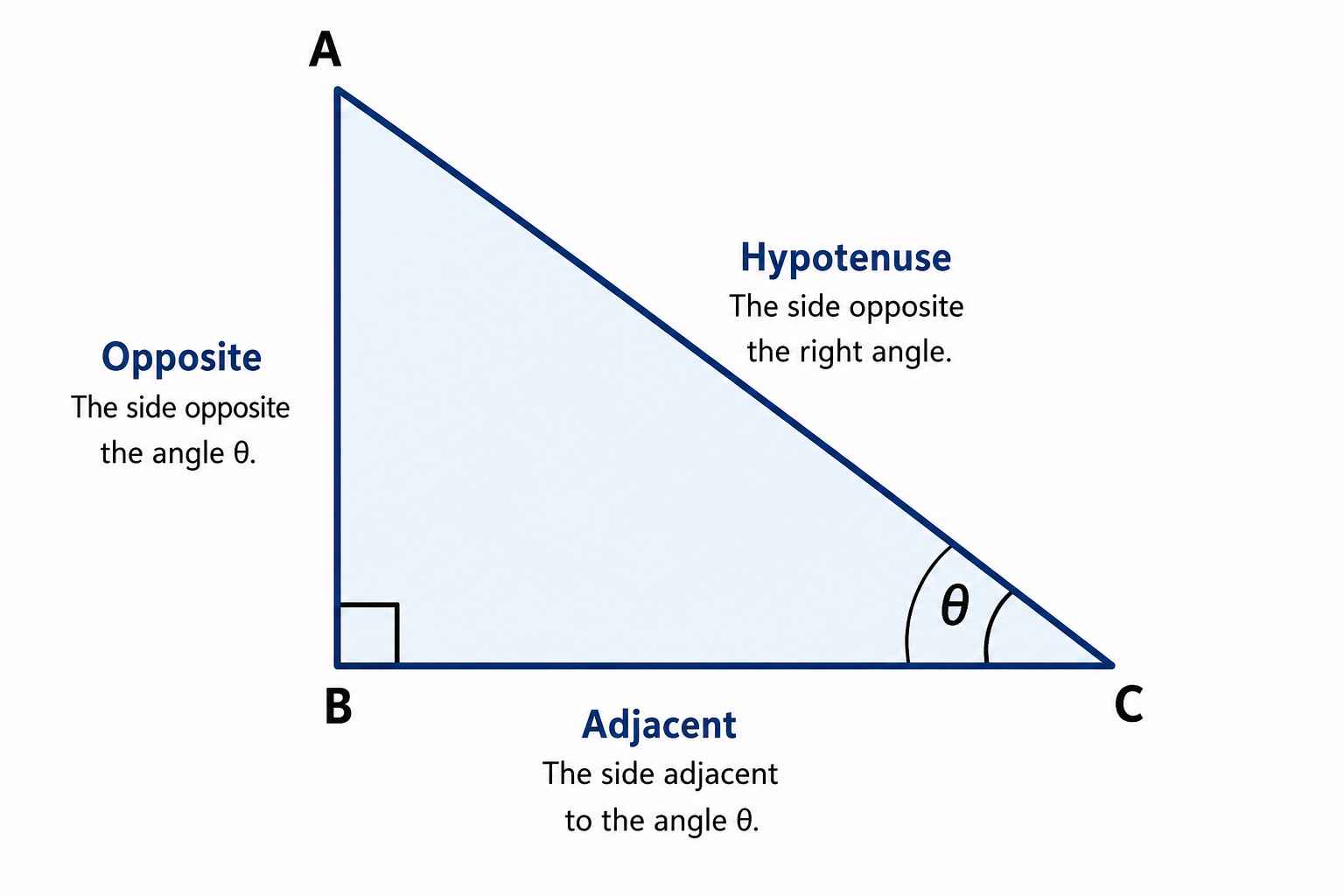
- Hypotenuse — the longest side, always opposite the right angle The Three Trigonometric RatiosEach ratio compares two sides of the right-angled triangle. The angle you are working with determines which side is Opposite and which is Adjacent.
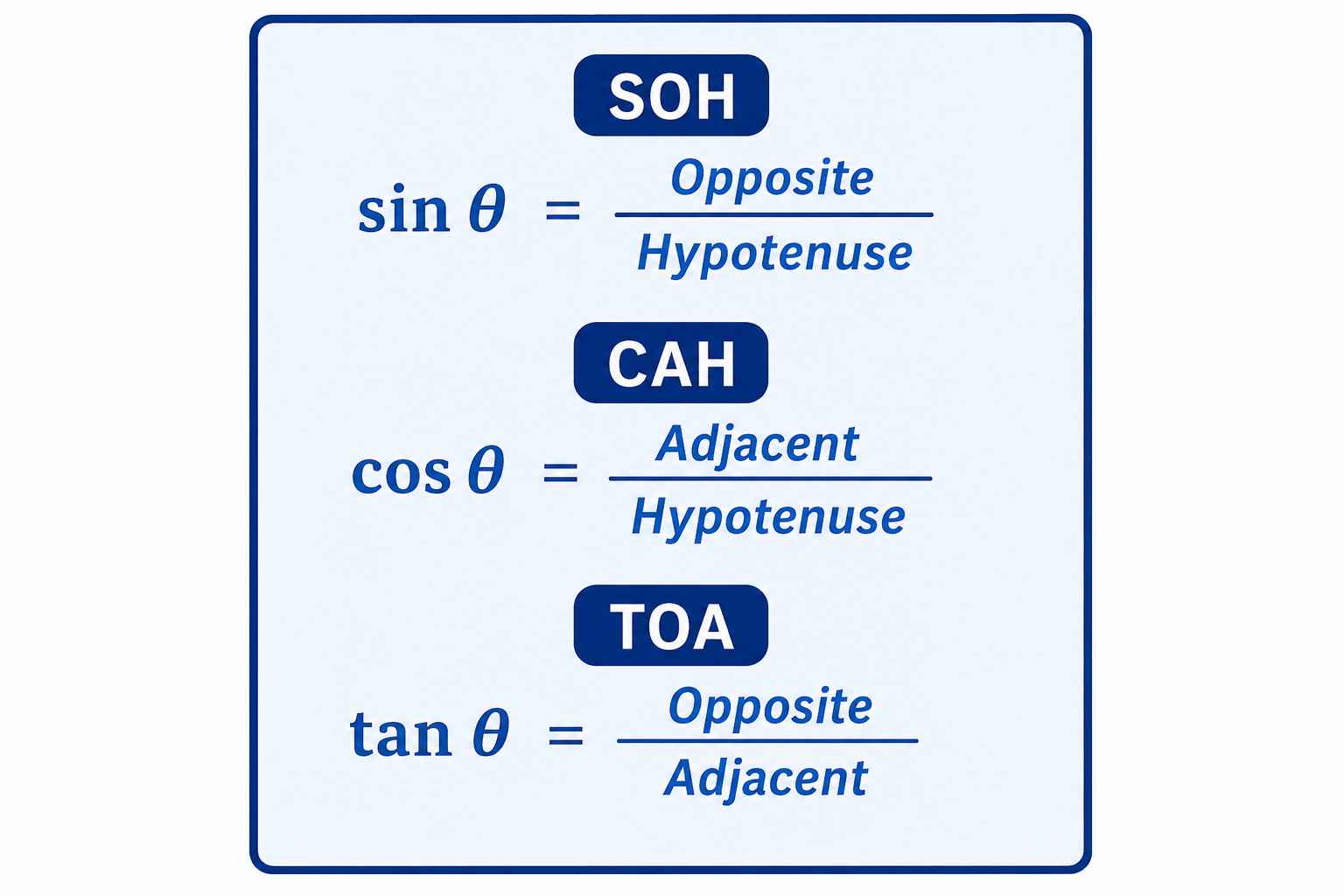
Memory Trick: SOHCAHTOA — say it out loud as one word: “So-Kah-Toe-Ah”. Many students also use the phrase: Some Old Hens Can Always Hear Their Own Approach.
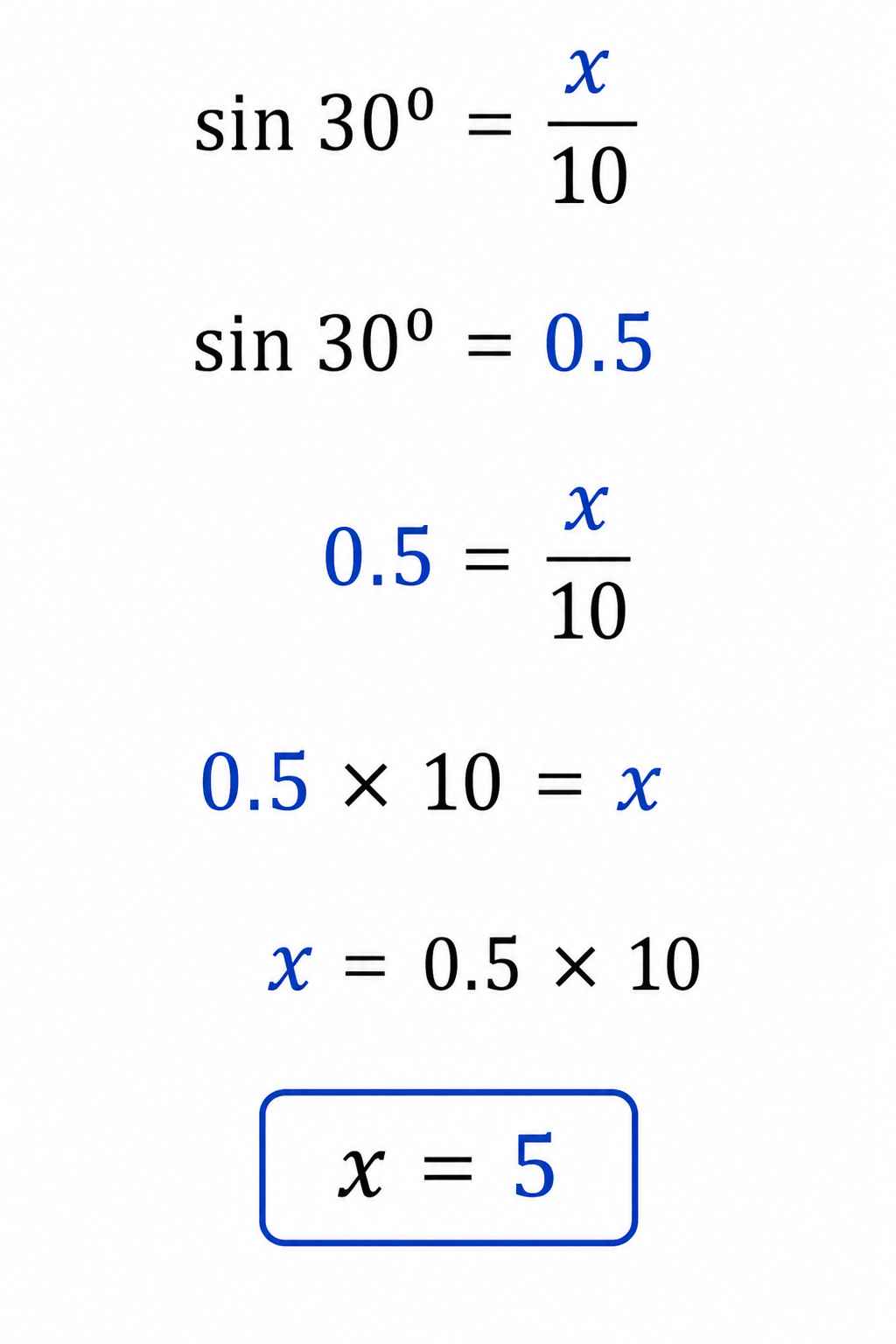
Using SOHCAHTOA: Finding a Missing Side
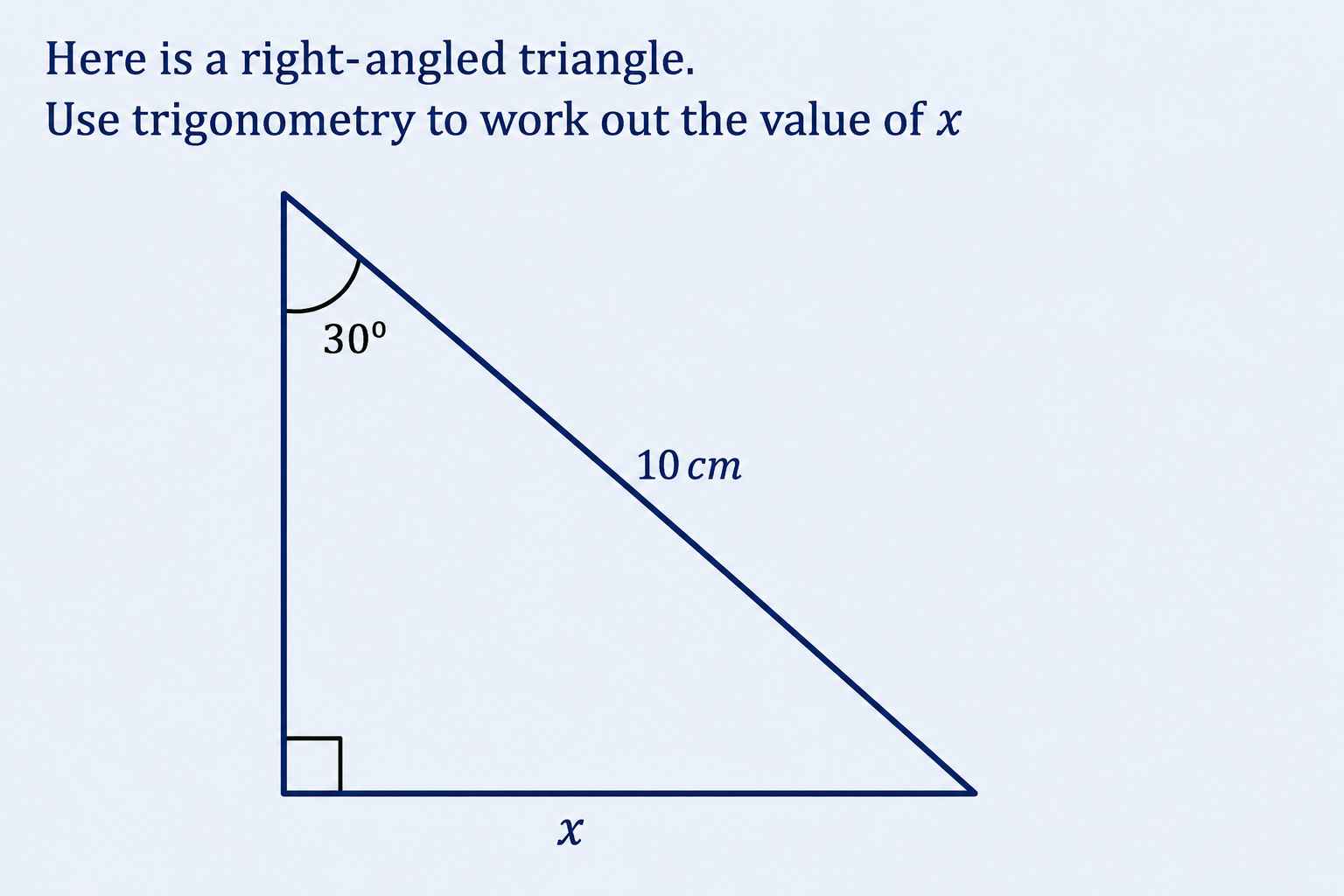
Solution –
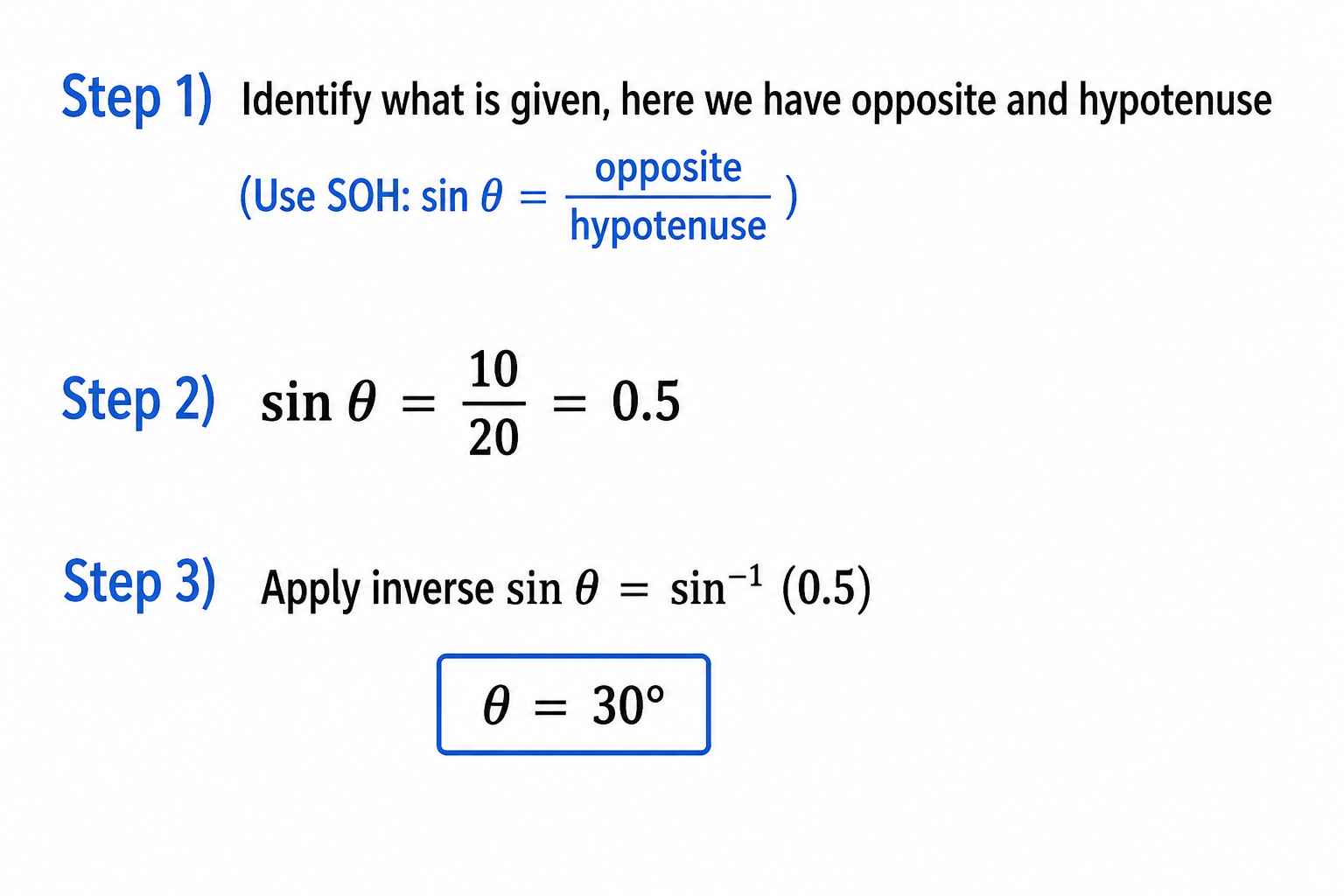
Using SOHCAHTOA: Finding the unknown Angle
Use trigonometry to find the unknown angle
Given opposite = 10 cm & Hypotenuse = 20 cm
Solution –
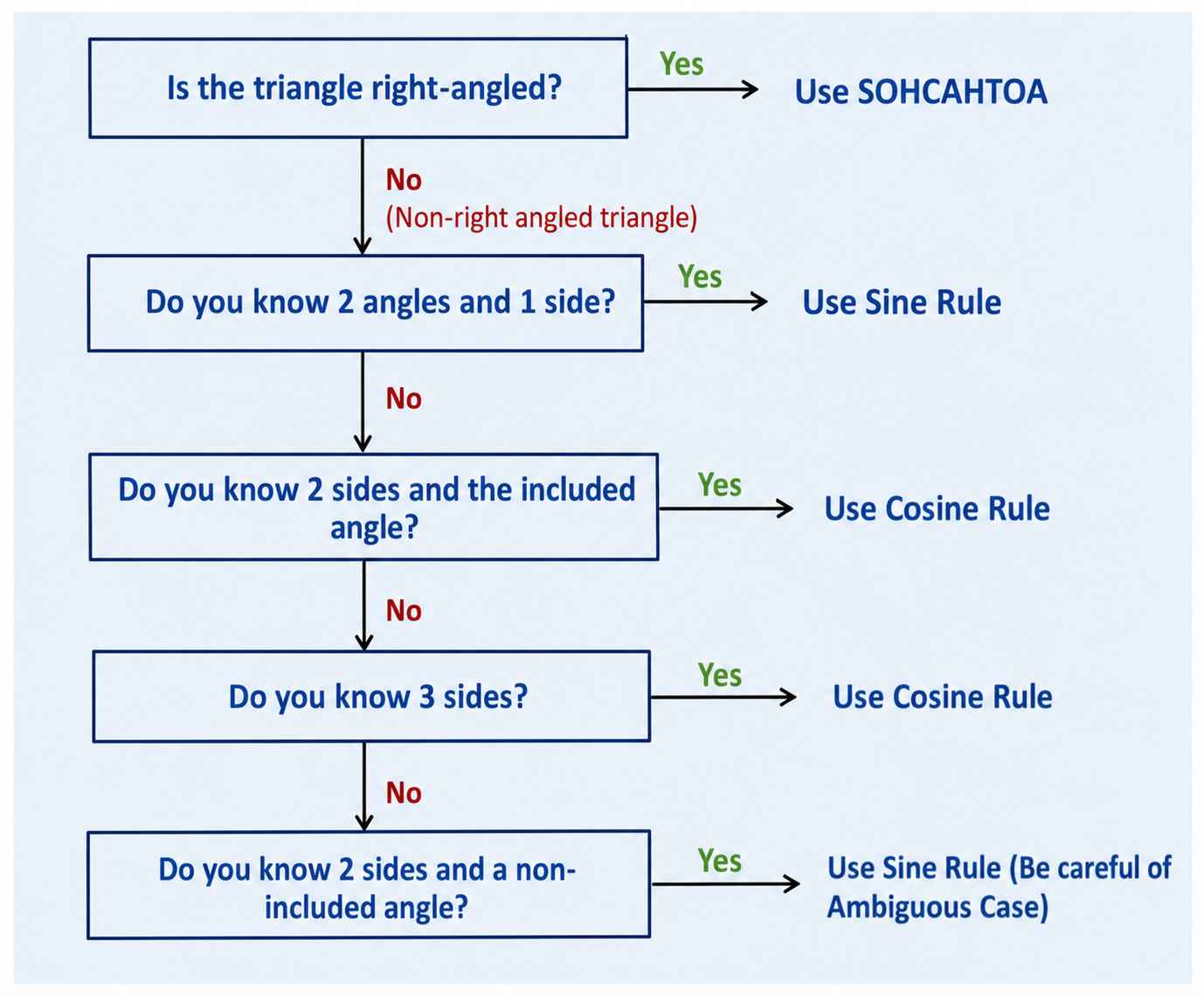
The 30-Second Formula Selection Method
Before performing any calculation, ask yourself these questions.
This simple process works for almost every IGCSE trigonometry question.
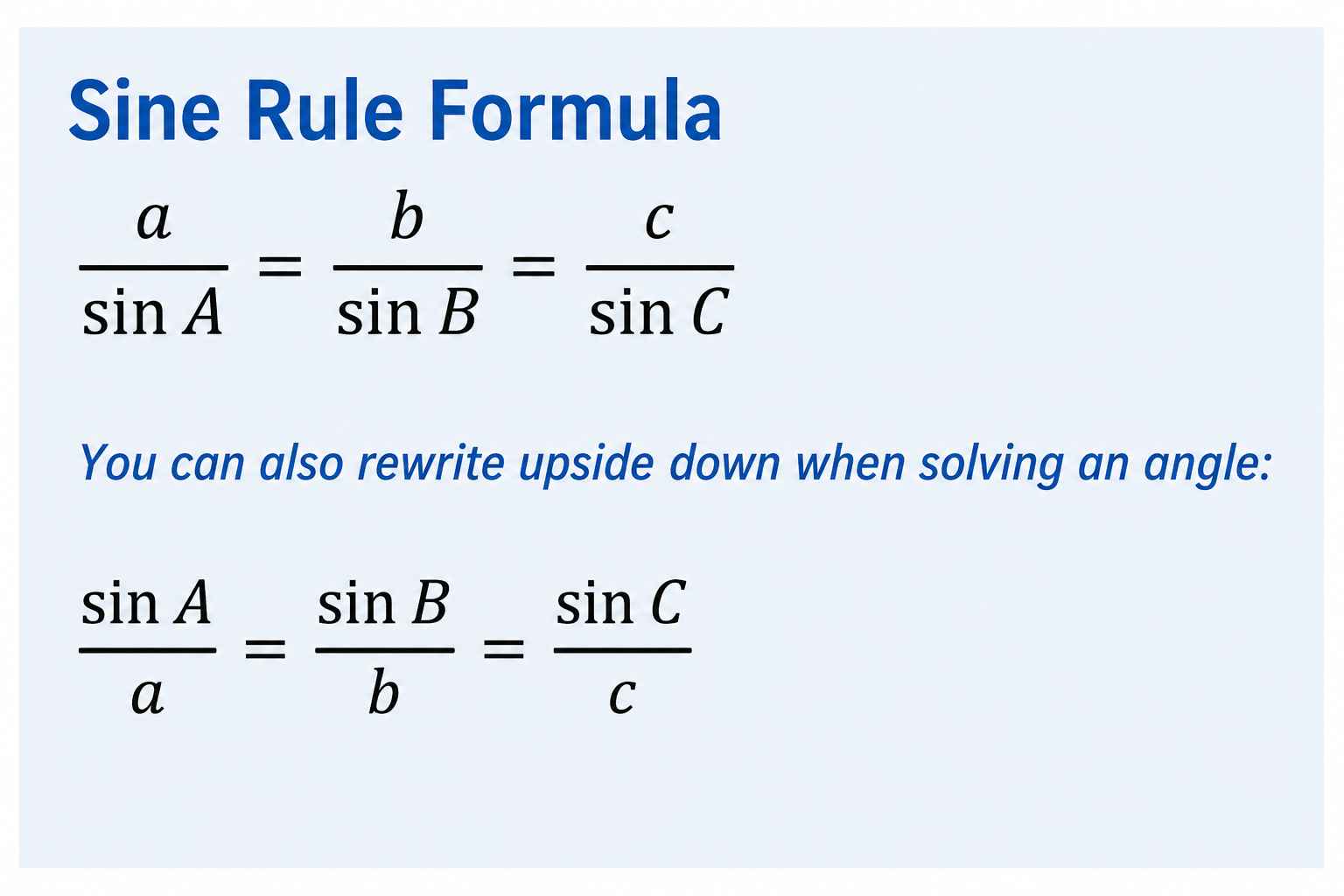
The Sine Rule Explained
The Sine Rule helps us find missing sides or missing angles in non-right-angled triangles.
IGCSE Sine Rule – Formula, Examples & When to Use It
When Should You Use the Sine Rule?
Use the Sine Rule when you have:
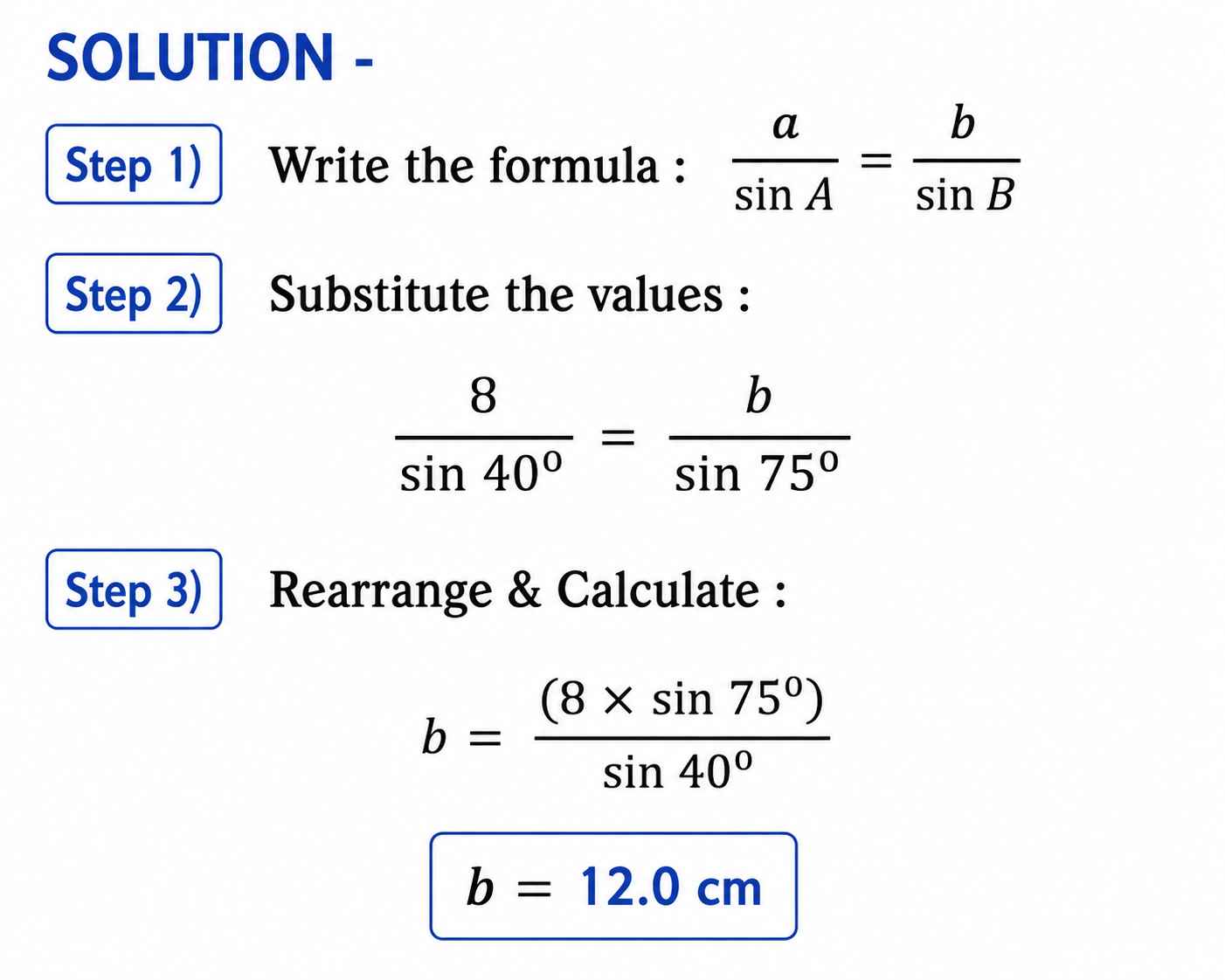
Example 1: Finding a Missing Side Using the Sine Rule
Example 2: Finding a Missing Angle Using the Sine Rule
Find the Missing Angle Using Sine Rule
Given –
A = 35°
b = 10 cm
a = 7 cm
Find angle B
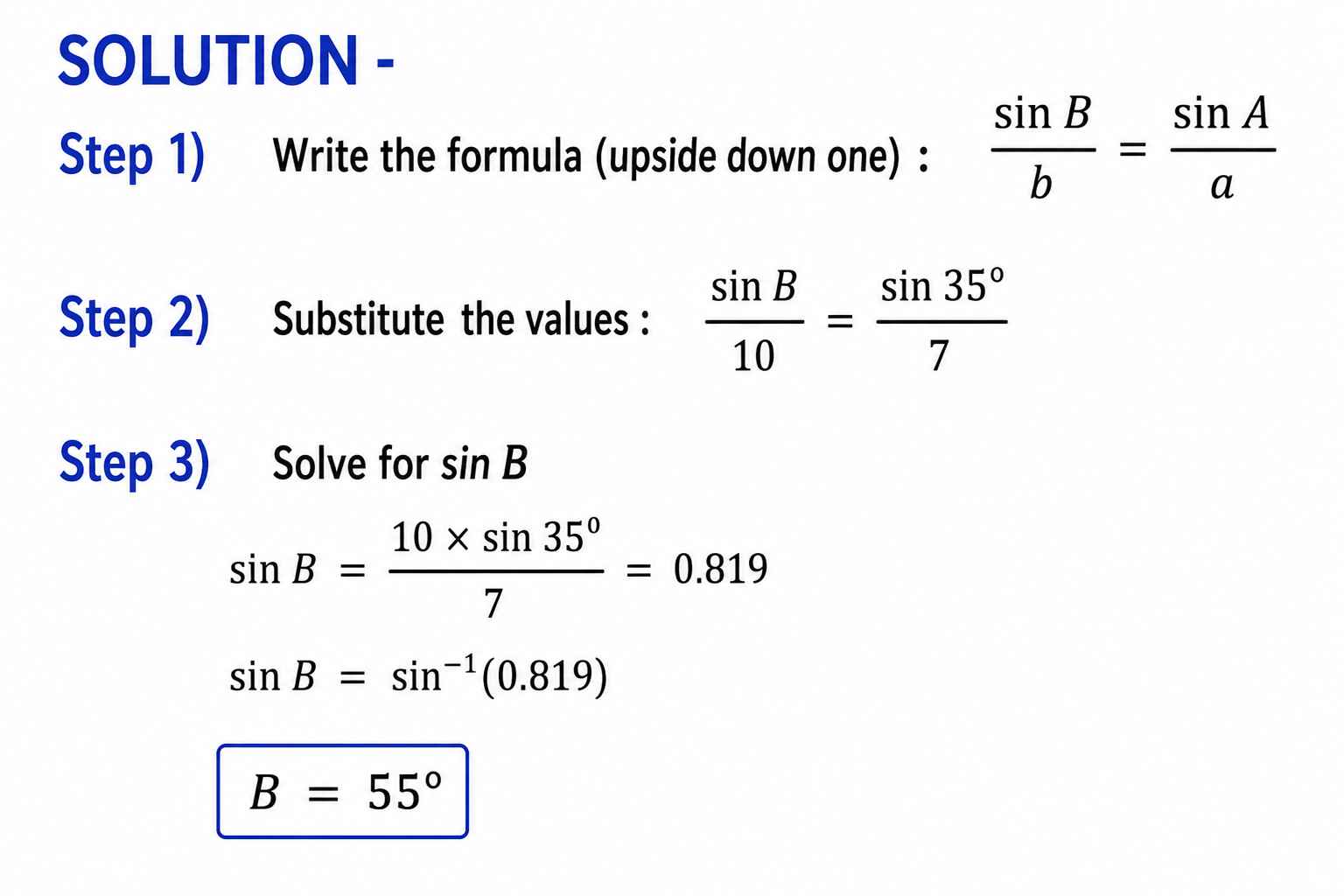
Calculator Reminder: Always use the inverse sine button to find a missing angle. This is also written as arcsin on some calculators.
Easy Trick to Remember the Sine Rule
Ask yourself:
“Do I have an angle and its opposite side?”
If the answer is yes, the Sine Rule is usually the correct choice.
Many students find this shortcut easier than memorising complicated conditions.
The Ambiguous Case in IGCSE Trigonometry: : An Important Exam Trap
One of the most challenging aspects of the Sine Rule is the Ambiguous Case.
Suppose your calculator gives:
sinB = 0.8
Your calculator returns:
B = 53.1°
However:
180° − 53.1° = 126.9° also has the same sine value.
This means there may be two possible triangles.
Always check:
- Does the question specify an acute angle?
- Does it specify an obtuse angle?
- Do all angles still add up to 180°?
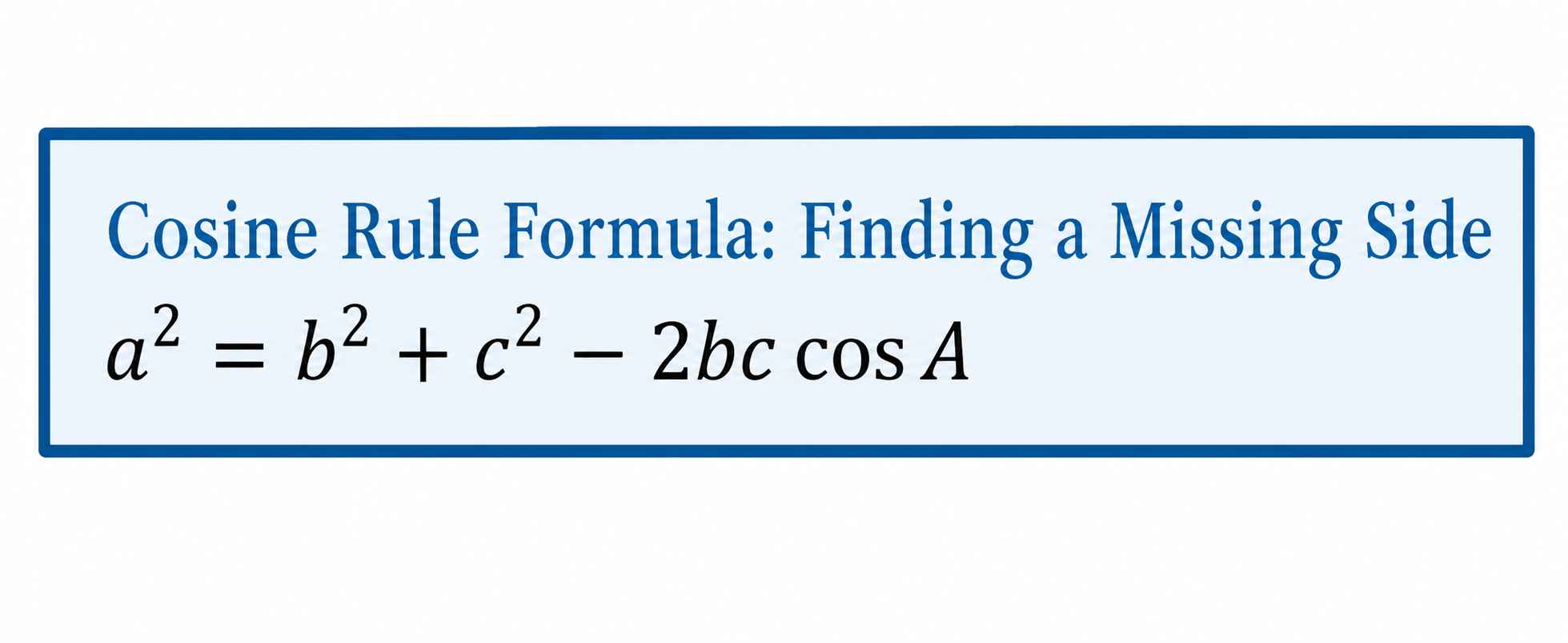
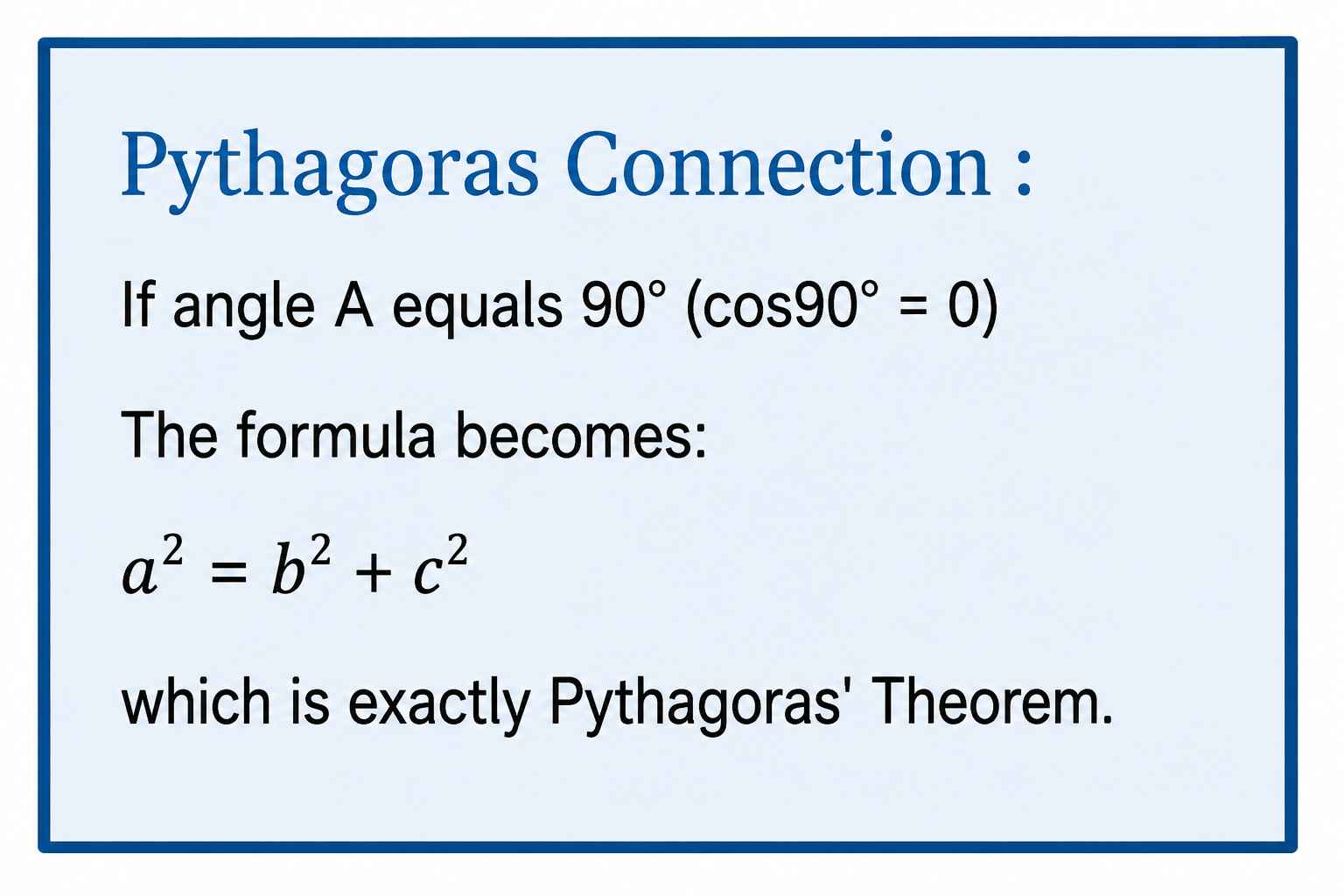
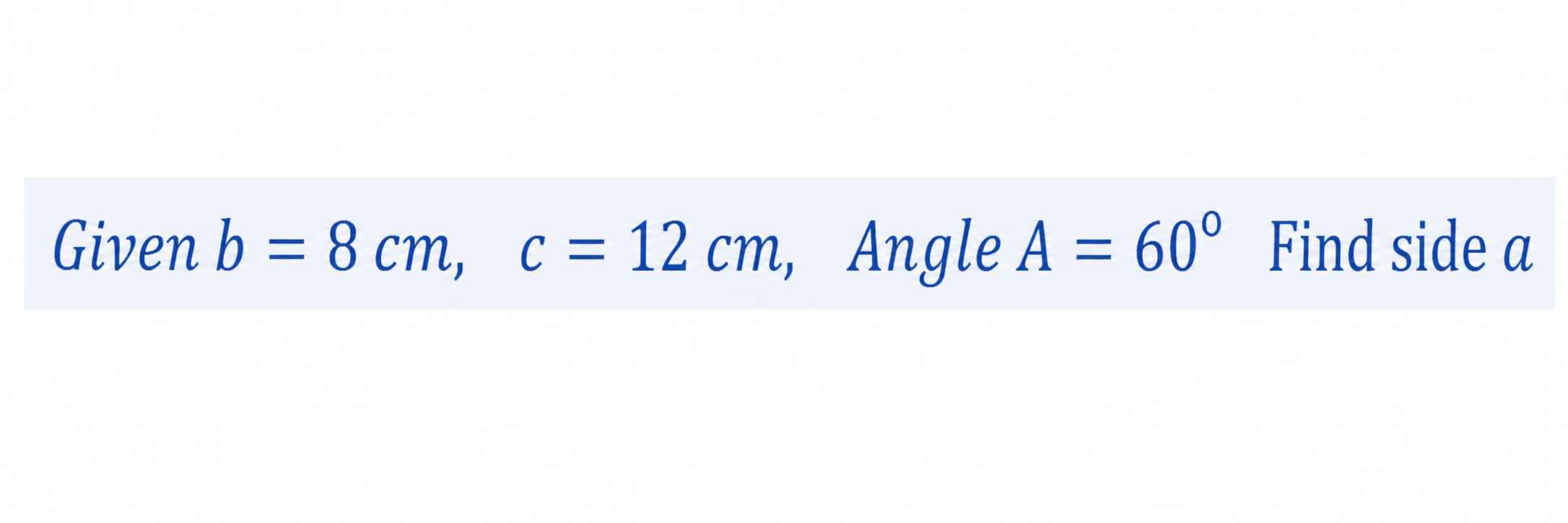
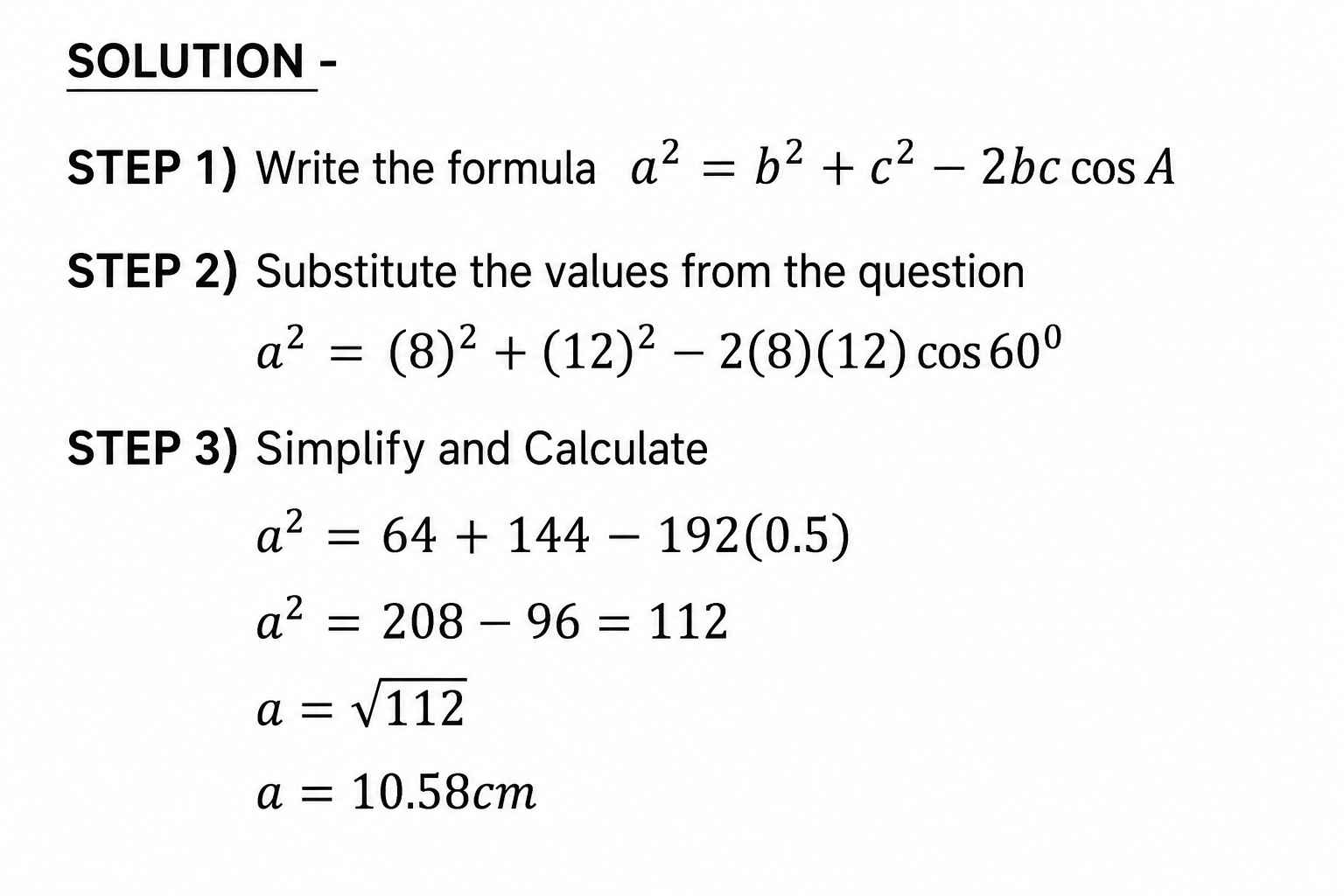
Example 3: Finding a Missing Side Using the cosine Rule
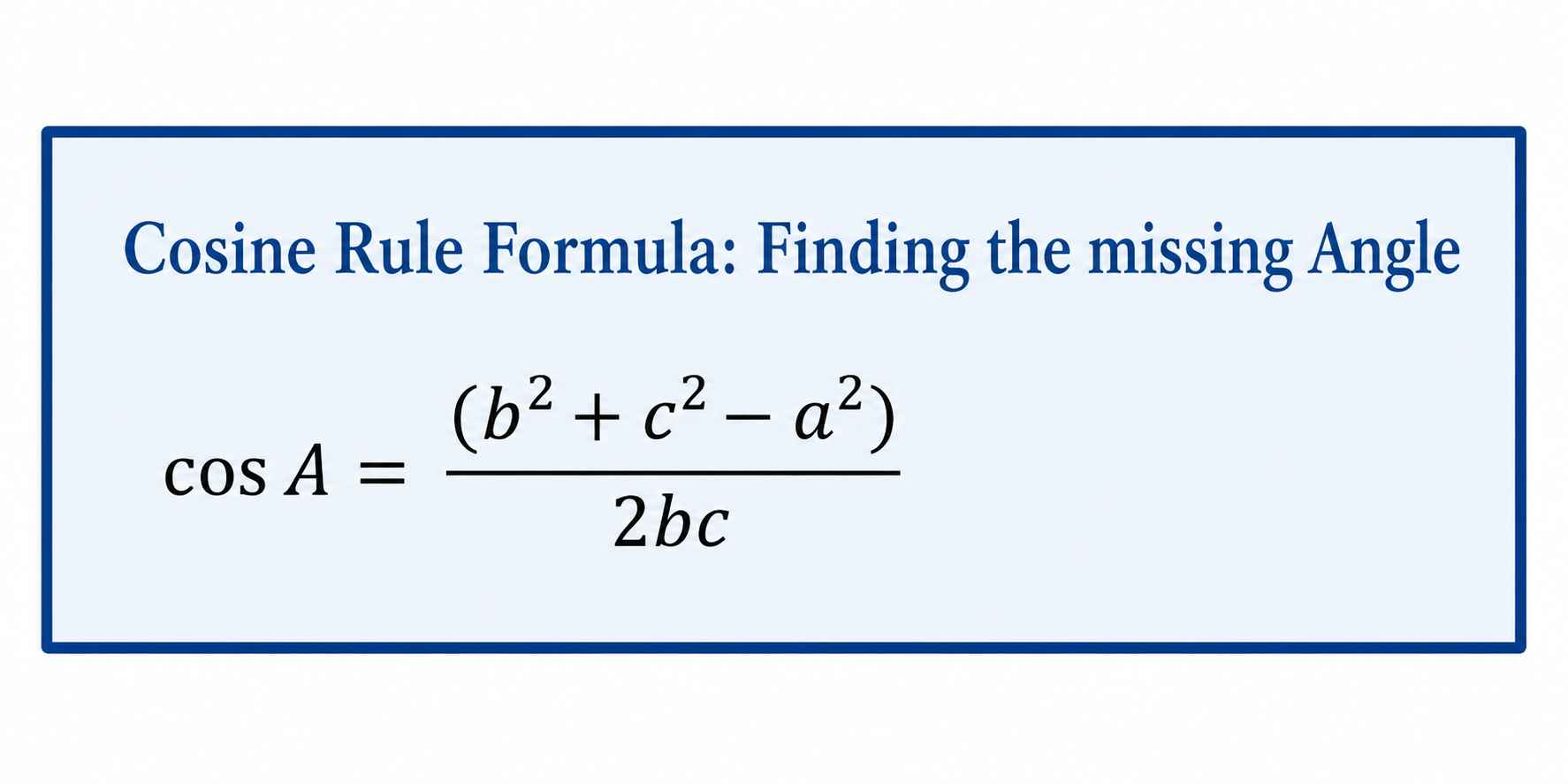
Finding an Angle Using the Cosine Rule
When all three sides are known, use:
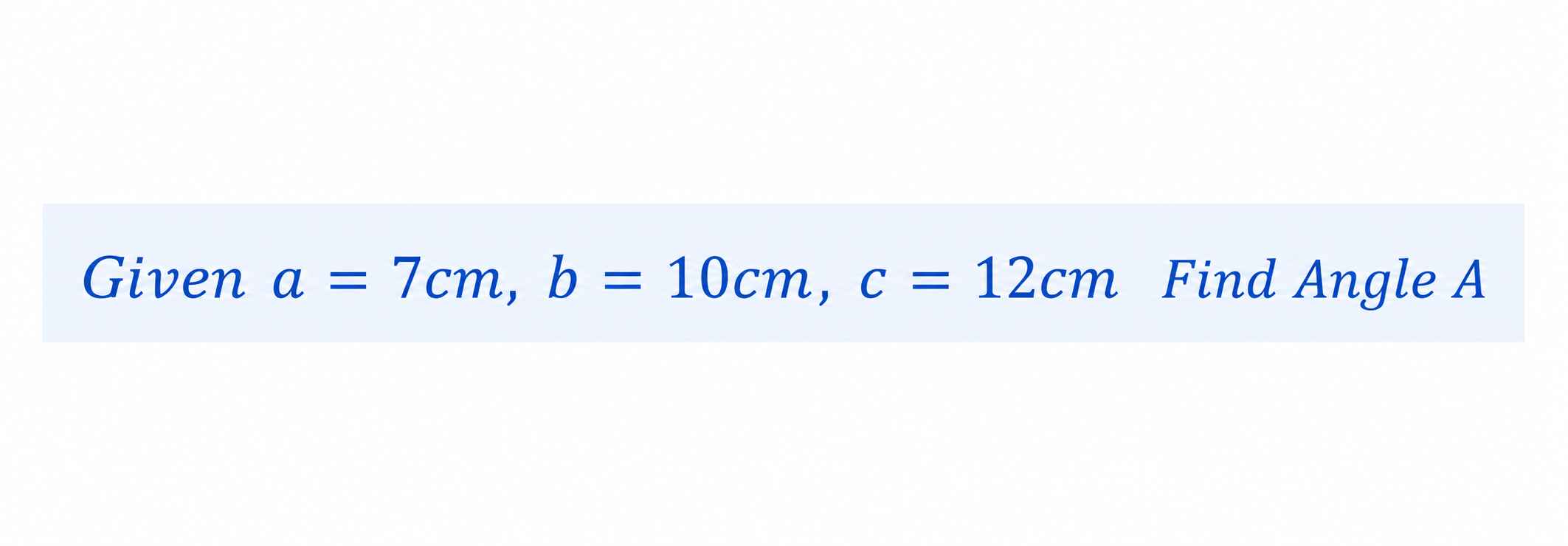
Example 4: Finding an Angle Using the Cosine Rule Formula
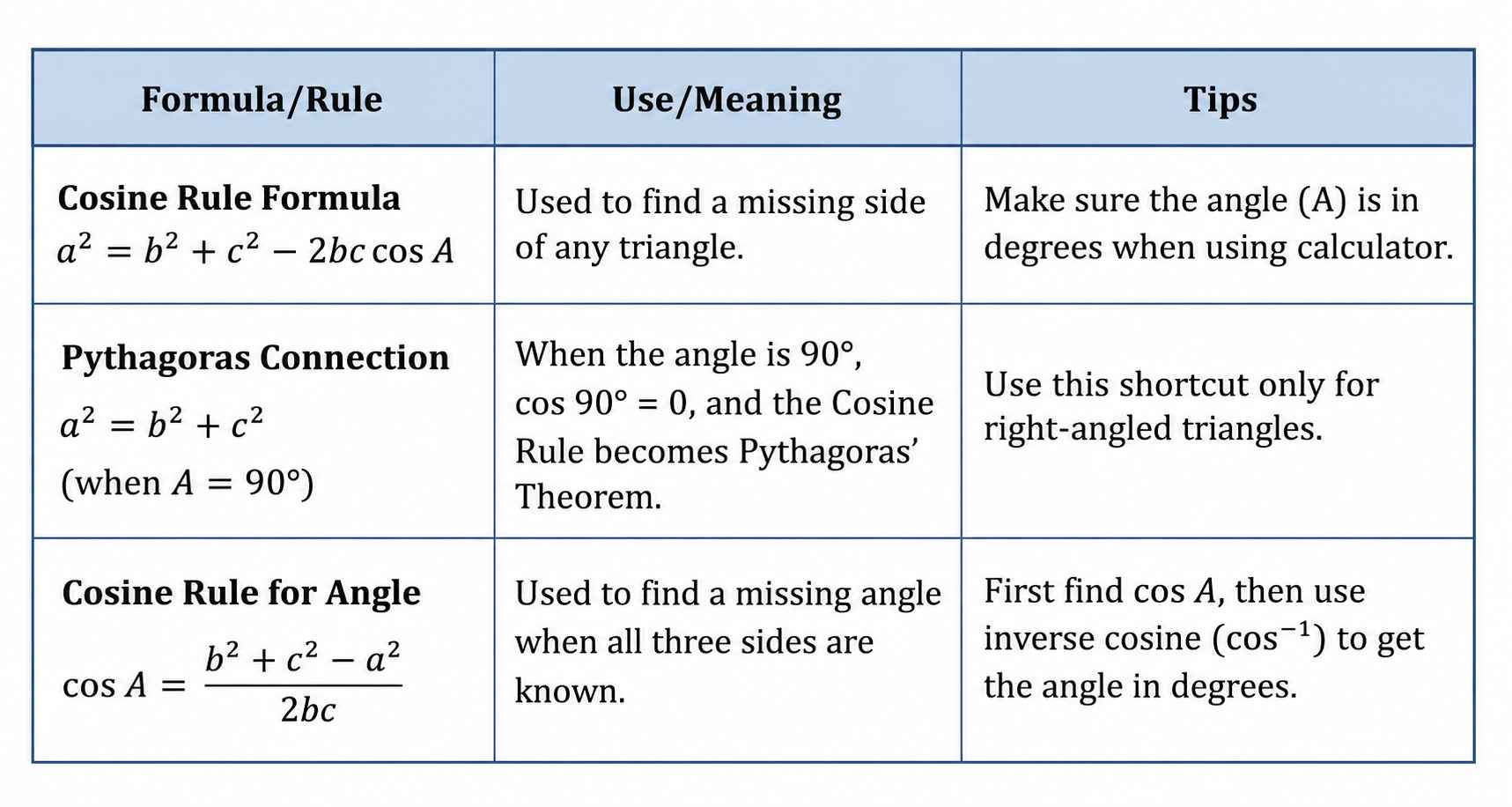
Sine Rule vs Cosine Rule: Which Formula One Should Choose?
Students often get confused between the two formulas.
Use this quick-reference table by Brightmindtutors before every IGCSE trigonometry question:
The #1 Calculator Mistake Students Make
Every year, students lose marks because their calculator is set to radians instead of degrees.
Before every examination:
Check Degree Mode
Example:
sin30°
Correct answer:
0.5
If your calculator is in radians, you will get a completely different result.
This simple check can save several marks.
How Examiners Try to Trick Students
IGCSE examiners often test understanding rather than memorisation.
Common traps include:
Hidden Angle-Side Pair
Students fail to recognise an opposite side.
Ambiguous Case
Two possible answers exist.
Multi-Step Questions
You may need:
- Sine Rule
- Cosine Rule
- Area Formula
all within one question.
Always read the entire problem before starting.
Grade 8 and Grade 9 Student Strategy
Top-performing students follow a systematic approach.Here is the exact method used by high scorers:
- Draw the triangle.
- Label all sides and angles.
- Decide the method.
- Write the formula first.
- Substitute carefully.
- Check the answer.
Mark Scheme Tip: Examiners award method marks for correct working shown, even if your final answer is wrong. Always show your full method – never skip steps.
Trigonometry in Real Life
Many students wonder why they need to learn trigonometry.
The reality is that trigonometry is used everywhere.
Construction
Calculating roof angles and building heights.
Aviation
Planning flight routes.
Navigation
Determining distances and directions.
Engineering
Designing bridges and structures.
Astronomy
Calculating distances between celestial bodies.
Computer Graphics
Creating realistic 3D environments and animations.
IGCSE Trigonometry Past Paper Insight
Trigonometry rarely appears on its own.
It is often combined with:
- Bearings
- Similar triangles
- Geometry
- Area calculations
- Coordinate geometry
- Three-dimensional shapes
Revision Advice: Students who practise only basic trigonometry questions often struggle with integrated problems, as it often gets coupled with other topics. Past papers are essential. Aim to complete at least 10 full past papers under timed conditions before your exam.
Common IGCSE Trigonometry Mistakes to Avoid
Mistake 1 Choosing the Wrong Formula
Always identify the information provided before calculating.
Mistake 2 Incorrect Triangle Labelling
Remember:
- A ↔ a
- B ↔ b
- C ↔ c
Mistake 3 Calculator in Radian Mode
Always use degrees.
Mistake 4 Rounding Too Early
Keep at least four decimal places until the final answer.
Mistake 5 Forgetting Square Roots
If: a² = 100
Then:
a = 10 (not 100).
Exact Trigonometric Values — Essential for NonCalculator Papers
New Addition: This topic was added to the Cambridge IGCSE 0580 syllabus for 2025–2027 and is specifically tested in Paper 1 (non-calculator). Students must memorise these values as no calculator is permitted.
The new specification requires you to know the exact values of sin x and cos x for 0°, 30°, 45°, 60°, and 90°, and tan x for 0°, 30°, 45°, and 60°. These are not approximations — they are precise values often involving square roots
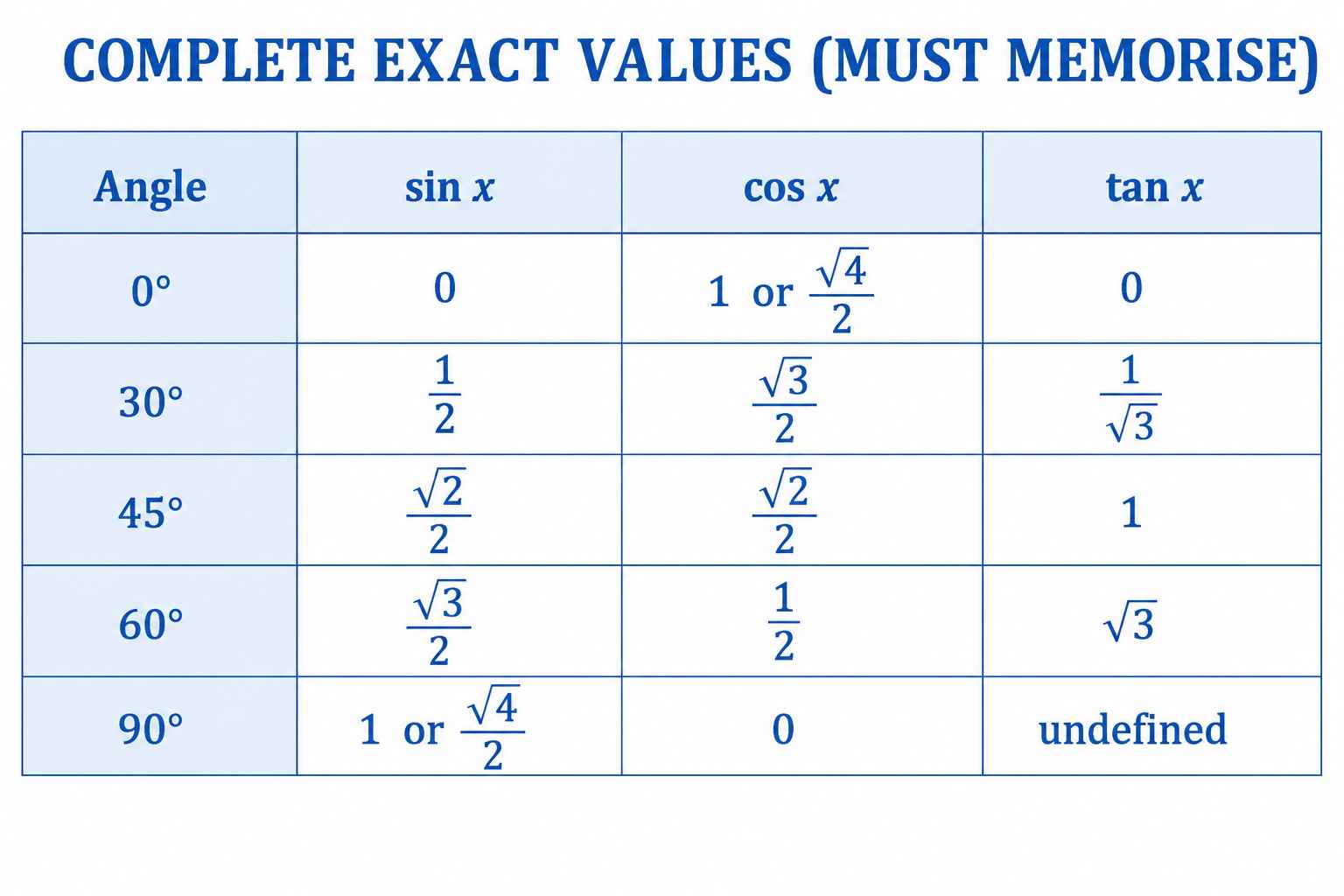
Memory Trick — The 0, 1, 2, 3, 4 Pattern: For sin 0°, 30°, 45°, 60°, 90°: write √0/2, √1/2, √2/2, √3/2, √4/2 and simplify. You get 0, 1/2, √2/2, √3/2, 1. For cos, read the sin values in reverse order
Questions often ask: Find the exact value of sin 60° × cos 30° or “Show that tan 45° = 1”.
Leave answers in surd form (e.g. √3/2 – do not convert to decimal. Writing a decimal in a “find the exact value” question scores no marks.
IGCSE PAPER STYLE QUESTION –
EXAMPLE 5 Finding Exact Value Without Calculator
Angles of Elevation and Depression in IGCSE Maths
Explicit Topic: It is listed in the Cambridge IGCSE 0580 specification. These questions appear regularly in both Paper 1 and Paper 2 and are often combined with trigonometry or Pythagoras.
Angle of Depression
The angle of depression is the angle measured downward from the horizontal to a point below. Look at the diagram below, an observer when focuses on the object the line of sight falls below the horizontal line which creates an angle of depression.
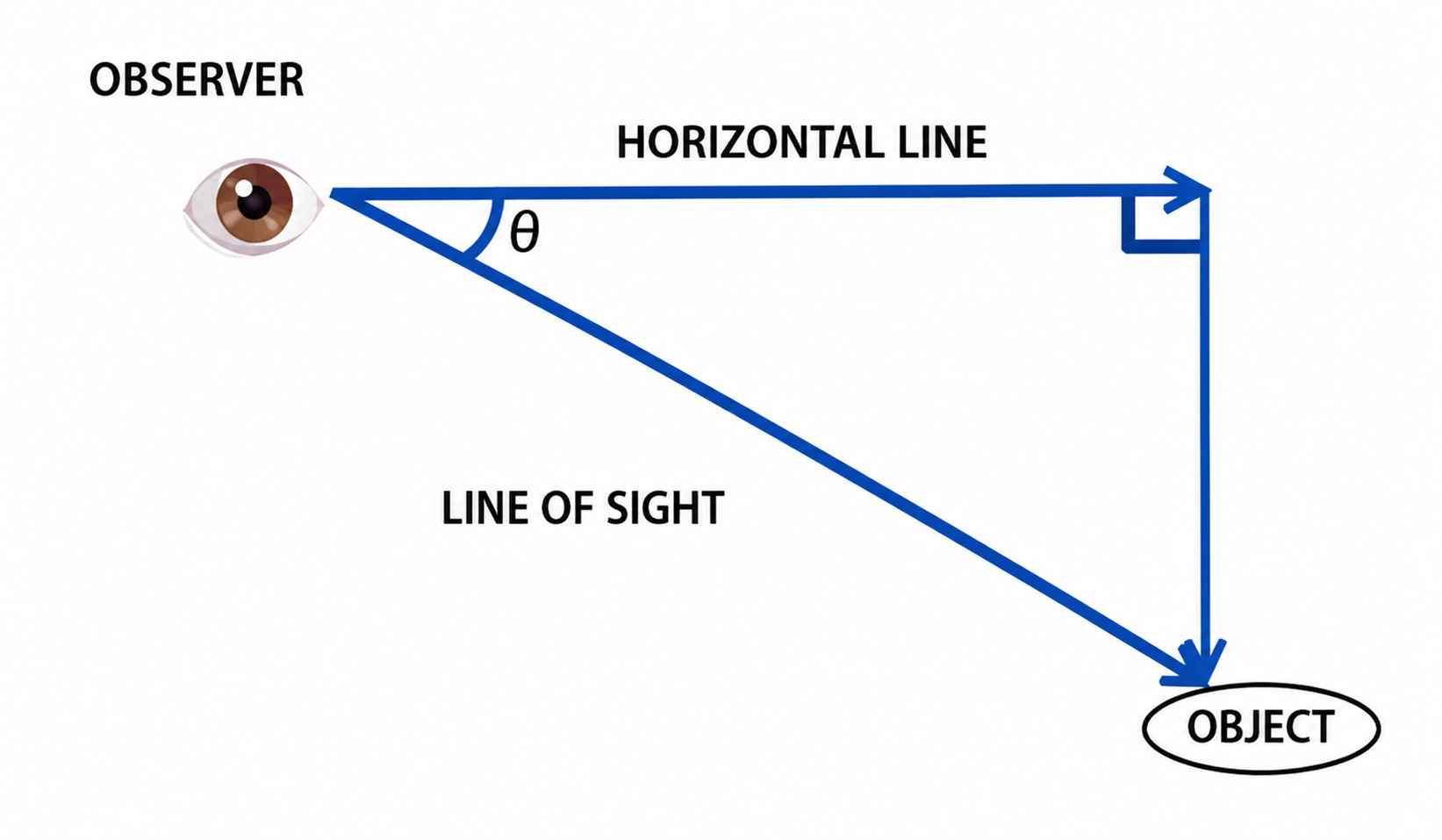
You can join object vertically with horizontal line and in that case we will get a right angled triangle and hence we can calculate the distance of the observer from the object using trigonometry
Angle of Elevation
The angle of elevation is the angle measured upward from the horizontal to a point above.
Look at the diagram below when the observer focuses on the object line of sight falls above the horizontal line which creates angle of elevation.
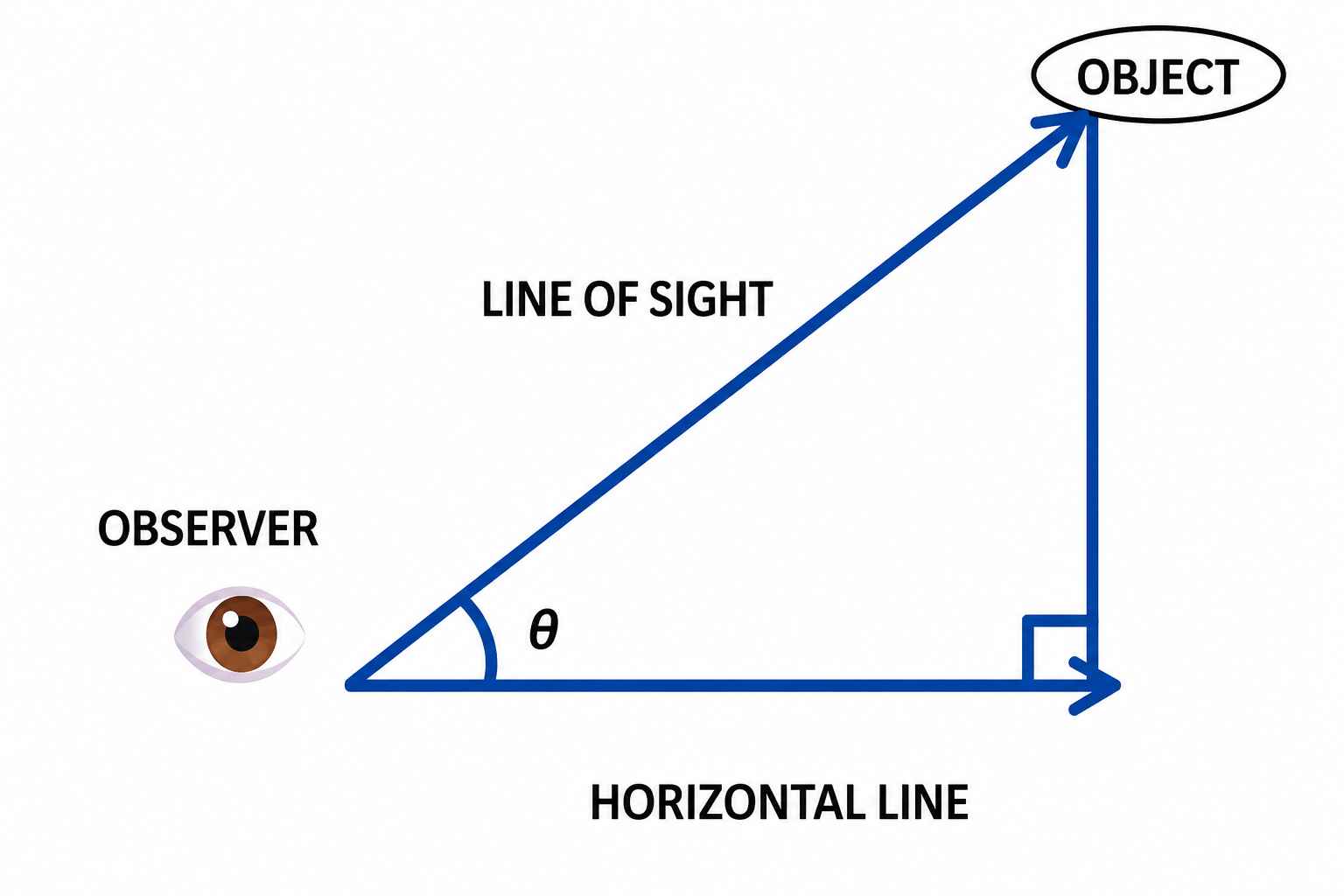
By joining object with vertically to horizontal line , we can create a right angle triangle and further more can calculate distance using trigonometric functions.
Key Rule: Angle of elevation from A to B = Angle of depression from B to A (alternate angles). This is frequently used in two-step exam problems.
Example 6 Angle of Elevation & Angle of Depression
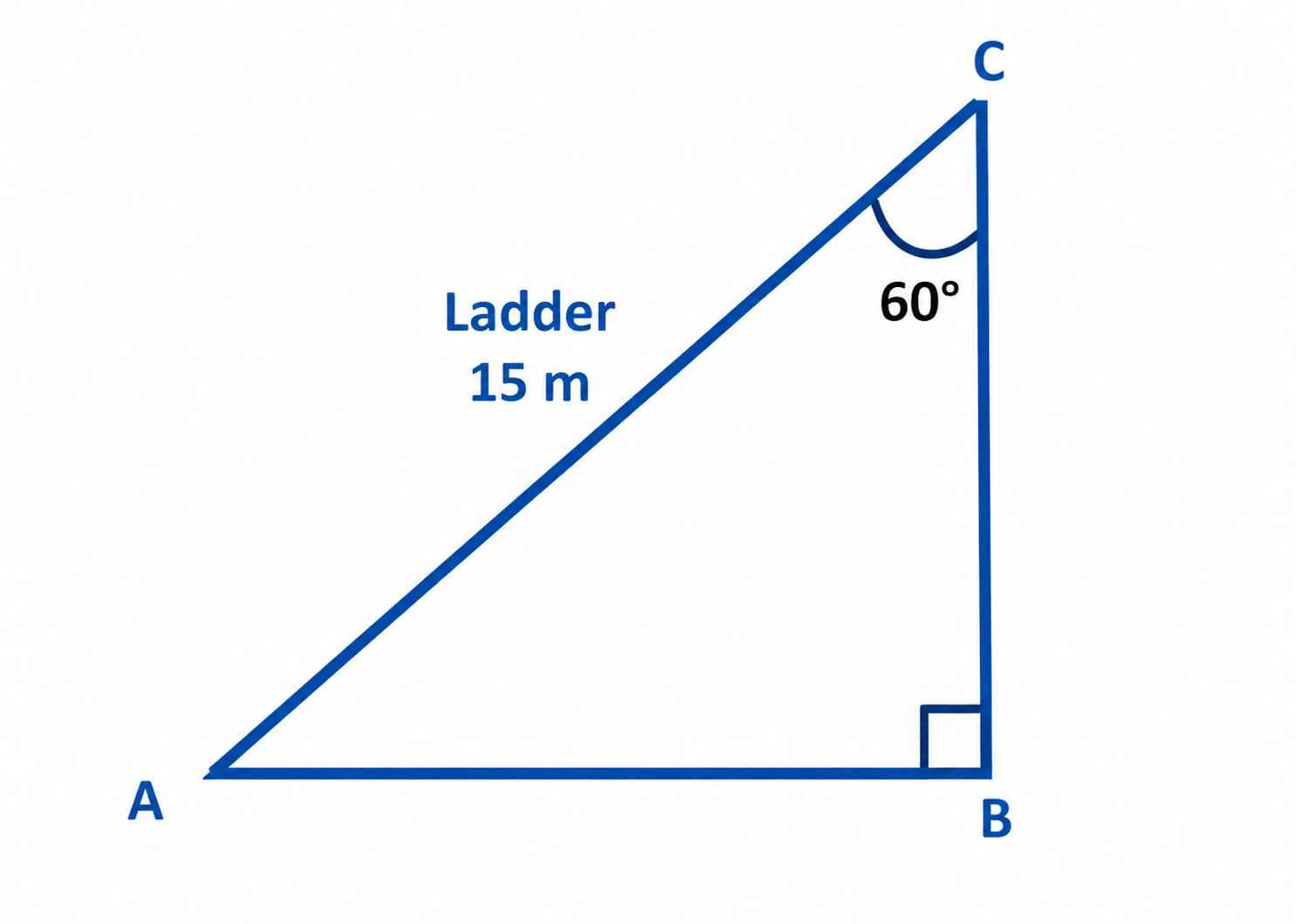
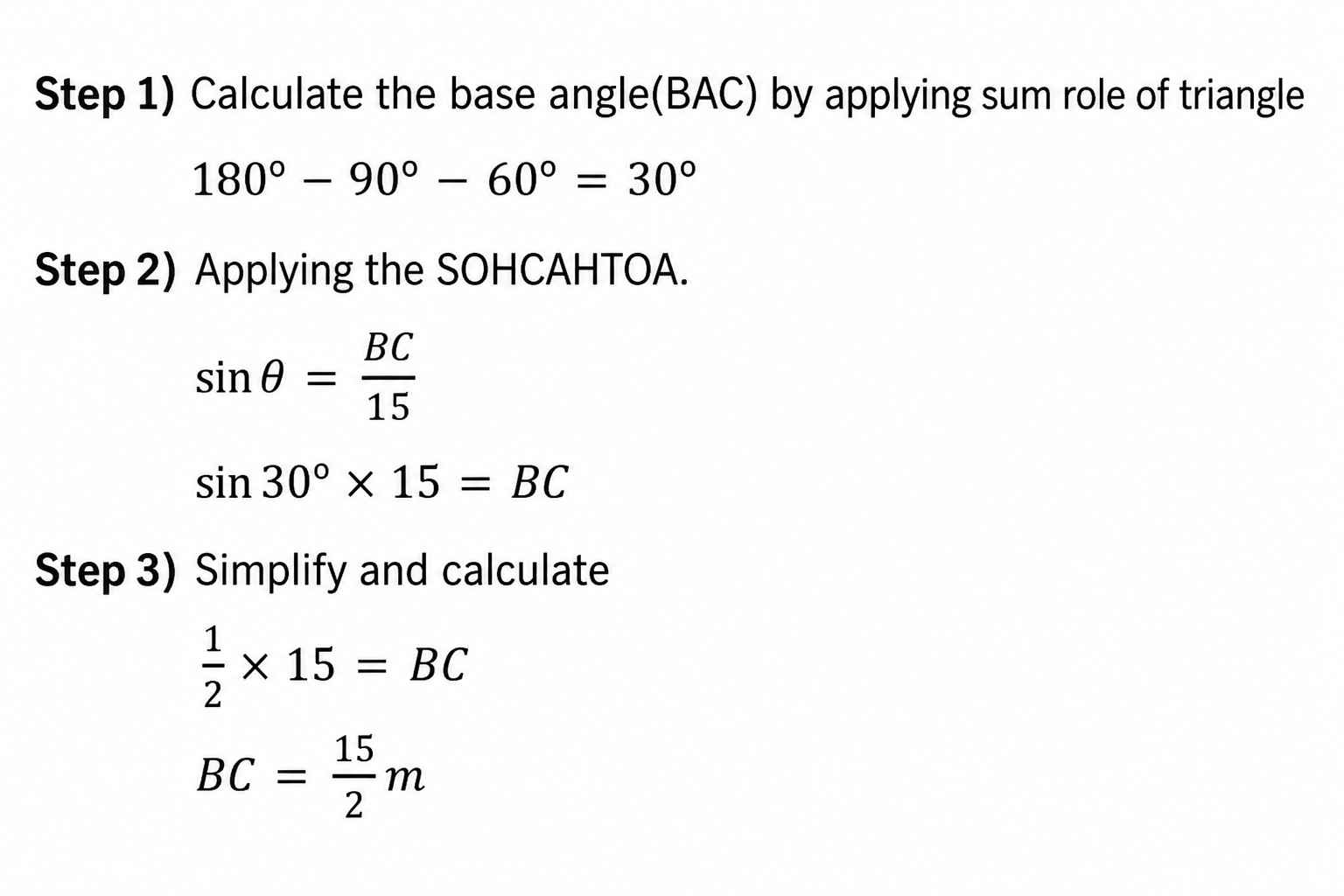
A ladder 15 m long just reaches the top of a vertical wall. If the ladder makes an angle of 60° with the wall, then calculate the height of the wall.
SOLUTION :
Trigonometric Graphs — Recognise, Sketch & Interpret
EXPLICIT: The 2025–2027 specification requires students to recognise, sketch, and interpret the graphs of y = sin x, y = cos x, and y = tan x for 0° ≤ x ≤ 360°
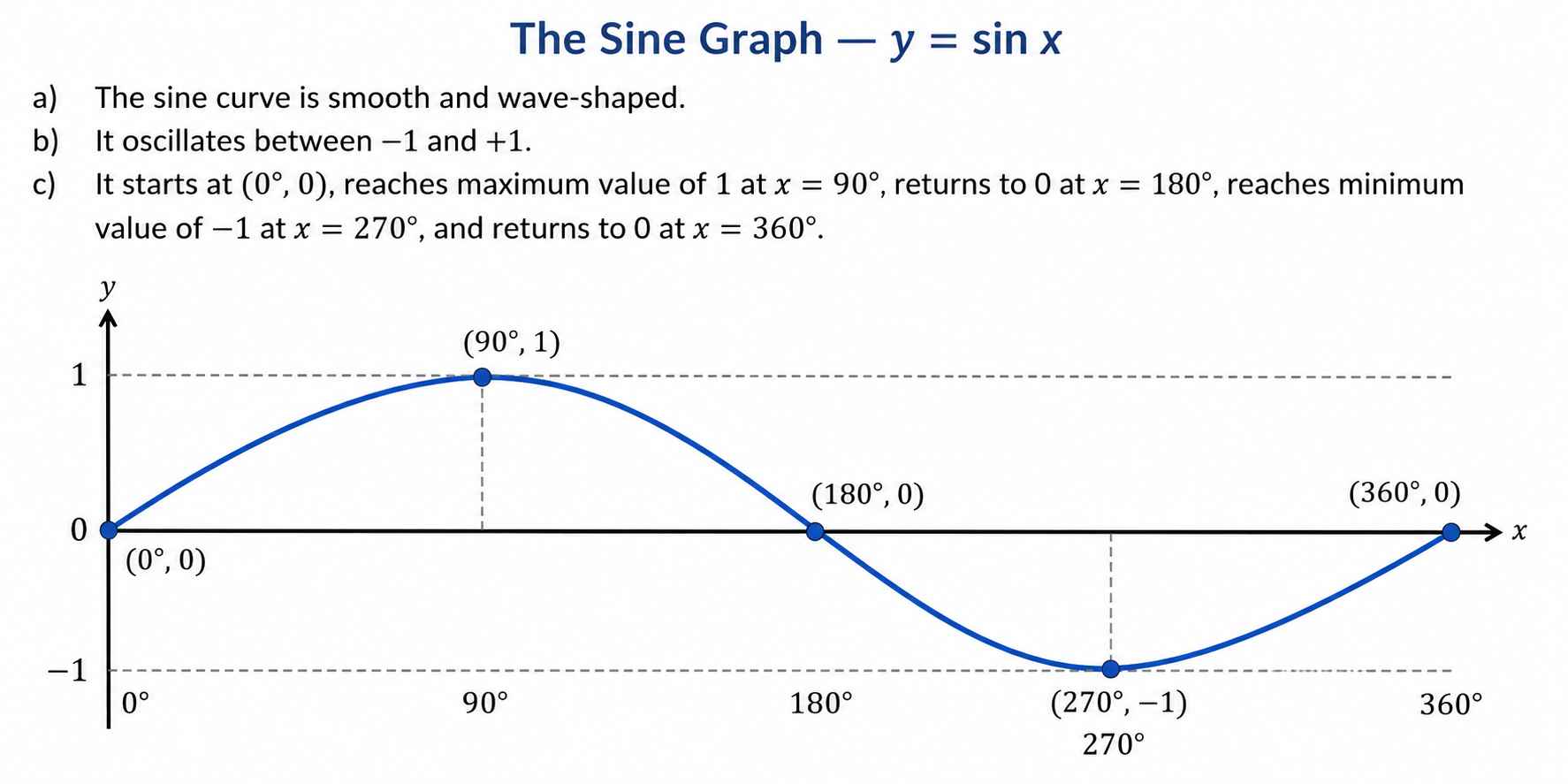
- The Sine Graph — y = sin x
- a) The sine curve is smooth and wave-shaped.
- b) It oscillates between −1 and +1.
- c) It starts at (0°, 0), reaches maximum value of 1 at x = 90°, returns to 0 at x = 180°, reaches minimum value of −1 at x = 270°, and returns to 0 at x = 360°.

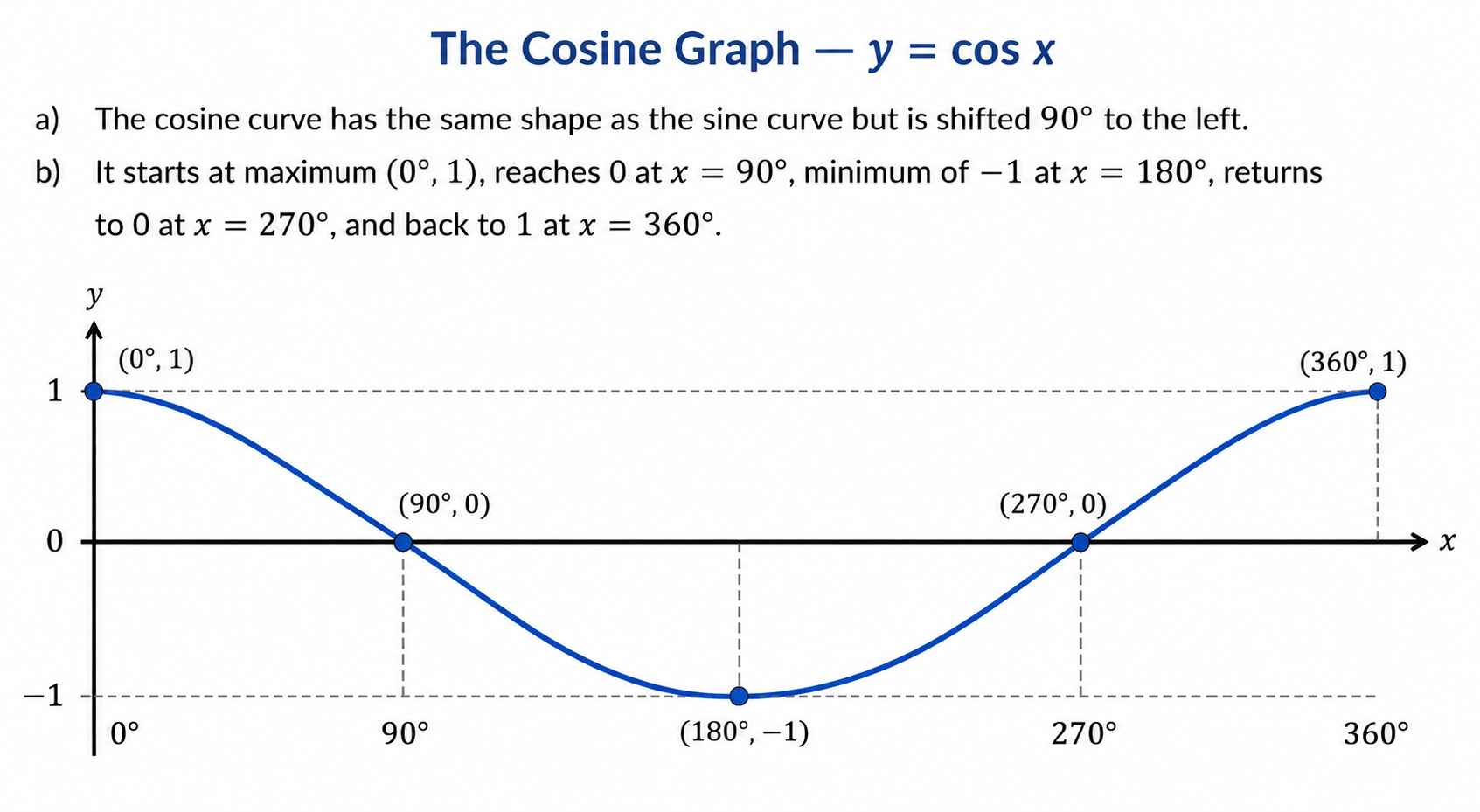
- The Cosine Graph — y = cos x
a)The cosine curve has the same shape as the sine curve but is shifted 90° to the left.
b)It starts at maximum (0°, 1), reaches 0 at x = 90°, minimum of −1 at x = 180°, returns to 0 at x = 270°, and back to 1 at x = 360°
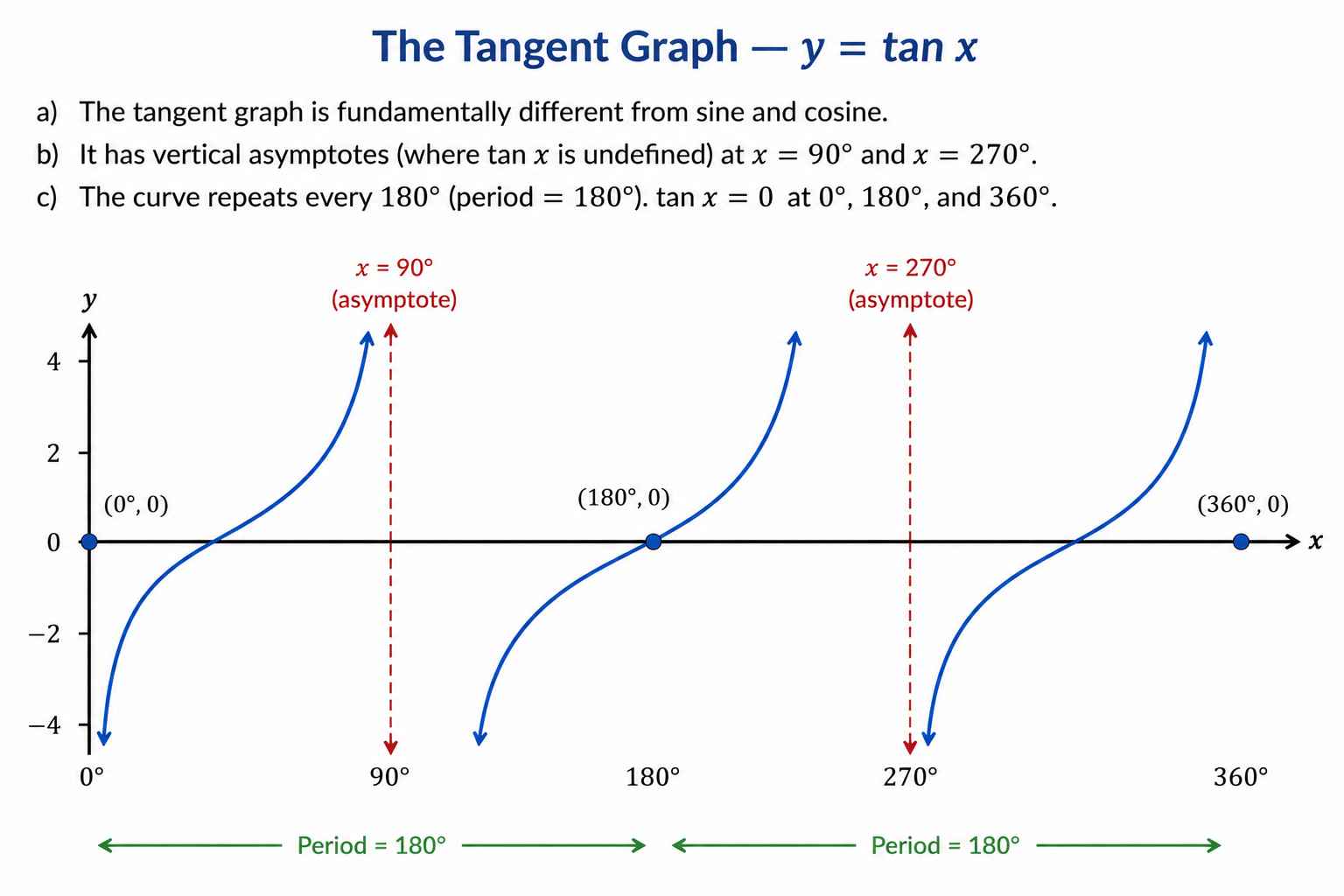
- The Tangent Graph — y = tan x
a)The tangent graph is fundamentally different from sine and cosine. b)It has vertical asymptotes (where tan x is undefined) at x = 90° and x = 270°.
c)The curve repeats every 180° (period = 180°). tan x = 0 at 0°, 180°, and 360°.
Examiner Tip:
Examiners commonly ask you to –
a) Identify the type of graph shown.
b) Writing the specific value of y for given value of x.
c) State the number of solutions to a trig equation by counting graph intersections.
Learn the shape of all three graphs — including the asymptotes on the tan graph. A poorly sketched tangent graph is one of the most common errors on Paper 2.
Solving Trigonometric Equations for IGCSE Maths
Important Requirement: Cambridge IGCSE 0580 specification mentions:
“Solve trigonometric equations involving sin x, cos x or tan x for 0° ≤ x ≤ 360°.”
When solving trig equations, your calculator gives only one answer. You must find all solutions within 0° to 360° by understanding in which quadrants each trig function is positive or negative
The CAST Diagram Rule:
a)All trig functions are positive in the first quadrant (0°–90°).
- b) Only Sine is positive in the second quadrant (90°–180°).
- c) Only Tangent is positive in the third quadrant (180°–270°).
- d) Only Cosine is positive in the fourth quadrant (270°–360°).
The memory aid is: All Students Take Calculus (ASTC) or All Silver Tea Cups or All school to collage
Finding the Second Solutions for any value of trigonametric equation:
- a) For sin x = k: second solution = 180° − first answer
- b) For cos x = k: second solution = 360° − first answer
- c) For tan x = k: second solution = 180° + first answer
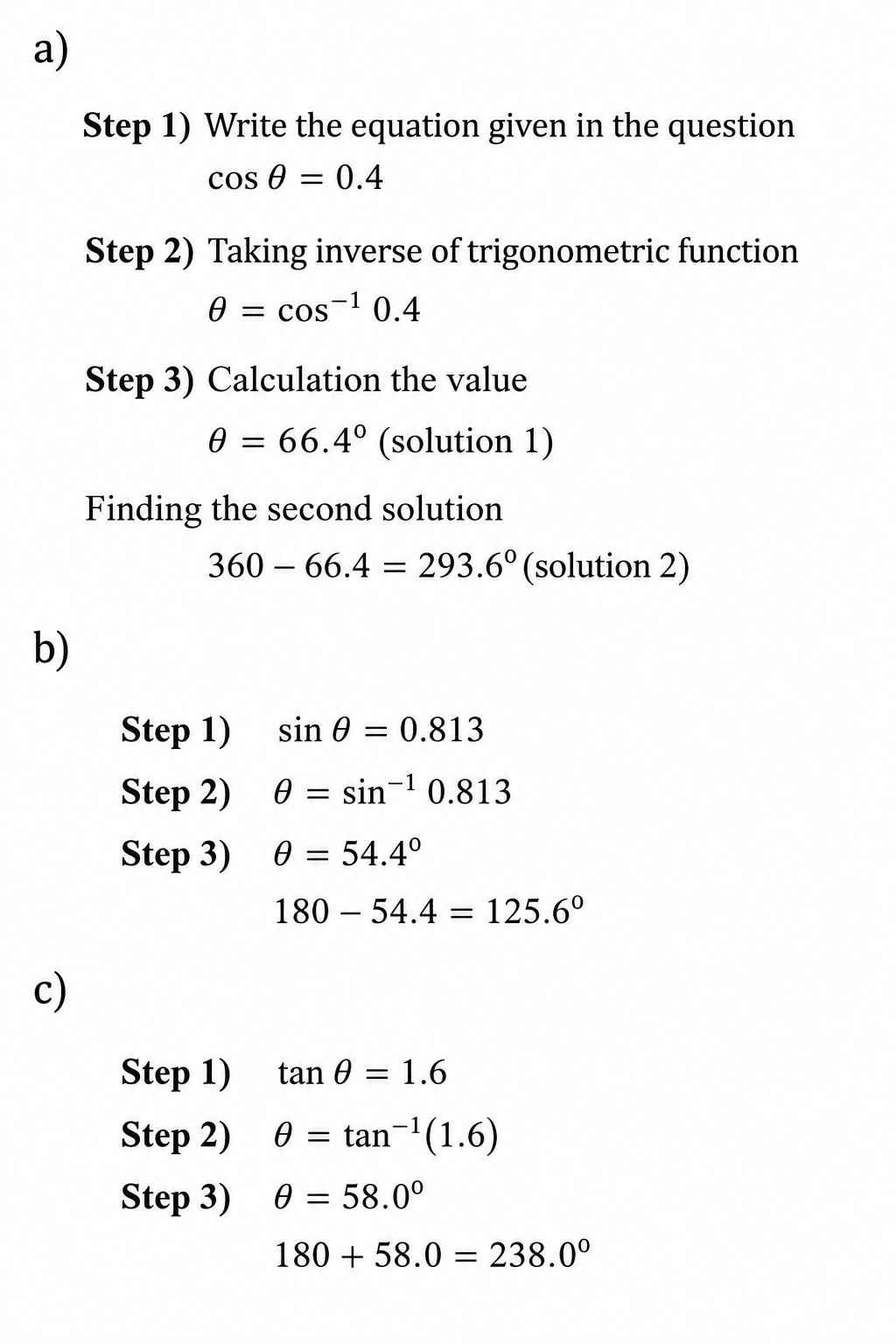
EXAMPLE 7 :SOLVING TRIGNOMETRIC EQUATIONS
Solve each equation for θ in the interval 0 ≤ θ ≤ 360° giving your answers to 1 decimal place.
a) cos θ = 0.4
b) sin θ = 0.813
c) tan θ = 1.6
SOLUTION :
Examiner Tip: Always write both solutions for your answer. A one-mark question may ask for one solution, but a two-mark question expects both.
Writing only one answer when two exist is one of the most common reasons students lose a mark unnecessarily.
3D Trigonometry — IGCSE Higher Mark Questions
For Extended Only: Three-dimensional trigonometry is required for IGCSE Extended candidates (0580) and regularly appears in higher-mark questions (often 4–6 marks).
In 3D trigonometry, you calculate lengths and angles in three-dimensional shapes such as cuboids, pyramids, prisms, and triangular wedges.
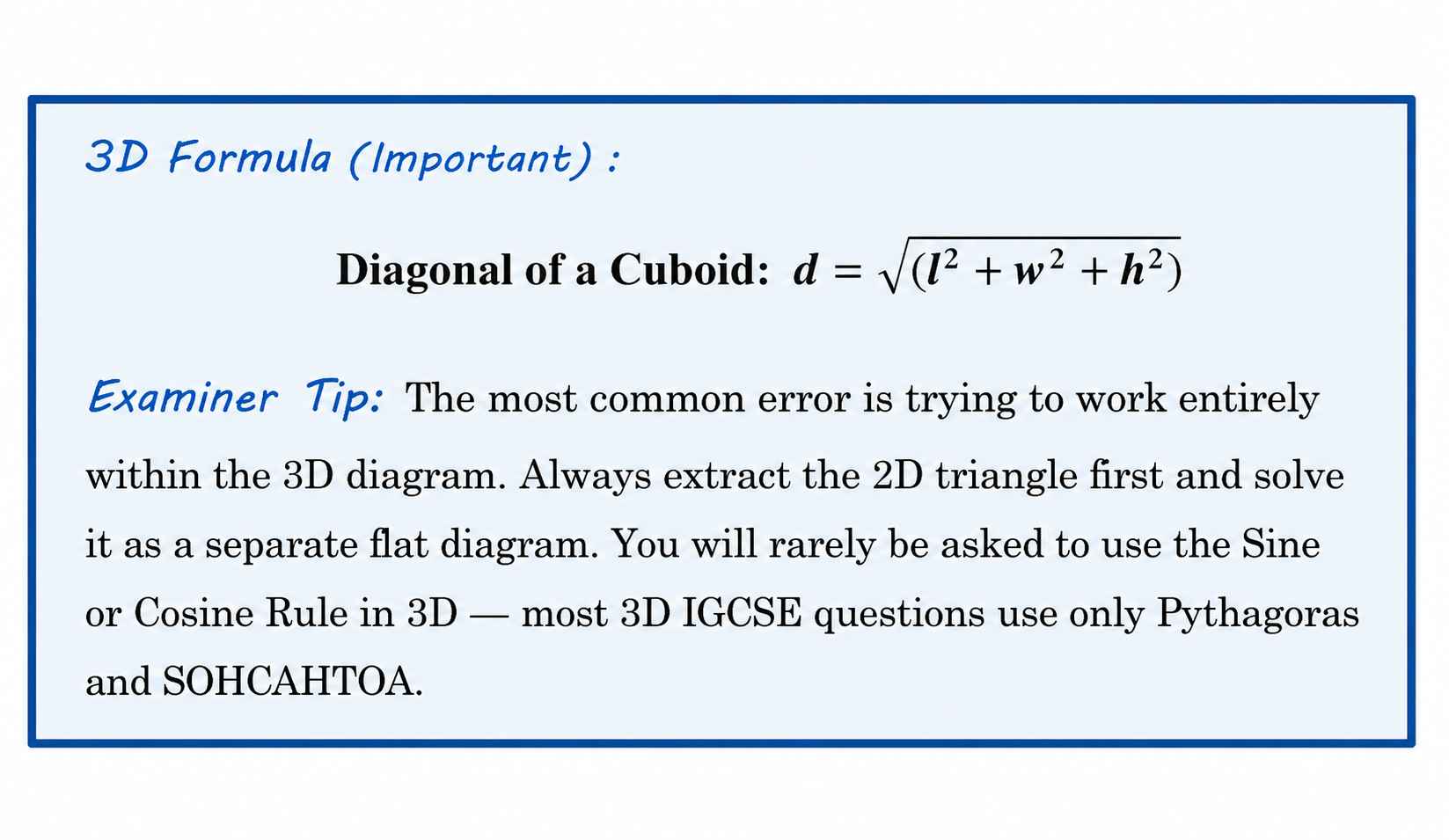
The key skill is identifying the correct 2D right-angled triangle hidden within the 3D shape
The 3D Problem-Solving Method:
Step 1) Draw the 3D shape and label all given dimensions clearly.
Step 2) Identify the diagonal or slant length you need — it is always part of a hidden 2D triangle.
Step 3) Extract that 2D triangle and redraw it separately with all known values.
Step 4) Apply Pythagoras or SOHCAHTOA to solve for the unknown.
Step 5) If a second step is needed, use the answer from Step 4 in a new 2D triangle.
Examiner Tips & High-Frequency Past Paper Question Patterns Analysis
Based on analysis of Cambridge IGCSE 0580 past papers, these question types appear most frequently in the trigonometry sections:
HIGH FREQUENCY QUESTIONS
Question Type 1: Bearing + Sine/Cosine Rule (4–5 marks) A ship travels from A on a bearing of 040° for 15 km to B, then on a bearing of 130° for 20 km to C. Find the distance AC and the bearing from A to C. These require you to find the angle at B between the two legs, then apply the Cosine Rule.
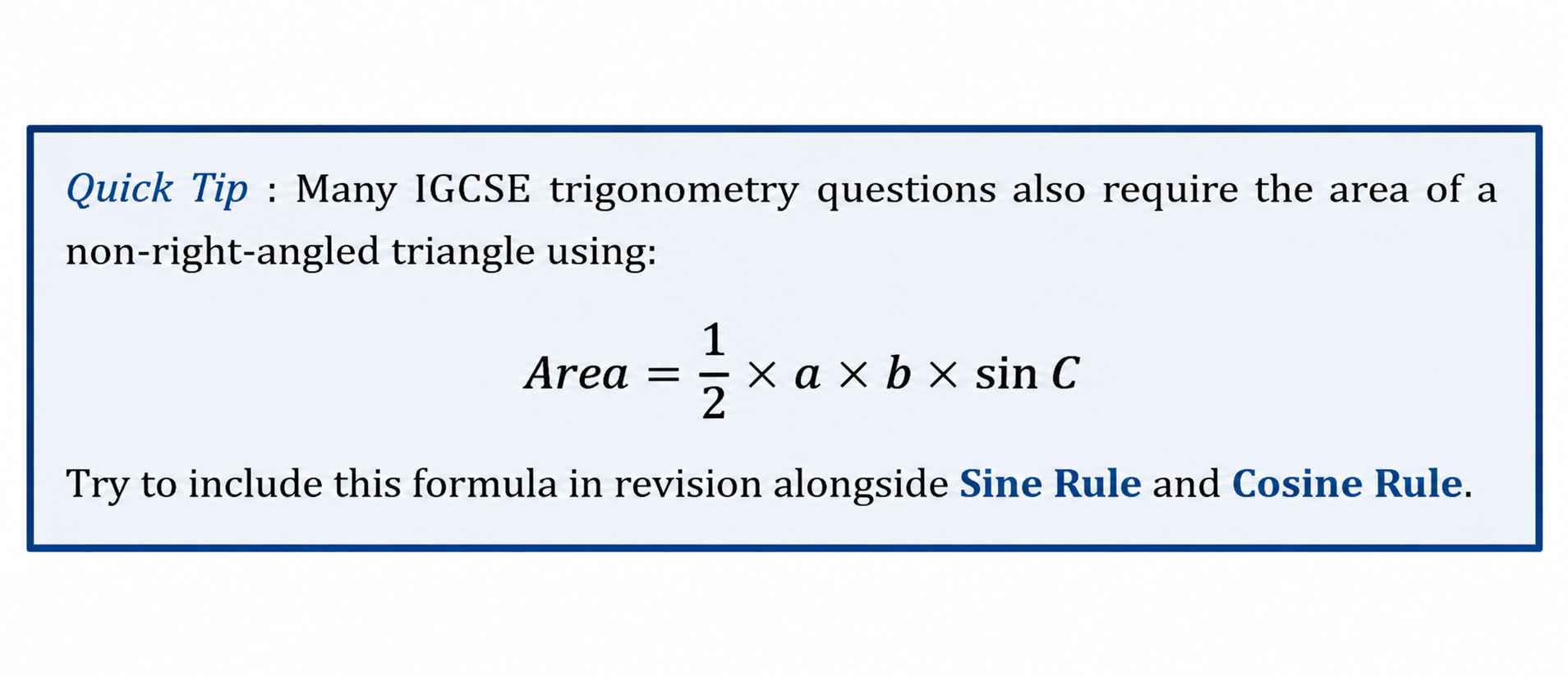
Question Type 2: Area of Triangle + Perimeter (3–4 marks) Given two sides and the included angle, find the area using Area = 1/2 × a × b × sin C, then find the third side using the Cosine Rule to calculate the perimeter. This two-step combination appears almost every year.
Question Type 3: 3D Cuboid Diagonal Angle (3–4 marks) Find the angle between a space diagonal and the base of a cuboid — always a two-step Pythagoras followed by SOHCAHTOA problem. Dimensions are usually easy integers to keep the focus on method.
Question Type 4: Solving Trig Equations (2–3 marks) Solve sin x = k or 2cos x + 1 = 0 for 0° ≤ x ≤ 360°. Always two solutions expected. These are straightforward mark-earners if you know the CAST diagram rules.
High-Frequency Question Type 5: Multi-Step Show That (4–5 marks) ‘Show that AB = 14.3 cm correct to 1 decimal place.’ These require complete working with no gaps. Every line of working earns a method mark. Never just write the target answer — examiners require the full calculation shown step by step.
General Examiner Tips Summary:
- If a question says ‘find the exact value’ — your answer must contain surds or fractions, never decimals.
- If a question says ‘show that’ — show every single step. A correct answer without working scores zero.
- Diagrams not to scale — never trust the visual size of sides or angles in exam diagrams.
- Give angles to 1 decimal place unless told otherwise — this is the default Cambridge requirement.
- Give lengths to 3 significant figures unless told otherwise.
- Never round during a multi-step calculation — only round at the very last step.
- For ‘find the bearing’ questions — bearings are always 3-digit numbers (e.g. 045°, not 45°).
The Ultimate Trigonometry Revision Checklist
Before your IGCSE Maths exam, make sure you can:
✓ Use SOHCAHTOA confidently
✓ Apply Pythagoras’ Theorem
✓ Identify opposite sides correctly
✓ Use the Sine Rule
✓ Use the Cosine Rule
✓ Find missing sides
✓ Find missing angles
✓ Solve multi-step questions
✓ Check answers logically
✓ Use your calculator correctly
If you can confidently complete all ten tasks, you are well prepared for the examination.
Frequently Asked Questions
Is Trigonometry Hard in IGCSE Maths?
Most students find it challenging initially, but it becomes much easier once they understand when to use each formula.
Which Is Easier: Sine Rule or Cosine Rule?
Most students find the Sine Rule easier because it requires fewer calculations.
Do I Need to Memorise These Formulas?
Always check the latest requirements of your exam board. However, understanding when to use the formulas is more important than memorising them.
How Can I Improve Quickly?
Focus on:
- Formula selection
- Past paper questions
- Calculator skills
- Daily practice
Even 20 minutes of focused revision each day can lead to significant improvement.
What are angles of elevation and depression?
Angle of elevation – the angle measured upward from the horizontal to point above.
Angle of depression – the angle measured downward from the horizontal to a point below.
What trigonometric graphs must I know for IGCSE?
You need to recognise, sketch and interpret the graphs of y = sin x, y = cos x, and y = tan x over the range 0° to 360°
What is 3D trigonometry and is it in IGCSE?
3D trigonometry involves applying trig ratios and Pythagoras’ theorem in three-dimensional shapes like cuboids, pyramids, and prisms — for example, finding the angle a diagonal makes with a base. This is an Extended-level topic, covered under Shape and Space in the Year 11 syllabus.
How Many Marks Trigonometry Carries in IGCSE Examination?
Trigonometry appears regularly throughout IGCSE Maths papers and contributes a significant number of marks across the examination. It often appears in multi-step questions worth 5-8 marks each. Mastering this topic can meaningfully improve your overall grade.
What calculator functions can I use for IGCSE Trigonometry?
sin, cos, tan (to calculate ratios), sin⁻¹, cos⁻¹, tan⁻¹ (to find angles), and the ability to confirm your calculator is in degree mode. Practice locating these functions on your specific calculator model well before exam day.
Final Thoughts
The biggest difference between average and top-performing IGCSE Maths students is not intelligence—it is confidence in selecting the correct method.
Remember:
- Right angle → SOHCAHTOA
- Angle-side pair → Sine Rule
- SAS or SSS → Cosine Rule
Once you master formula selection, trigonometry becomes one of the most straightforward and rewarding topics in the syllabus.
At Bright Mind Tutors, we help students build confidence, strengthen mathematical understanding, and develop exam techniques that lead to higher grades. Through expert guidance, personalised support, and exam-focused teaching, students can transform trigonometry from a challenging topic into one of their strongest areas in IGCSE Mathematics.
Start practising today, stay consistent, and remember: every expert mathematician was once a beginner who simply kept solving one problem at a time.