

If you are studying VCE Mathematical Methods, there is a very good chance that SACs — School-Assessed Coursework — are keeping you up at night. They count for 34% of your final study score, meaning they can make or break your ATAR. Two of the most heavily examined areas in SACs are probability and statistics and calculus, and for many students, these are also the most conceptually demanding.
This guide walks you through everything you need to know: what SACs actually assess, how probability and calculus show up in them, and the proven strategies that help students move from average to outstanding.
What Are VCE Maths Methods SACs and Why Do They Matter?
SACs (School-Assessed Coursework) are internal assessments completed throughout Units 3 and 4 of VCE Mathematical Methods. Unlike end-of-year exams, SACs are administered and marked by your school — but they are moderated by VCAA to ensure consistency across Victoria.
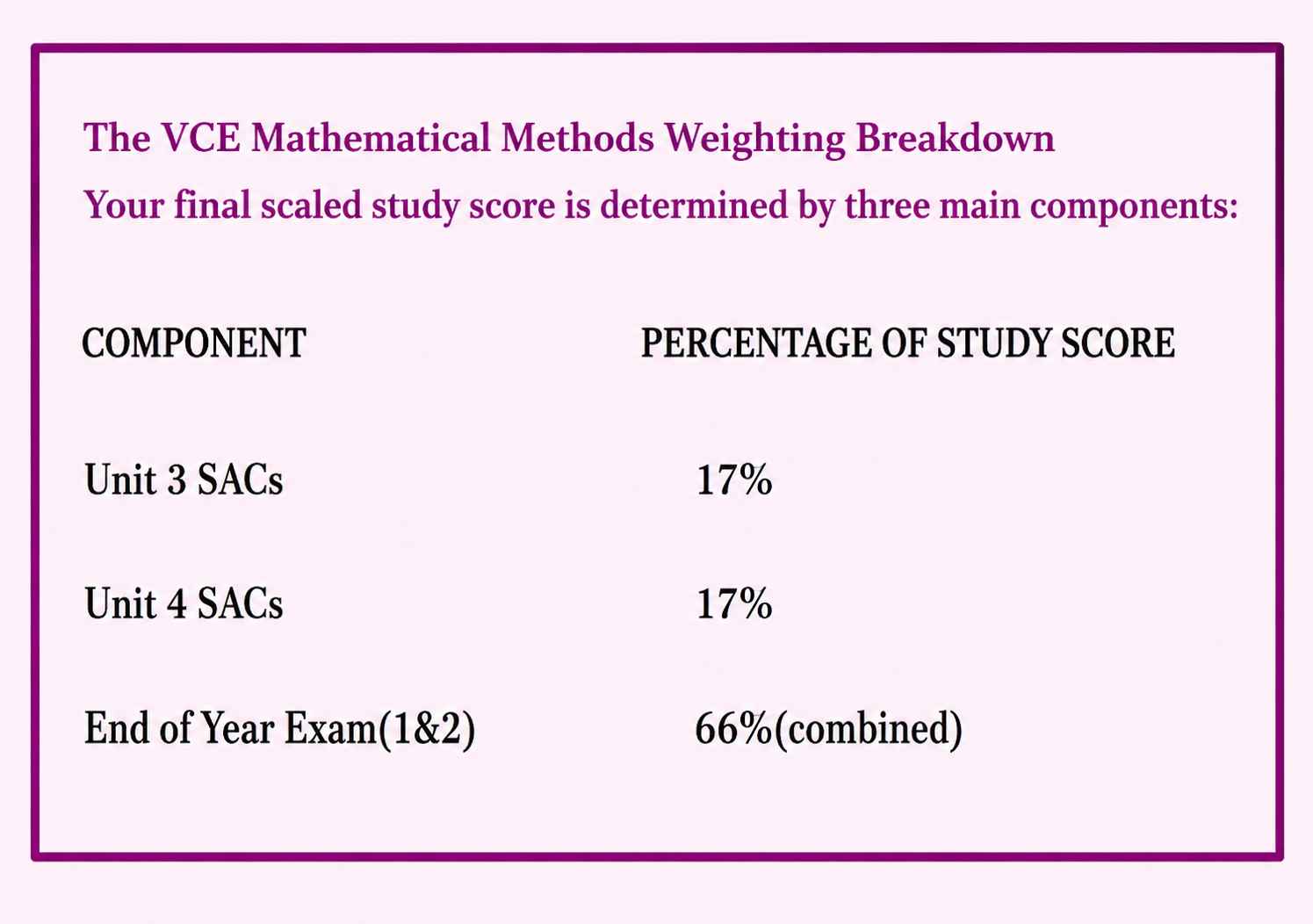
The Golden Advantage: Nailing your Unit 3 and Unit 4 SACs gives you a massive competitive advantage and relieves academic pressure before you step into the end-of-year VCAA examination rooms.
The Three Forms of Mathematical Methods SACs
According to the VCAA study design, SACs typically take three distinct forms:
- Application Tasks: An extended, multi-part problem-solving task spanning several hours (usually focused on calculus).
- Analysis Tasks: Shorter, deeply contextualized problem-solving scenarios.
- Skills-Based Tests: Shorter, timed assessments focused on mechanics and exact algebraic manipulation.
In a typical school curriculum, probability and calculus appear across all three formats, often interwoven. For instance, a calculus application task might require you to find the area under a probability density function (PDF) using definite integrals. Understanding this link is the secret to scoring highly.
Mastering the Probability Component in Methods SACs
The Key Concepts You Must Know
Probability in VCE Maths Methods is more sophisticated than the probability you encountered in earlier years. You are now working with:
Discrete random variables — variables that take specific, countable values. You need to be able to construct probability distributions, calculate expected values (E(X)), variance (Var(X)), and standard deviation. Questions often ask you to interpret what these values mean in context, not just compute them.
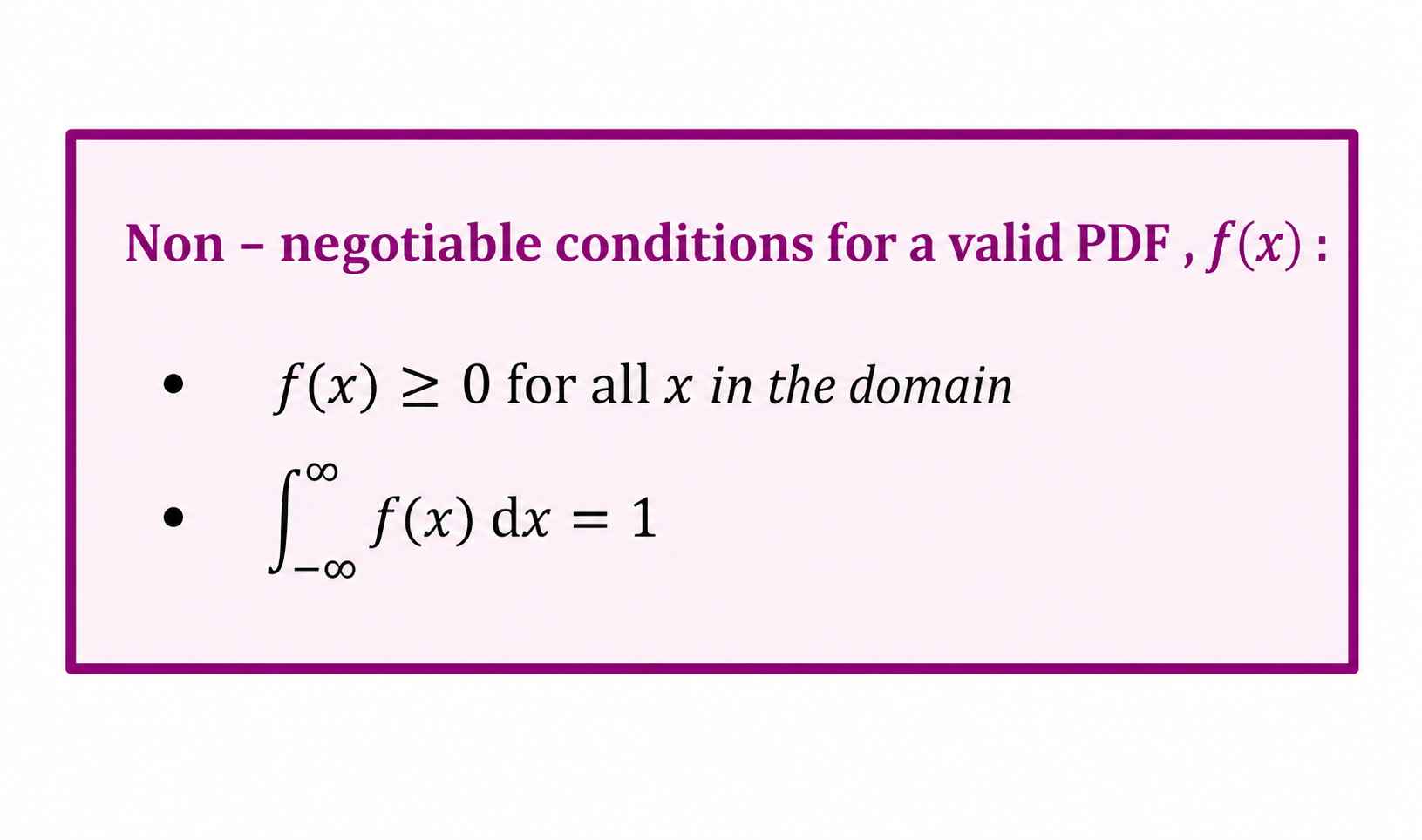
Continuous random variables and probability density functions (PDFs) — this is where calculus and probability formally meet.
The normal distribution — you need to understand its properties (symmetry, the 68–95–99.7 rule), use the standard normal distribution for calculations, and work confidently with z-scores. The normal distribution appears frequently in SAC application tasks because it models so many real-world phenomena.
Binomial distribution — recognising when a situation satisfies the binomial conditions (fixed number of trials, two outcomes, constant probability, independent trials) and correctly applying the binomial formula is a recurring exam skill.
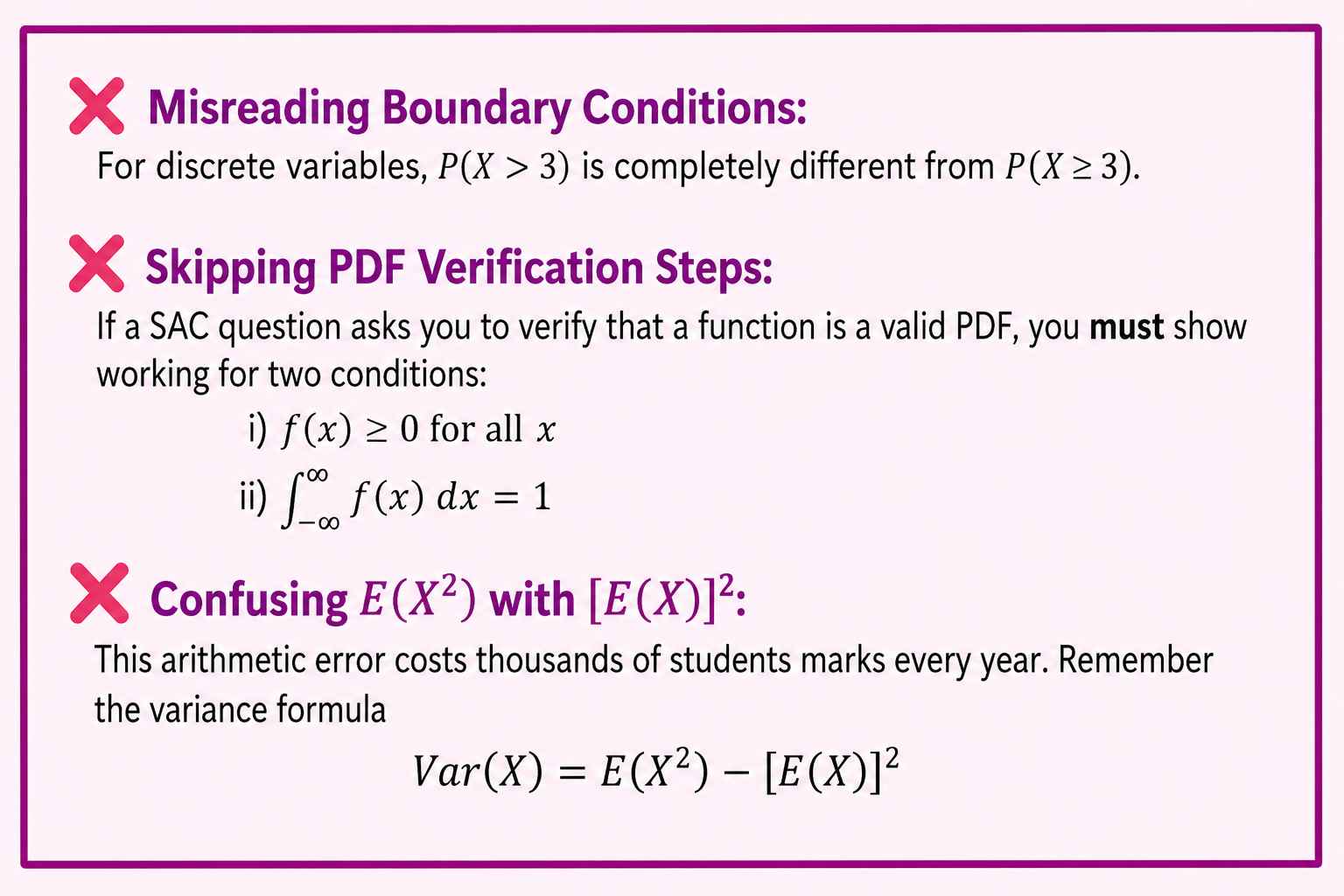
Common SAC Probability Mistakes
SAC Strategy for Probability
Before your probability SAC, work through every type of probability distribution the course covers. Do not just practise calculations — practise writing up solutions. SAC marking schemes reward students who show clear reasoning and interpret results in context. A bare numerical answer with no working or explanation rarely scores full marks.
Also, make a concise formula sheet even if one is provided. The act of writing it out consolidates the formulas in your memory and makes you more fluent when you need to apply them under pressure.
Mastering Calculus for Maths Methods SACs
Why Calculus Feels Hard (and How to Change That)
Many students find calculus conceptually difficult because it is abstract. Differentiation and integration are not just procedures — they represent rates of change and accumulation, and understanding the meaning behind the mechanics is what separates high-scoring students from the rest.
The good news: VCE Maths Methods calculus is entirely manageable with deliberate practice and a clear understanding of the underlying ideas.
Differentiation: What You Need to Know Cold
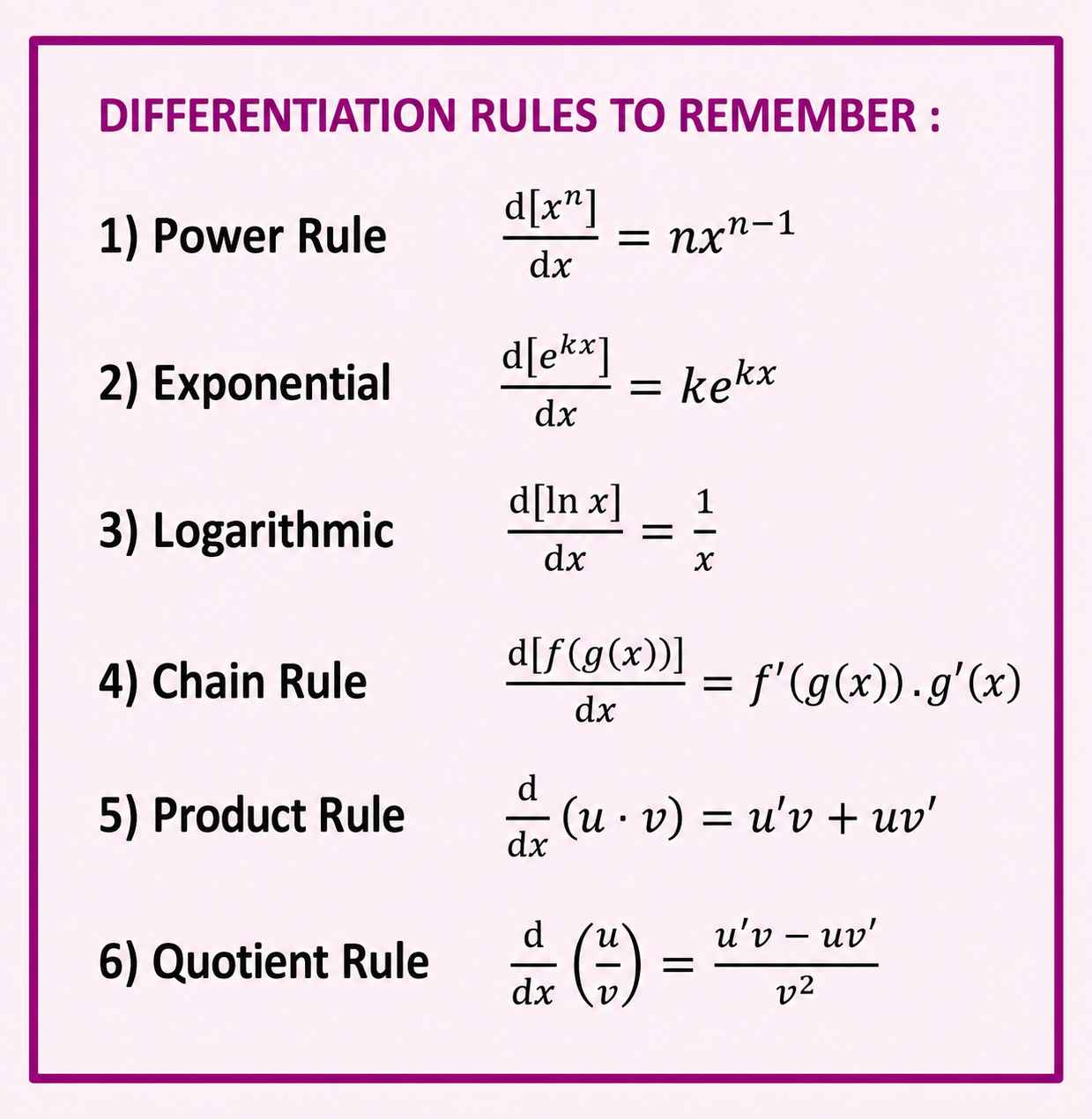
You must be able to differentiate the following without hesitation:
- Power functions using the power rule
- Exponential functions (base e)
- Logarithmic functions (natural log)
- Trigonometric functions (sin, cos, tan)
- Composite functions using the chain rule
- Products of functions using the product rule
- Quotients using the quotient rule
Common Error
The chain rule in particular trips students up. When differentiating f(g(x)), the result is f'(g(x)) × g'(x). A common error is forgetting to multiply by the derivative of the inner function. Practise this until it is second nature.
SACs will ask you to:
- Find the gradient of a curve at a point
- Determine where a function is increasing or decreasing
- Locate and classify stationary points (local maxima, minima, points of inflection)
- Solve optimisation problems — finding maximum or minimum values in real-world contexts
Optimisation questions are a SAC favourite because they test both your calculus skills and your ability to interpret a mathematical result in context. After finding the optimal value, always state what it means in the problem’s context and check that it satisfies any domain restrictions given.
Integration: The Other Half of the Story
Integration in Maths Methods covers both indefinite and definite integrals. You need to:
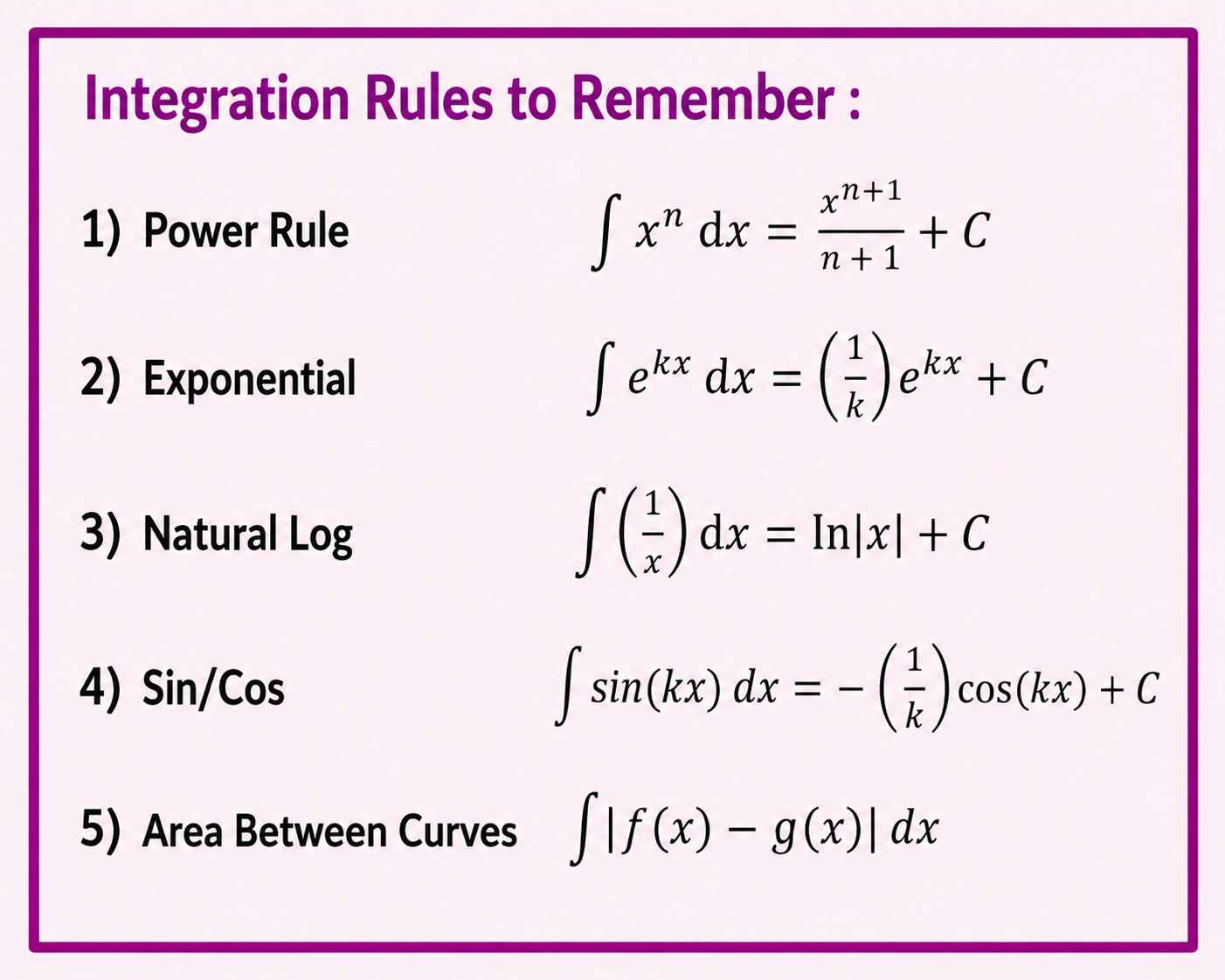
- Apply the reverse of the power rule
- Integrate exponential and logarithmic functions
- Integrate trigonometric functions
- Use integration to find the area between curves
- Connect integration to probability density functions
Common Errors
The area between two curves is a classic SAC question type. To find the area between f(x) and g(x) from a to b, you integrate |f(x) − g(x)| over the interval. Students often forget to check which function is on top throughout the interval — if the curves cross, you need to split the integral at the crossing point.
Another common source of errors: forgetting the constant of integration (+c) in indefinite integrals. In a SAC this will cost you marks every time.
The Fundamental Theorem of Calculus
Understanding the connection between differentiation and integration is not just theoretical — it is tested directly. The Fundamental Theorem tells us that if F is an antiderivative of f, then:
∫[a to b] f(x) dx = F(b) − F(a)
This is the engine behind every definite integral calculation. Make sure you can explain what this means geometrically (area under a curve) as well as carry out the computation.
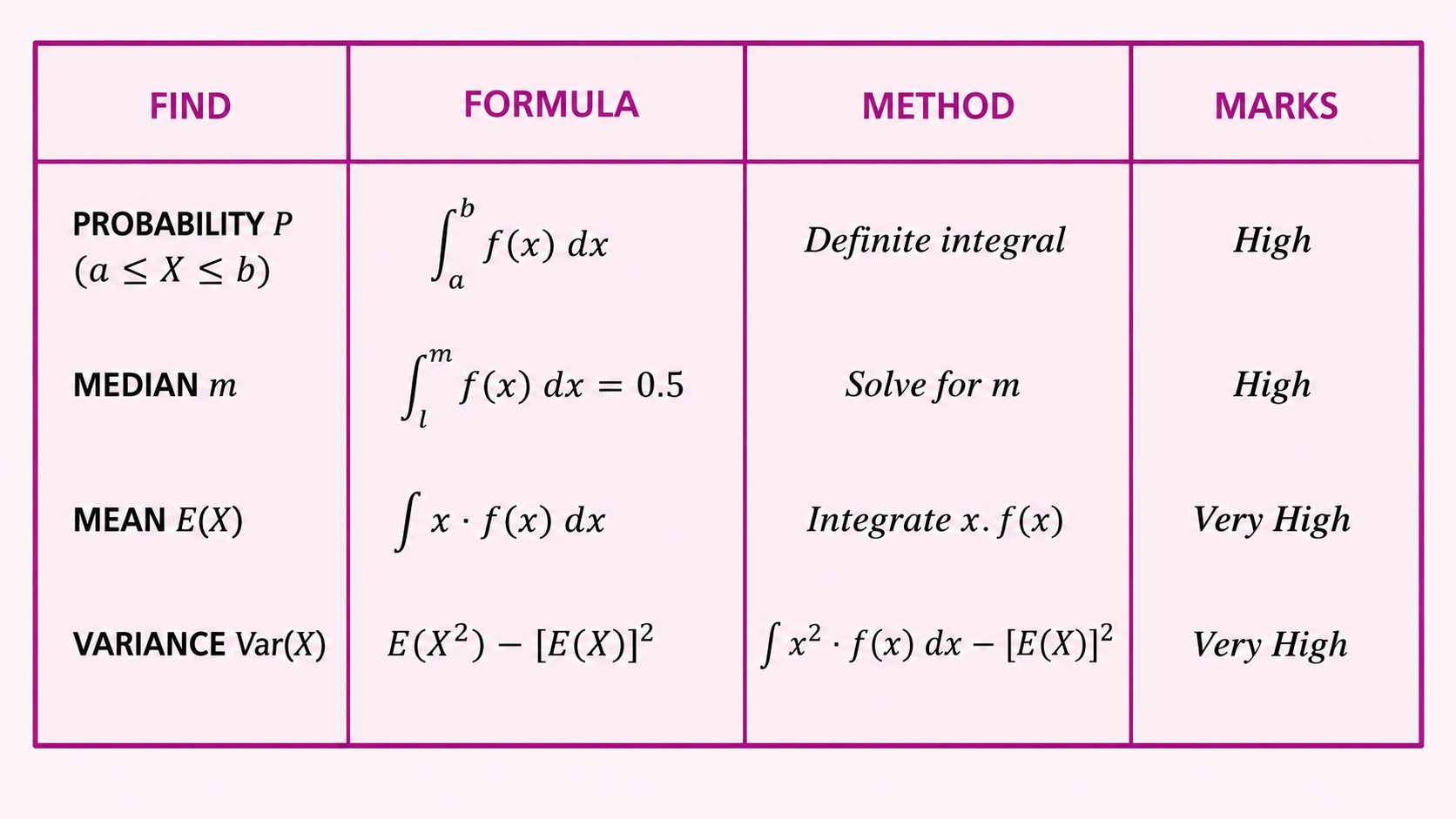
P(a ≤ X ≤ b) = ∫[a to b] f(x) dx
This is integration in service of probability. To find the median of X, you solve:
∫[lower bound to m] f(x) dx = 0.5
To find the mean (expected value), you calculate:
E(X) = ∫ x · f(x) dx over the full domain
To find variance:
Var(X) = E(X²) − [E(X)]² = ∫ x² · f(x) dx − [E(X)]²
SAC questions that combine these topics are often the highest-value questions on the task. Students who have practised the connection between integration and probability are the ones who score those marks.
If X is a continuous random variable with PDF f(x):
SAC Preparation: A Week-by-Week Approach
Two Weeks Out
- Identify every topic that could appear on the SAC based on your teacher’s guidance and the VCAA study design.
- Create a topic checklist and rate your confidence in each area (1–5).
- Begin with the topics you rated lowest — do not practice what you already know at the expense of your weakest areas.
- Work through past SAC-style tasks from your school or tutoring provider.
One Week Out
- Shift from topic-by-topic review to full practice tasks under timed conditions.
- Review your marked practice attempts carefully — errors are information, not evidence of failure.
- Consolidate your formula sheet and review worked examples for any topic still feeling shaky.
- Sleep adequately. Memory consolidation happens during sleep, and fatigue significantly impairs mathematical reasoning.
The Night Before
- Light review only — go over your formula sheet and one or two worked examples.
- Avoid attempting new problems or untested question types.
- Prepare everything you need (pens, calculator, ruler) the night before so the morning is calm.
During the SAC
- Read every question fully before beginning.
- If you are stuck, move on and return — do not let one question consume disproportionate time.
- Show all working clearly. Marks are allocated for method, not just answers.
- Use appropriate mathematical notation throughout.
- When asked to interpret a result, always write a sentence in context.
FREQUENTLY ASKED QUESTIONS
1.How much do SACs count toward my VCE Maths Methods study score?
SACs contribute 34% of your final study score in Units 3 and 4. The remaining 66% comes from two external VCAA exams at the end of the year.
2. Can I use a CAS calculator in my SAC?
It depends on the SAC type. Skills-based tests are often CAS-free or restricted. Analysis and application tasks typically permit CAS. Always check with your teacher before assessment.
3.What topics appear most in Maths Methods SACs?
Calculus (differentiation and integration), continuous probability distributions and PDFs, the normal distribution and combined problems
4.How does VCAA moderate SAC scores?
VCAA benchmarks school SAC scores against student performance on external exams. Your ranking within your school cohort matters — as does your school’s overall performance statewide.
5.How do I improve my written explanations in SACs?
Practice writing one sentence of interpretation for every numerical result. Read VCAA examiner reports — they show exactly the language that scores marks.
How Expert Tutoring Supports SAC Success
SACs are not just tests of knowledge — they test how well you can communicate mathematical reasoning under time pressure. That is a skill that develops with targeted, expert guidance.
At Bright Mind Tutors, our experienced maths tutors work one-on-one with VCE students to build both conceptual understanding and exam technique. We help students:
- Diagnose exactly where their gaps are in probability and calculus
- Work through SAC-style tasks with detailed feedback on working and presentation
- Develop efficient strategies for the specific question types that appear most often
- Build confidence in the weeks leading up to assessment tasks
With over 200 expert instructors and students across Australia benefiting from personalised online sessions, Bright Mind Tutors has helped many VCE students improve their SAC scores and ultimately their study scores.
If you are preparing for an upcoming SAC and want tailored support, book a free trial session and see the difference one-on-one expert coaching makes.
Final Thoughts
VCE Maths Methods SACs in probability and calculus are genuinely challenging — but they are not insurmountable. The students who do well are not necessarily the most naturally gifted at mathematics. They are the ones who understand what is being assessed, practise consistently, learn from their mistakes, and ask for help when they need it.
Start early, practise smart, and do not underestimate the value of deeply understanding the connection between calculus and probability. Those two topics together are the heart of Mathematical Methods, and mastering them will serve you not just in SACs, but in your end-of-year exams and well beyond.
Ready to Boost Your SAC Score?
Bright Mind Tutors offers live 1:1 online tutoring for VCE students across Australia.
• 200+ expert tutors • Personalised sessions • Victoria, NSW, QLD & beyond
Book Your FREE Trial Session at test.techmaxtechnology.com/