

Preparing for GCSE Physics can feel overwhelming because the syllabus covers many different concepts, formulas, and practical applications. However, one thing becomes clear when students analyse past papers: certain topics appear again and again in exams. Although question wording changes each year, exam boards such as AQA, Pearson Edexcel, and OCR regularly return to the same high-value areas because these topics test core scientific understanding.
This guide by our expert tutors covers the most frequently examined GCSE Physics topics so instead of spreading revision equally across every chapter, it helps to focus extra attention on the concepts that examiners consistently prioritise.
1. Energy Transfers and Energy Stores
Energy is one of the most frequently examined topics in GCSE Physics because it forms the basis of many other chapters. Almost every exam paper contains at least one question linked to energy transfers, calculations, or efficiency.
What Examiner Test:
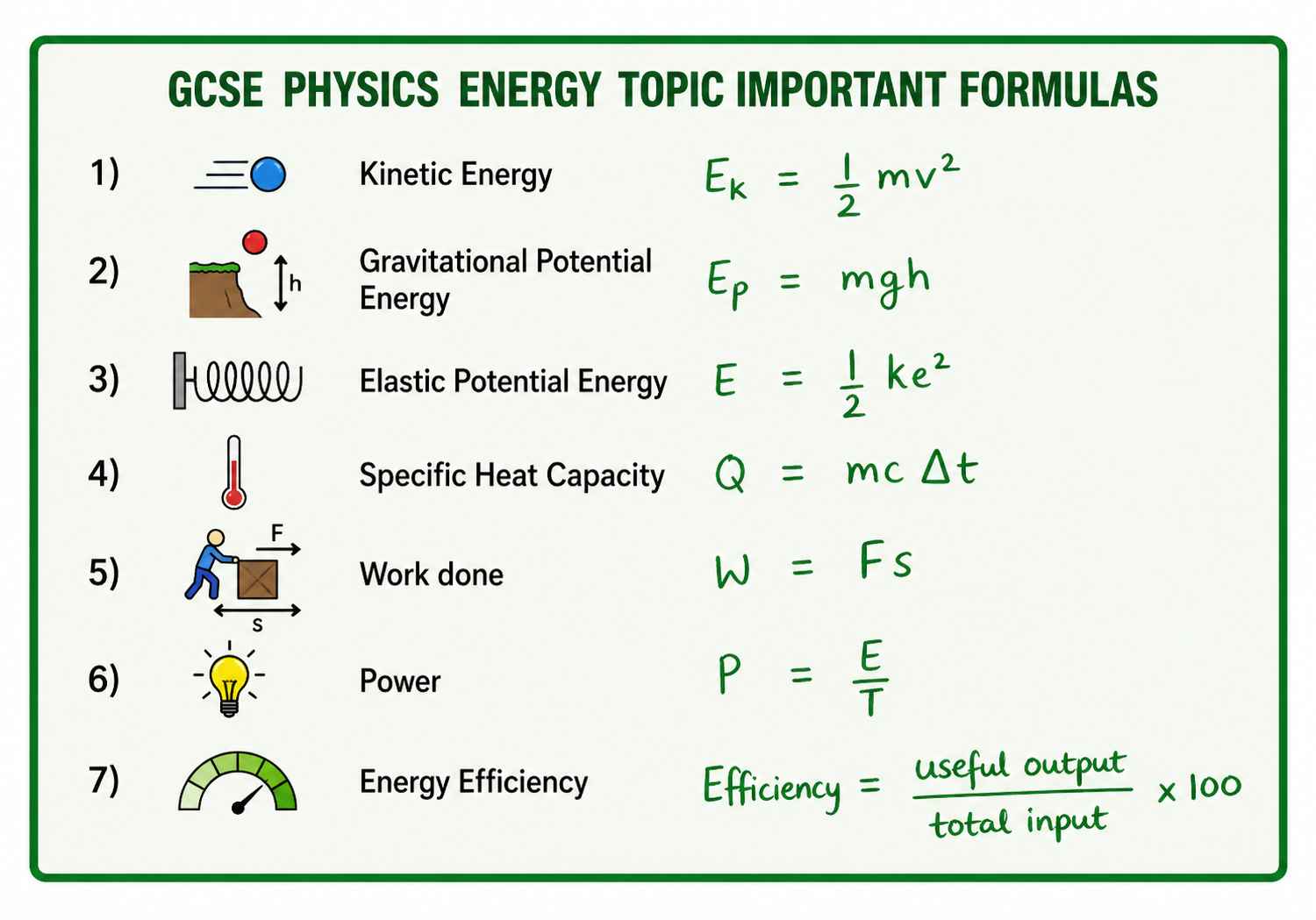
- Kinetic energy
- Gravitational potential energy
- Elastic potential energy
- Energy efficiency
- Useful and wasted energy transfers
- Everday examples : appliances , renewable systems
One reason this topic appears so often is that it combines mathematical calculations with real-world examples.
Students should be confident using formulas, identifying energy stores, and explaining how energy moves through a system.A strong understanding here often leads to easy marks because examiners repeatedly use familiar scenarios.
Please find the list of formulas required for this chapter
2. Electricity and Circuit Calculations
Electricity is another major topic that consistently appears across GCSE Physics papers because it allows examiners to test theory, calculations, and practical knowledge in one section.
The most common areas include:
- Current
- Voltage
- Resistance
- Series circuits
- Parallel circuits
- Electrical power
Students often lose marks because they mix up circuit rules, especially when comparing how current and potential difference behave in different circuit types.
Questions also regularly include circuit diagrams where students must predict meter readings or explain why resistance changes.
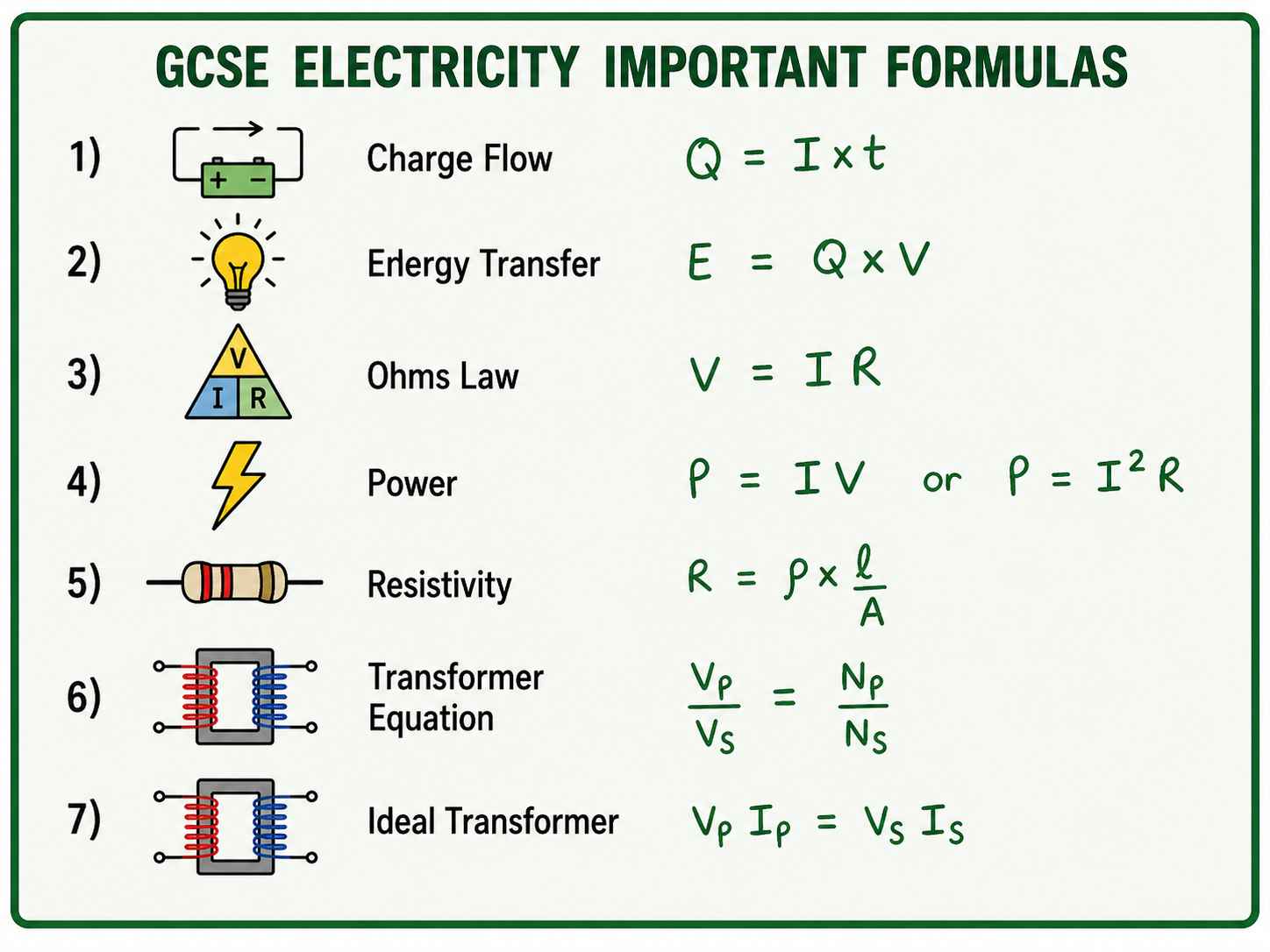
Please find detail of Important Formulas for GCSE Physics
To score well, students need repeated practice with these equations and get clear understanding of how components behave in a working circuit.
3. Forces, Motion and Acceleration
Forces remain one of the most repeated GCSE Physics topics because they connect mathematical skill with scientific explanation.
Typical exam questions cover:
- Speed and acceleration calculations
- Velocity-time graphs
- Newton’s Laws
- Resultant force
- Braking distance
- Stopping distance
Students are often asked to explain why stopping distance increases or how seat belts reduce injury during collisions.
Graph interpretation is especially important here because many questions involve calculating gradients or describing motion from the graph – skills easy to improve with targeted practice.
This topic rewards students who understand both formulas and the science behind everyday motion.
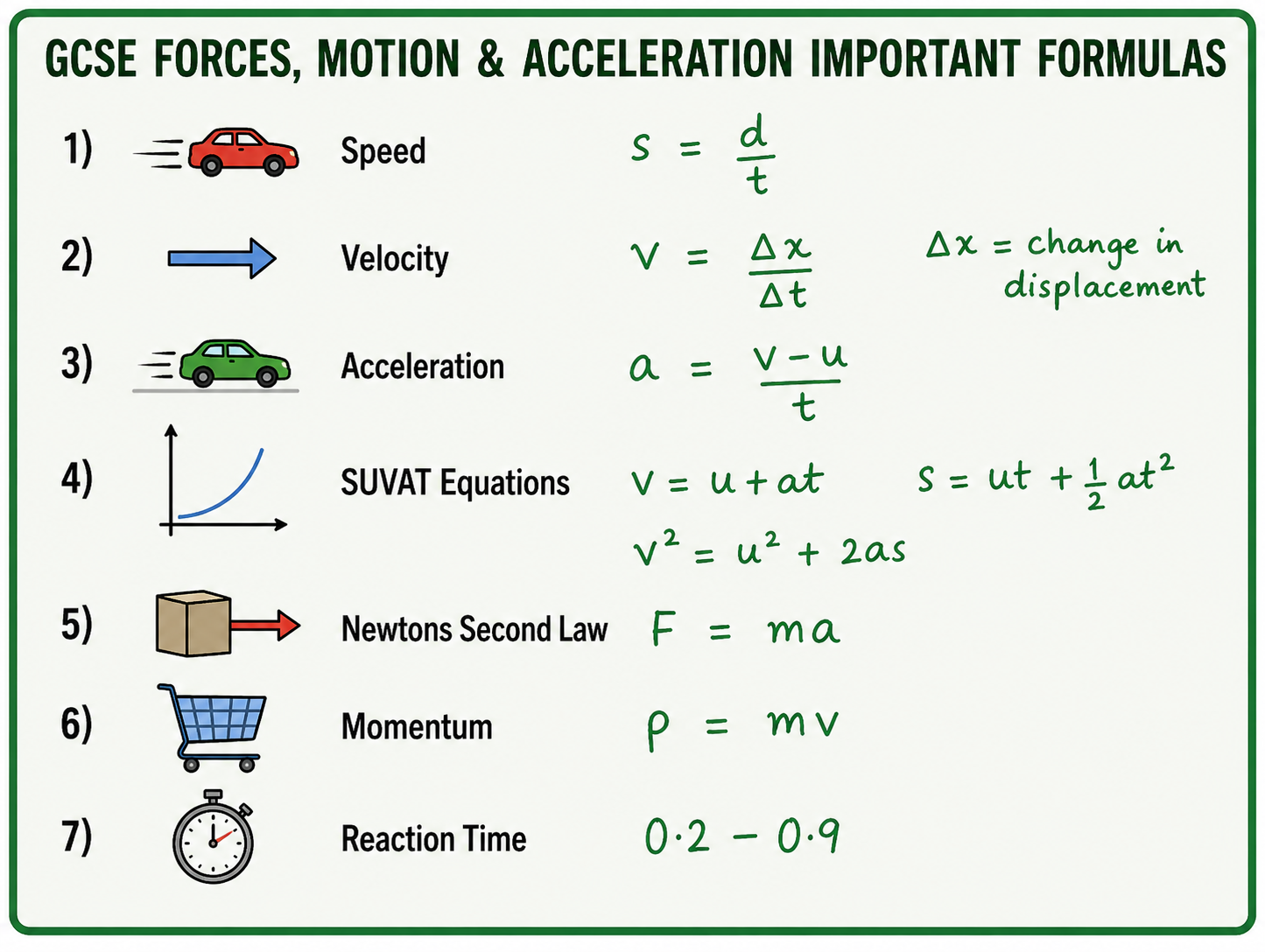
Please find detail of Important Formulas for GCSE Physics
4. Waves and the Electromagnetic Spectrum
Wave-based questions appear regularly because they test both scientific definitions and mathematical formulas.
Frequently repeated areas include:
- Wave speed
- Frequency
- Wavelength
- Reflection
- Refraction
- Electromagnetic waves
Students are often asked to compare transverse and longitudinal waves or explain uses of electromagnetic radiation in daily life.
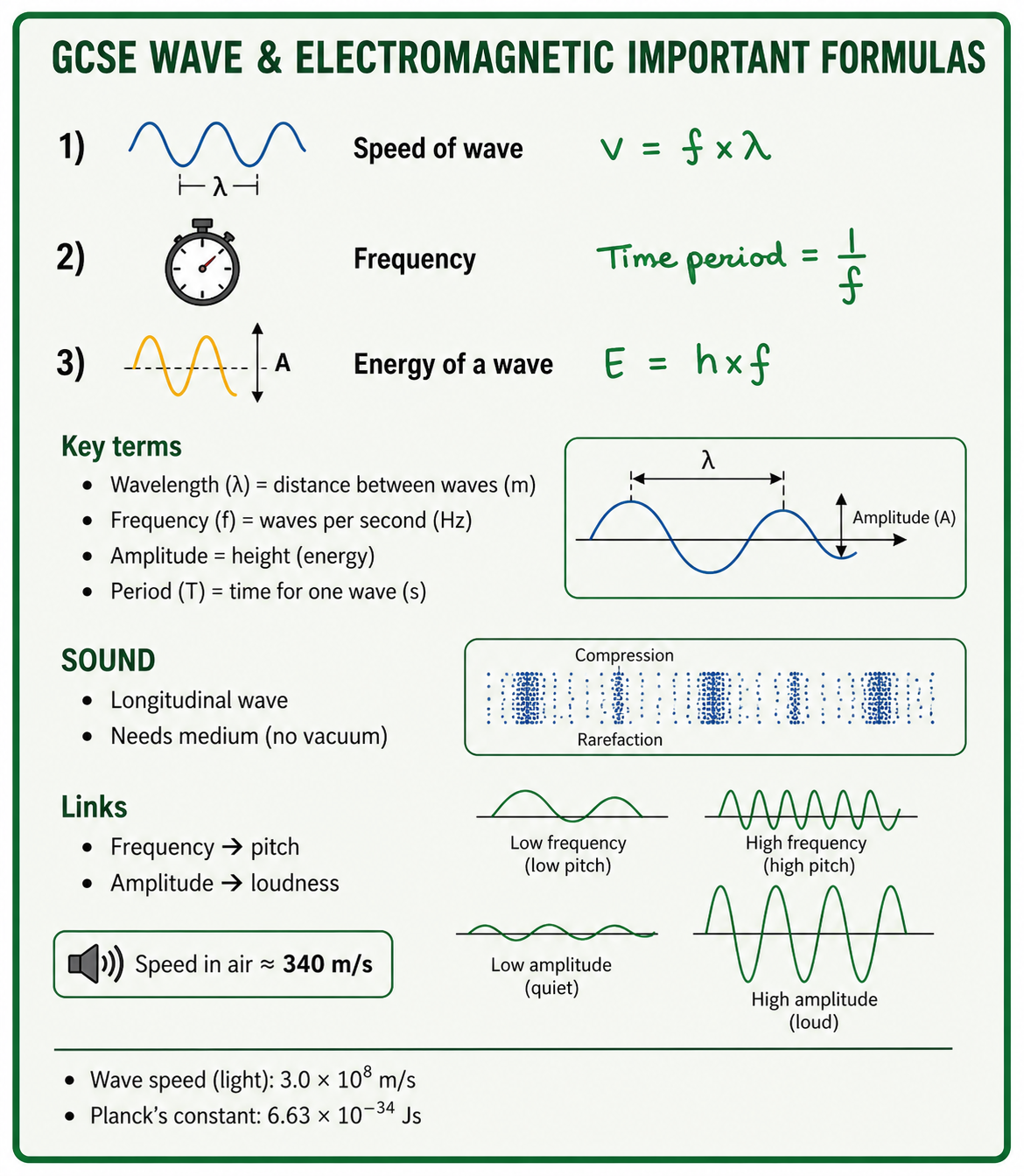
The wave equation is highly important because it appears in calculation questions across multiple exam boards.
A strong revision strategy is to combine formula practice with diagram-based learning.
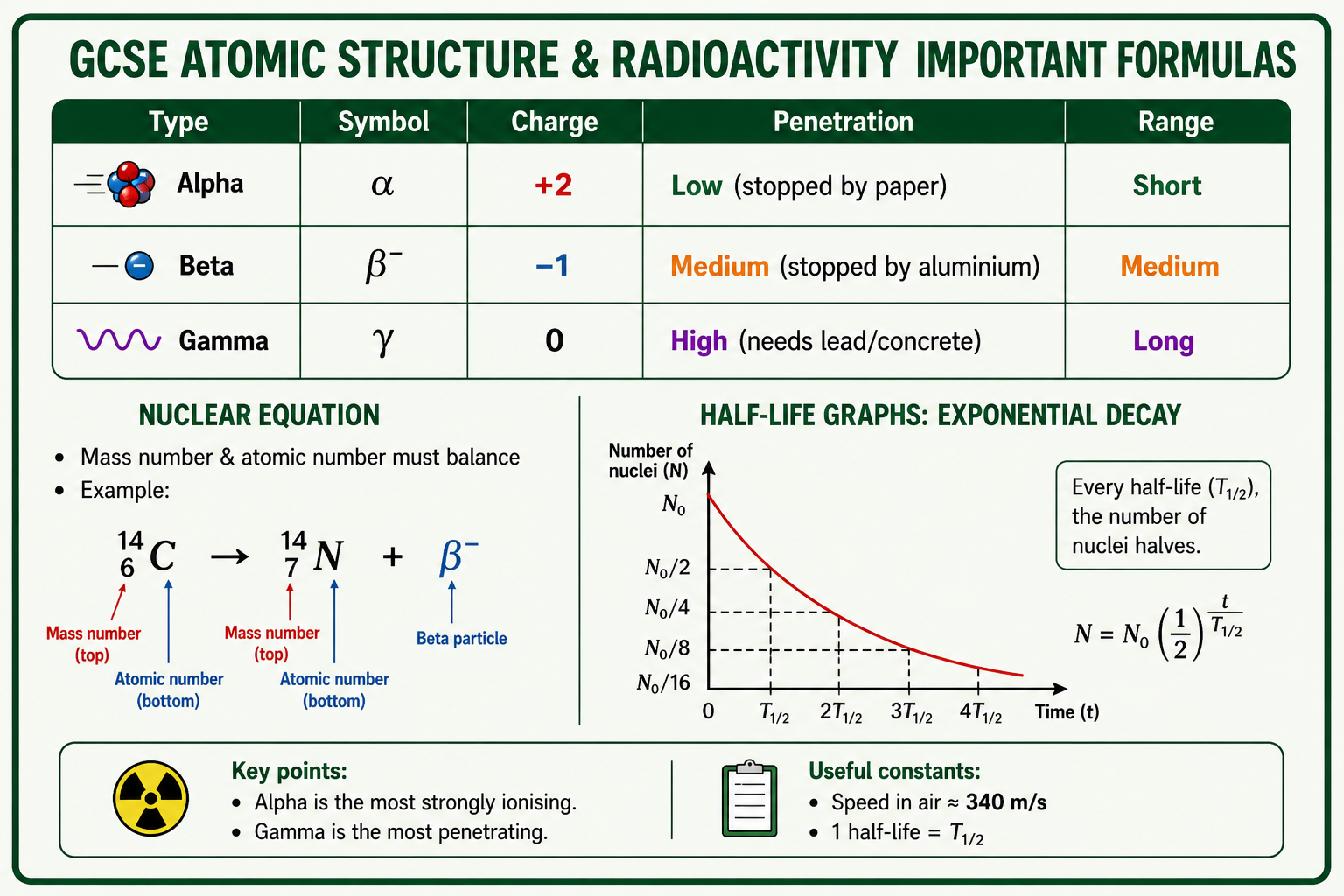
5. Atomic Structure and Radioactivity
Atomic structure remains one of the most predictable GCSE Physics topics because exam boards repeatedly test radioactive processes and nuclear understanding.
Common repeated areas include:
- Alpha radiation
- Beta radiation
- Gamma radiation
- Half-life
- Nuclear decay equations
- Isotopes
Half-life questions often appear because they combine interpretation, logic, and calculation.
Students must also understand why different types of radiation behave differently and where each is used in medicine or industry.
Examiners also frequently ask about how scientific models of the atom developed over time.
6. Particle Model of Matter
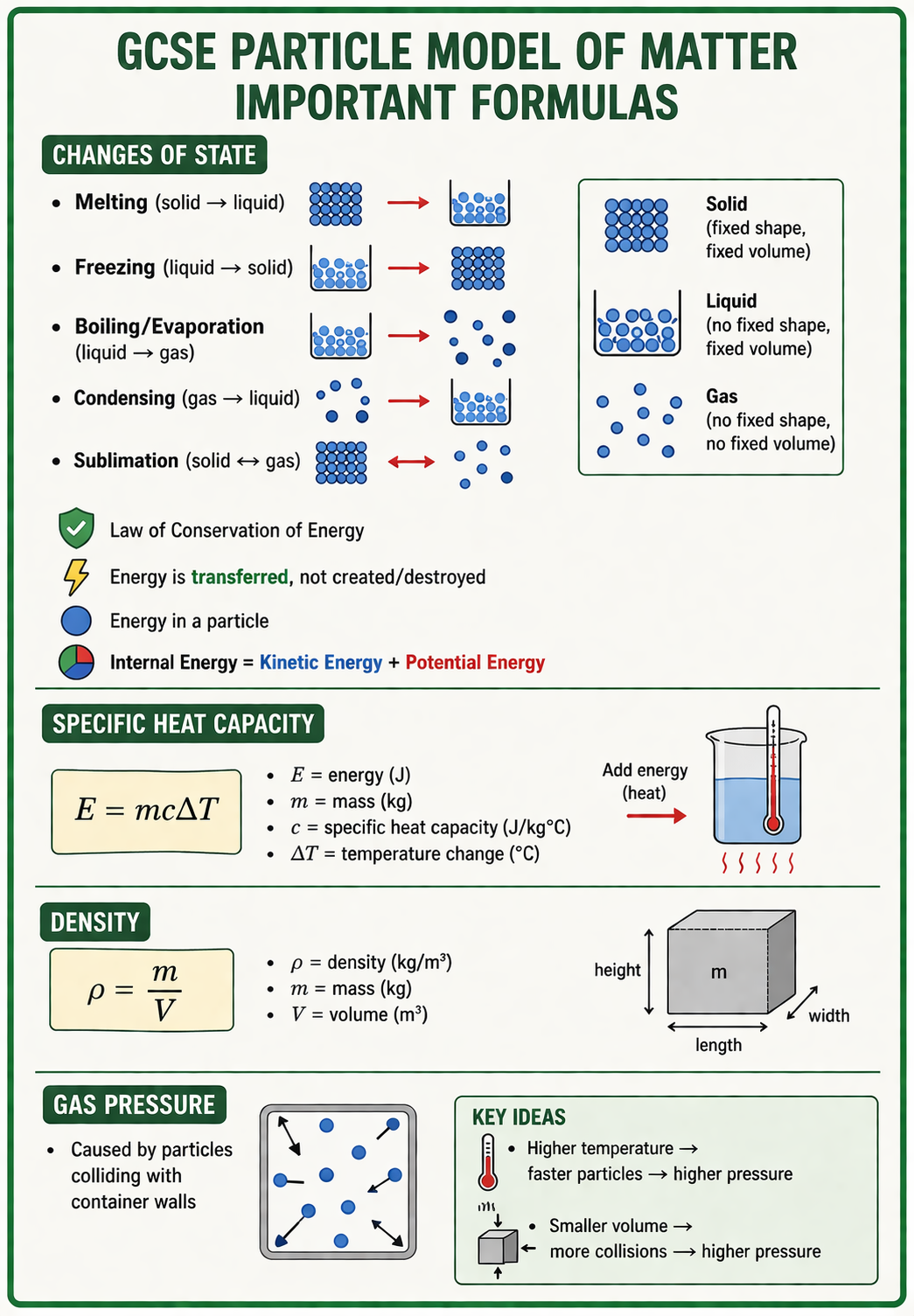
The particle model appears regularly because it links microscopic understanding with thermal energy and material behaviour.
Important areas include:
- Density
- Internal energy
- Specific heat capacity
- Changes of state
- Gas pressure
Specific heat capacity is especially important because it regularly appears in calculation questions.
Students often lose marks by forgetting units or failing to rearrange formulas correctly.
Density questions are also common because they are straightforward yet easy to test in different contexts.
This topic becomes much easier when formulas are practised repeatedly.
7. Magnetism and Electromagnetism
Magnetism often surprises students because it appears more frequently than expected.
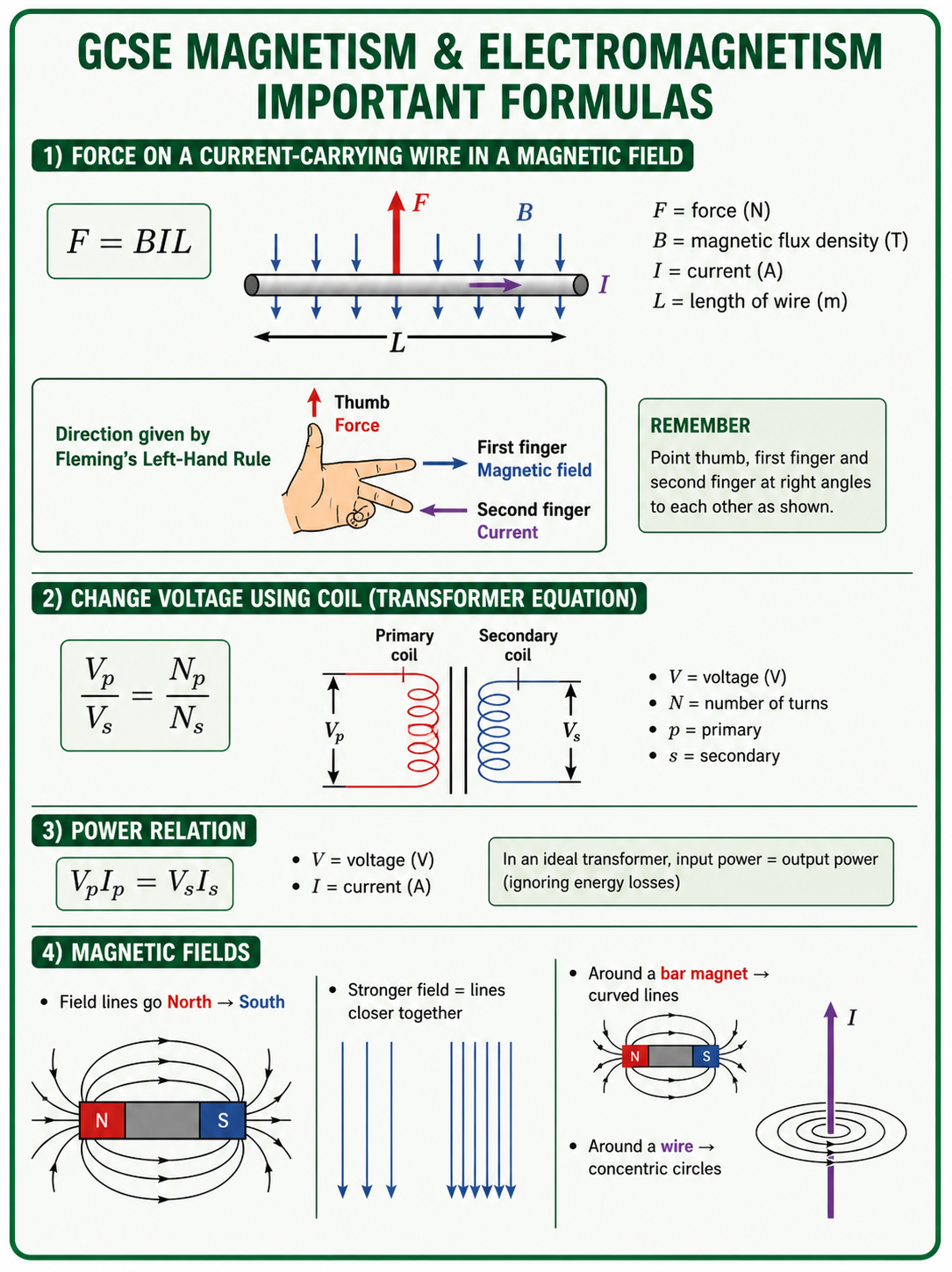
Common exam areas include:
- Magnetic fields
- Permanent magnets
- Electromagnets
- Transformers
- Motor effect
Transformer calculations are especially common because they test formula application and understanding of electricity transmission.
Students should also understand why the national grid uses high voltage to reduce energy losses.
Many marks are available here because questions often follow repeated patterns.
8. Required Practicals in GCSE Physics
Required practical questions now appear regularly, even when they are not labelled directly as practicals.
Students often see questions involving:
- Resistance experiments
- Measuring density
- Investigating waves
- Thermal energy experiments
The key is understanding:
- Independent variables
- Dependent variables
- Control variables
- Accuracy improvements
- Sources of error
Examiners often ask how an experiment could be improved or why a method gives unreliable results.
Students who revise practical methods carefully often gain marks quickly.
9. Formula Rearrangement and Physics Maths Skills
Many students understand physics concepts but lose marks because of weak maths skills.
Repeated mathematical skills include:
- Formula rearrangement
- Unit conversion
- Standard form
- Significant figures
Physics papers often include equations where students must solve for a different variable rather than substitute directly.
This is why maths practice is essential throughout revision.
A student who improves formula confidence often improves their overall physics grade immediately.
10. Graph Analysis and Data Interpretation
Graph questions appear across nearly every GCSE Physics paper because they test interpretation rather than memory.
Students regularly face:
- Distance-time graphs
- Velocity-time graphs
- Cooling curves
- Wave diagrams
Typical tasks include:
- Finding gradients
- Calculating areas
- Describing trends
- Comparing data
These questions are often simple but require careful reading.
Many avoidable mistakes happen because students rush through graph axes.
Why These GCSE Physics Topics Repeat Every Year
Exam boards focus on these topics because they represent the core scientific principles that every GCSE Physics student must understand.
Even when paper style changes, the same foundations remain central.
That means students who master these repeated topics usually feel more confident in the exam hall because familiar concepts appear across multiple questions.
Strategic revision often gives better results than trying to memorise every chapter equally.
Best Revision Strategy for GCSE Physics Success
To improve exam performance, students should:
- Focus first on repeated topics
- Practise past paper questions weekly
- Memorise formulas separately
- Review mistakes carefully
- Use timed revision sessions
Past papers help students recognise recurring question styles.
The more students practise examiner language, the easier questions become.
Final Thoughts
GCSE Physics becomes much easier when students understand which topics matter most. Energy, electricity, forces, waves, atomic physics, and practical skills continue to dominate exam papers because they test the most important scientific knowledge. Students who repeatedly revise these areas usually perform more confidently and score better. At Bright Mind Tutors, focused learning helps students strengthen weak areas, improve exam technique, and build confidence before exams. Smart revision always starts with knowing what comes up most often.
DOWNLOAD GCSE PHYSICS IMPORTANT FORMULA SHEET