

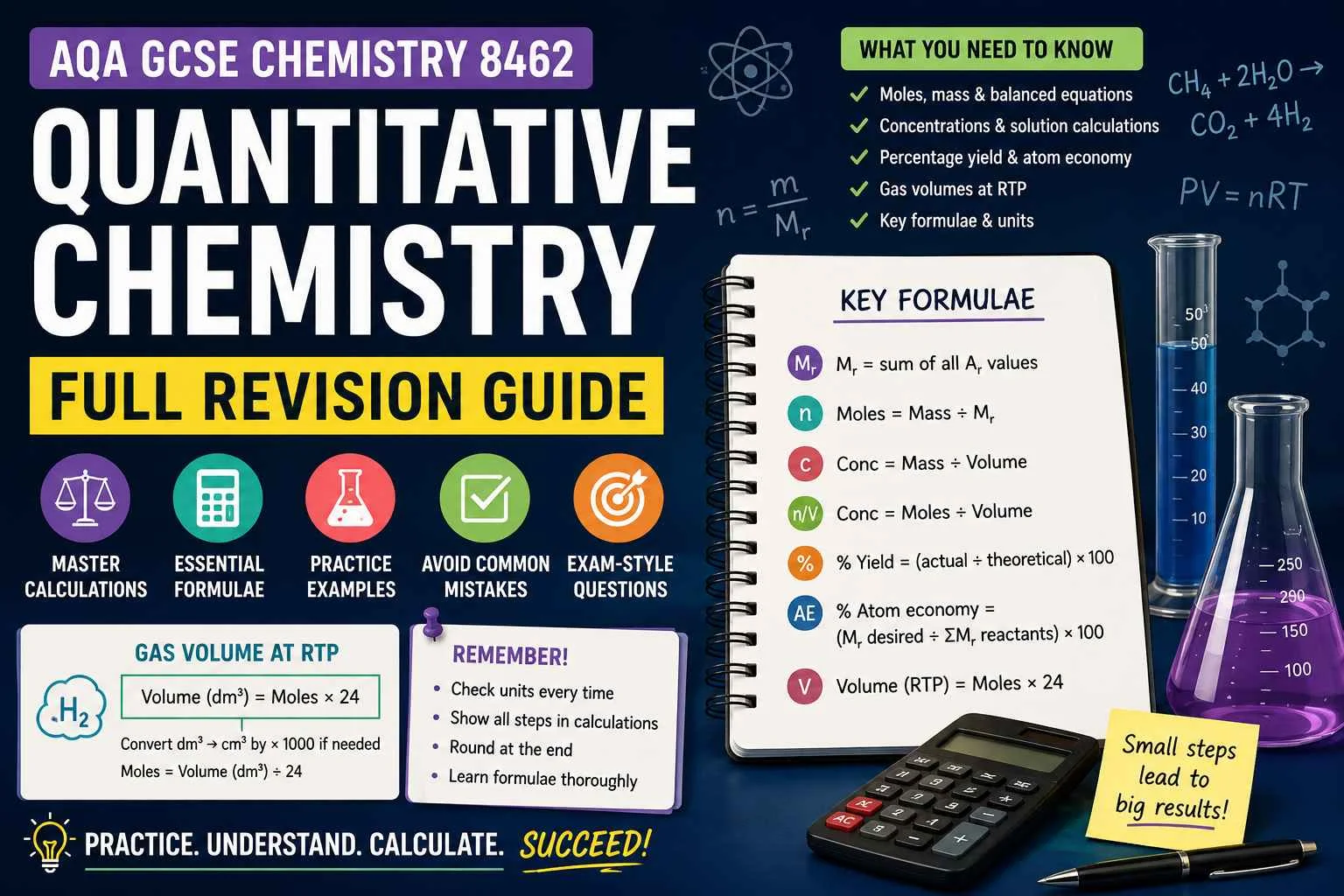
Quantitative chemistry is the part of GCSE Chemistry that teaches how to calculate masses, moles, concentrations, yields, atom economy, and gas volumes. AQA lists this as Topic 4.3, and it is part of Paper 1 content.
This topic is important because it connects balanced equations to real measurements and appears in both short calculations and longer exam questions.
Here in this article you will find every AQA spec point the same way our GCSE Chemistry tutors do in 1:1 sessions— conservation of mass to gas volumes — with worked examples, decision flowcharts, empirical formulas, and past paper questions with mark schemes.
Conservation of Mass & Balanced Equations
The law of conservation of mass states that no atoms are created or destroyed during a chemical reaction. Therefore, the total mass of the products always equals the total mass of the reactants.
This is why all symbol equations must be balanced — the number of atoms of each element must be identical on both sides. A balanced equation shows this conservation because the number of atoms are balanced on the both sides
CURIOUS
(important for conceptual questions in GCSE)
Some Reactions tend to lose mass, it is usually because a gas has formed during reaction and escaped into air.
Subscripts vs. coefficients — don’t confuse them
In 2H₂O: the large 2 in front is a coefficient, it multiplies with the whole formula (2 molecules of water). The small 2 subscript in H₂ is part of the formula (2 hydrogen atoms per molecule).
Never change subscripts to balance an equation — only change coefficients.
Relative Formula Mass (Mᵣ)
Relative Formula Mass (Mᵣ) , is calculated by adding the relative atomic masses of all the atoms present in a given compound or molecule.
Exam Tip
A periodic table with relative atomic masses is provided in the AQA exam, so you will never need to memorise atomic masses — but you do need to know how to read the table correctly and how to handle brackets in chemical formulae.
Our Special Class
At BrightMindTutors, our GCSE Expert Tutor spends an entire lecture just going through the data booklet and decoding tricks of the booklet to help you in the exam.
Example 1: Calculate the relative molecular mass (Mᵣ) of Al₂(SO₄)₃
Given (Aᵣ): Al = 27, O = 16, S = 32
Solution –
STEP 1) Count the total atoms of each element present
Al₂(SO₄)₃ = 2 Aluminium + 3 Sulfurs + 12 Oxygens
STEP 2) Multiply the (Aᵣ) with total number of atoms for each element and add them together
Mᵣ = 27 x 2 + 32 x 3 + 12 x 16
Mᵣ(Al₂(SO₄)₃) = 342
Example 2: Calculate the relative molecular mass (Mᵣ) of Ca(OH)₂
Given (Aᵣ):
Ca = 40, O = 16, H = 1
Solution – Total number of atoms present
Ca(OH)₂ = 1 Ca + 2 O + 2H
Mᵣ = 40 + (2 × 16) + (2 × 1) = 40 + 32 + 2
Mᵣ(Ca(OH)₂) = 74
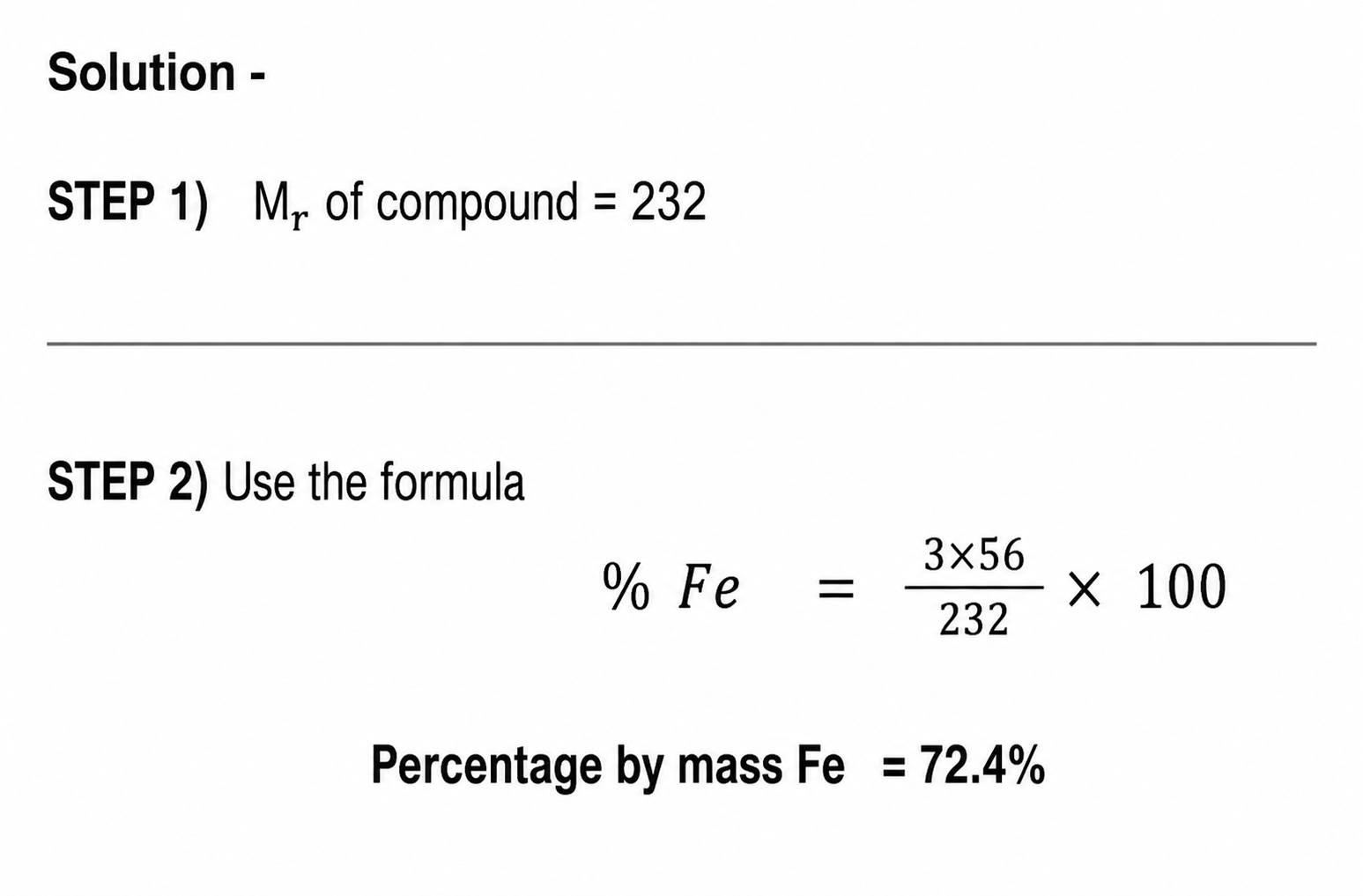
Empirical Formula & Molecular Formula
(High Frequency topic)
This appears in almost every AQA paper and is one of the most commonly examined calculation types, yet many students miss it entirely in revision.
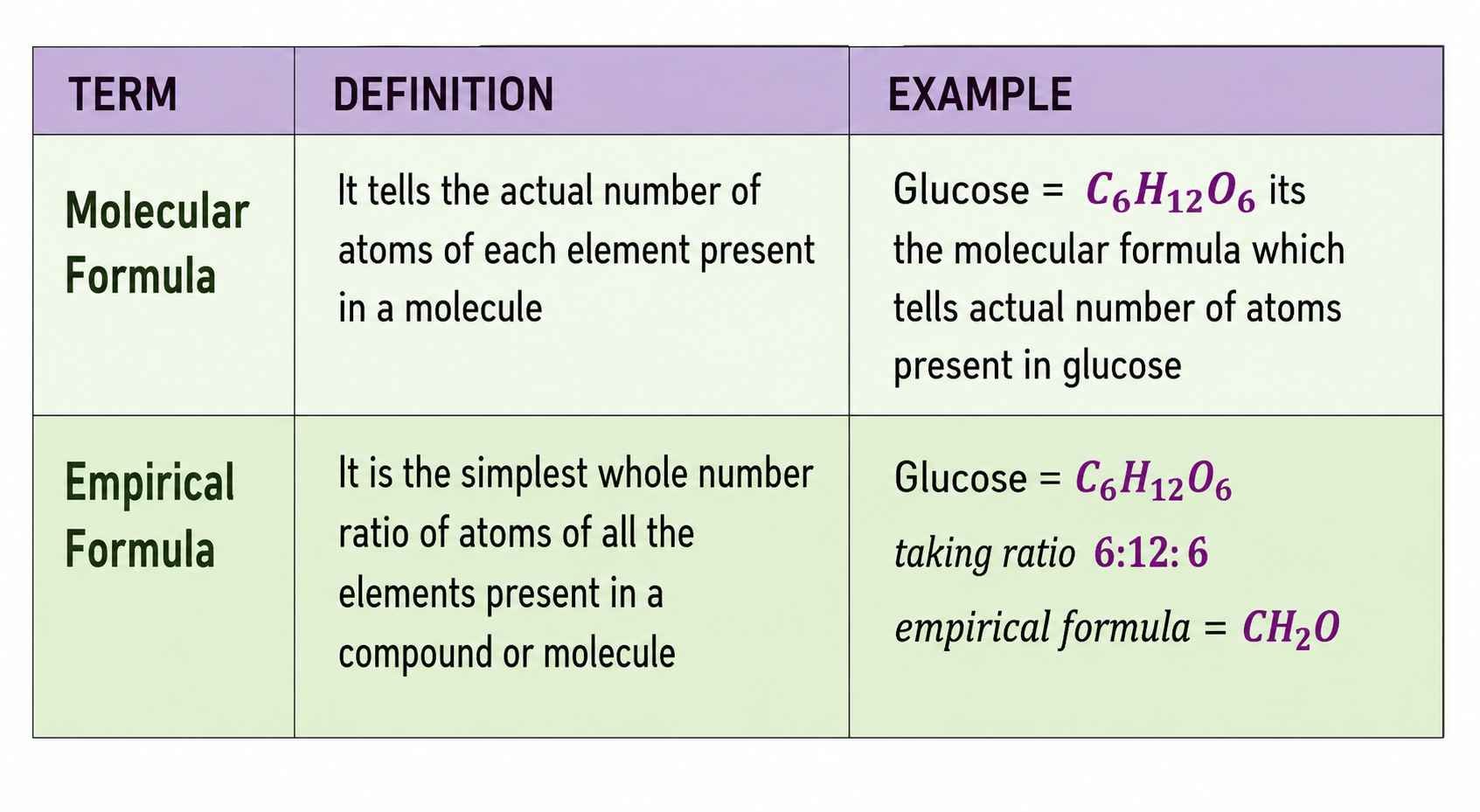
How to Calculate Empirical Formula — The Step By Guide
Example 4: Ester Y has the following composition by mass:
- C – 48.65%
- H – 8.11%
- O – 43.24%
Calculate the empirical formula of Ester Y.
Solution – We can actually prepare a table to find the answer
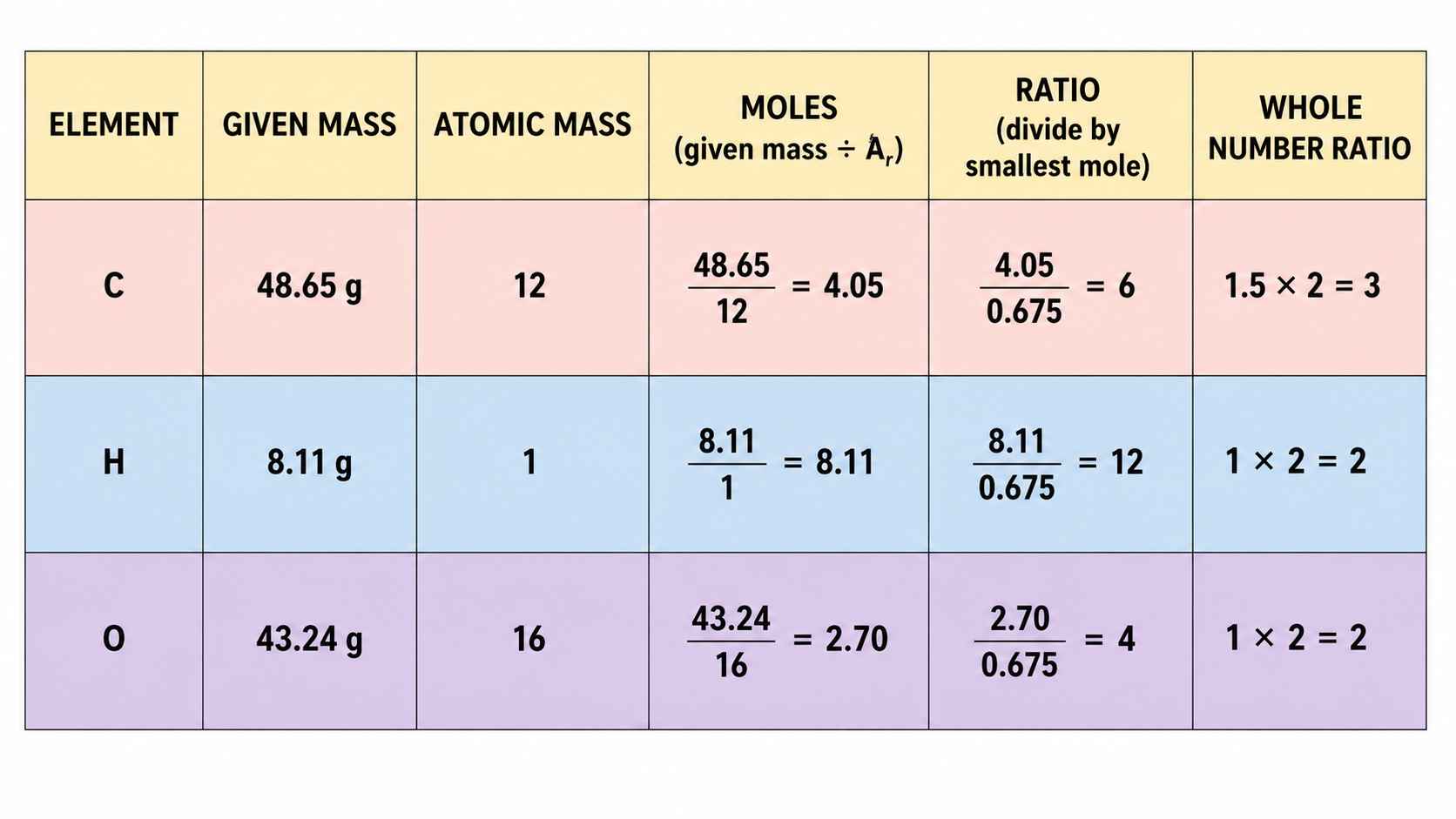
Required empirical formula = C₃H₆O₂
Finding Molecular Formula from Empirical Formula
You need the empirical formula & the Mᵣ of the compound
REMEMBER
To find the Molecular Formula from the Empirical Formula, we need to find the n factor.
Step 1:
n = Molecular Mass (Mᵣ) ÷ Empirical Mass
Step 2:
n × Empirical Formula = Molecular Formula
Example 5: Ester Z has the empirical formula C₂H₄O and a relative molecular mass of 88. Determine the molecular formula of Ester Z.
Solution –
STEP 1) Empirical Mass of Ester = 12 ×2+4×1+16×1
= 44
STEP 2) n = Mᵣ of ester Z ÷ Mass of empirical formula
n = 88 ÷ 44 = 2
STEP 3) Molecular Formula = 2 × Empirical Formula
= 2 × C2H4O
Molecular Formula = C₄H₈O₂
Exam Tip: What if you get a non-whole ratio?
If dividing by the smallest gives:
- 1.5 → multiply everything by 2.
- 1.33 → multiply everything by 3.
- 1.25 → multiply everything by 4.
Memorise these: they come up every year.
The Mole (Higher Tier)
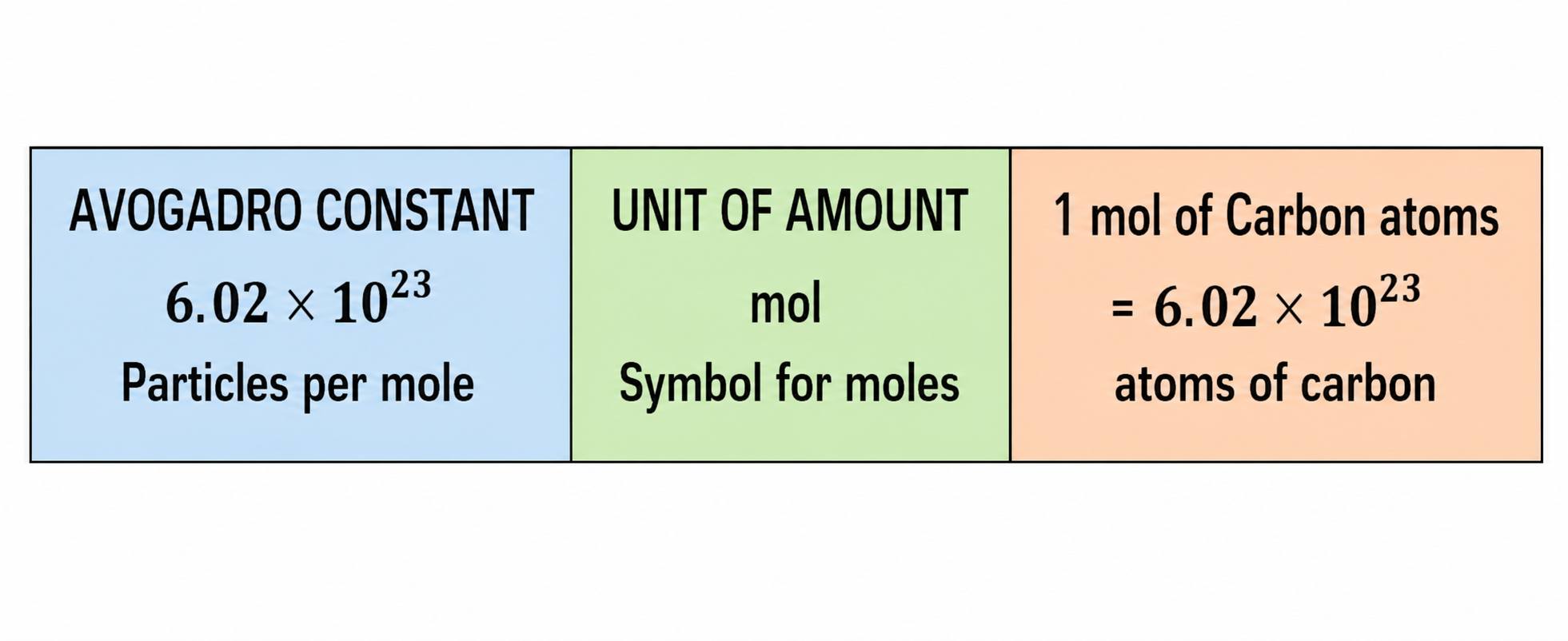
The mass of one mole of a substance in grams numerically equals its Mᵣ. For example, Mᵣ(CO₂) = 44, so 1 mole of CO₂ = 44 g.
A mole is simply a unit for counting particles, just like a “dozen” is a unit for counting twelve of something. The difference is that a mole counts an enormous number of particles — atoms, molecules, or ions — because atoms themselves are so incredibly small.
The mole is the chemist’s counting unit. One mole contains = 6.02 × 10²³
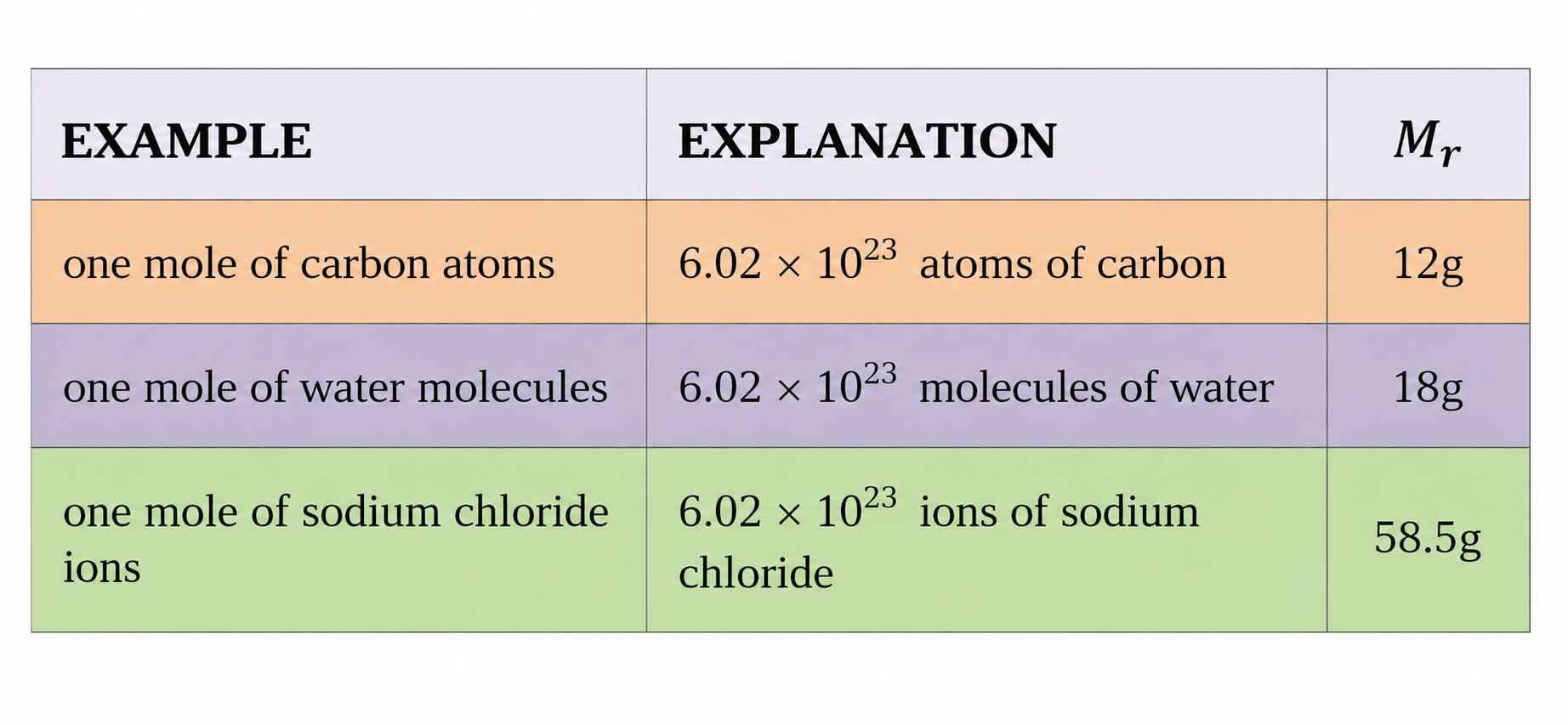
The Moles Formula — the most important in Topic 3
This is the most important formula for Paper 1 as well as Paper 2. This formula is constantly used in quantitative chemistry in several ways as these calculations rarely appear as a single isolated question. Instead , they are woven into :
- Reacting masses and stoichiometry questions
- Percentage yield and atom economy calculations
- Concentration of solutions (mol/dm³)
- Titration calculations
- Empirical formula questions
- Gas volume calculations (using the 24 dm³ rule at room temperature and pressure)
This is exactly why moles is considered a “gateway topic” — get comfortable with it, and a huge portion of the AQA Chemistry paper becomes far more manageable. Struggle with it, and those marks become very difficult to access, even if you understand the surrounding chemistry concepts perfectly well.
The Key Moles GCSE Formula Every Student Must Know
The most important formula in this entire topic, and one you should be able to recall and rearrange without hesitation, is:
Moles = Mass (g) ÷ Molar Mass (g/mol)
This is often written using the “formula triangle” method, where:
- Mass sits at the top
- Moles and Molar Mass sit at the bottom
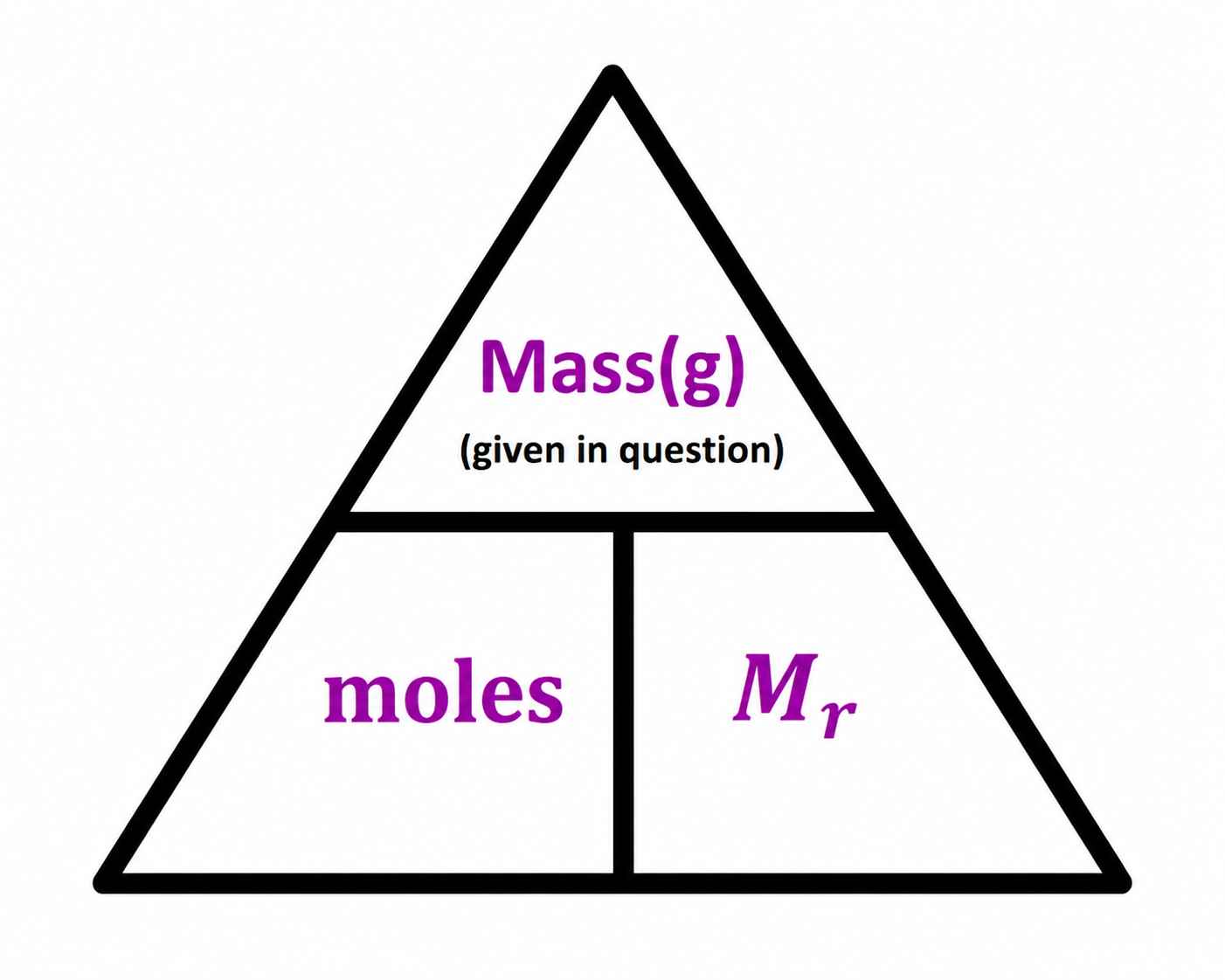
Covering up the value you want to find tells you exactly what calculation to perform. So if you need to find mass, you multiply moles by molar mass. If you need to find molar mass, you divide mass by moles.
It is worth noting that on the current AQA specification, this formula is provided on the exam paper, so you do not need to memorise it word-for-word. However, knowing it well enough to use it instantly, without having to puzzle over where each number goes, saves valuable time in the exam and reduces careless errors.
Worked Example: Finding Moles from Mass
Let’s put the formula into practice.
Example 6: How many moles are there in 11 g of CO₂?
Solution –
STEP 1: Find the Mᵣ of CO₂ → 44
(find masses of carbon and oxygen from periodic table and add them)
STEP 2: Apply the formula
Moles = Mass ÷ Molar Mass
Moles = 11 ÷ 44
Moles = 0.25 mol
This is a classic AQA-style question, and notice how the entire calculation depends on getting the Mᵣ correct first. This is why so much emphasis is placed on practising Mᵣ calculations separately before moving on to full moles questions.
Worked Example: Finding Mass from Moles
The formula triangle also works in reverse.
Reading a balanced Chemical Equation (Important Skill for GCSE)
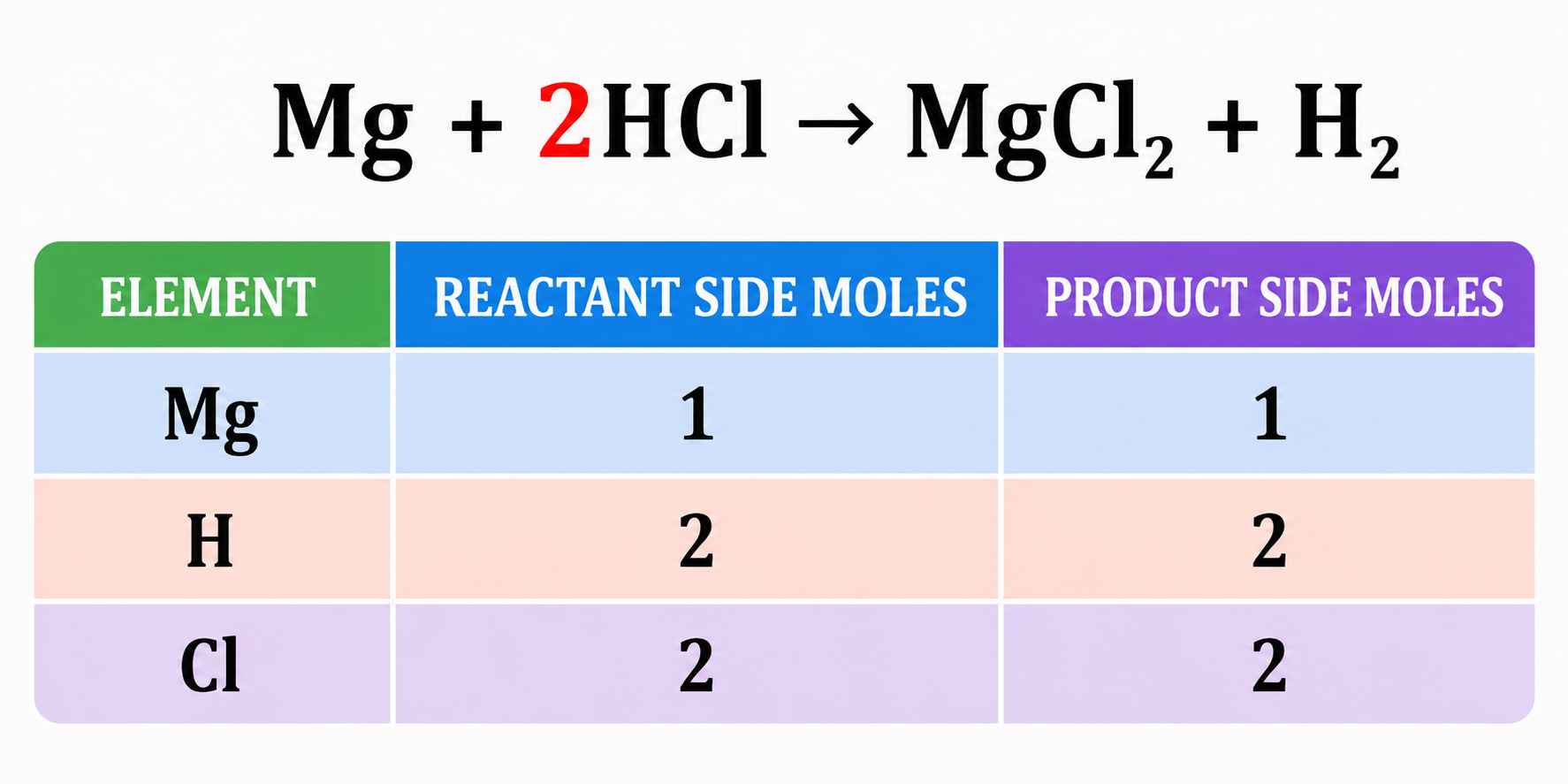
Example 8: Calculate the mass of magnesium needed to react completely with 0.4 moles of HCl. (IMP)
Mg + 2HCl → MgCl₂ + H₂
Solution –
STEP 1: Underline the elements for which the mass/moles is given and for which they are asking the mass/moles
STEP 2: Compare the mole ratio of Mg to HCl
2 mole of HCl requires 1 mole of Mg
0.4 mole of HCl needs → 0.4 ÷ 2 = 0.2 mol
STEP 3 : Find the Mᵣ of Mg → 24
Apply the formula
Mass = Moles × Molar Mass
Mass = 0.2 × 24
Mass of Mg = 4.8 g
Example 9: What mass of Fe is produced from 48 g of Fe₂O₃ by the reaction above?
[Mᵣ: Fe₂O₃ = 160, Fe = 56]
Fe₂O₃ + 3CO → 2Fe + 3CO₂
Solution –
STEP 1) Underline the elements for which the mass/moles are given and for which they are asking the mass/moles. Its Fe and Fe₂O₃
STEP 2) Finding the moles of Fe₂O₃
moles of Fe₂O₃ = Mass ÷ Mᵣ
= 48 ÷ 160
= 0.3 mol
1 mol of Fe₂O₃ makes 2 mol of Fe
0.3 mol of Fe₂O₃ → 0.3 × 2 mol of Fe = 0.6 mol of Fe
STEP 3) Mass of Fe = mol × Mᵣ
= 0.6 × 56
Required Mass of Fe = 33.6g
Summary of above method
STEP 1) Find the mole ratio of elements under consideration from the equation.
It’s usually a 2-element relation. For one element, the moles/mass are given; for the other, you have to find them.
STEP 2) Compare the mole ratio of both substances and find the moles of the other element by comparing the mole ratios.
STEP 3) Use the mole formula to find the mass of the element they want you to find.
Required formula can be derived from the triangle given in the data booklet:
Mass = Moles × Mᵣ
THIS IS THE BACKBONE OF ALMOST EVERY REACTING MASS QUESTION IN GCSE MOLES
Using Moles to Balance Equations (HT)
Example 10: A compound contains only aluminium and carbon. 0.03 moles of this compound reacted with excess water to form 0.12 moles of Al(OH)₃ and 0.09 moles of CH₄.
Solution –
STEP 1) Writing the moles of elements given
Compound(reactant) = 0.03 Al(OH)₃ = 0.12 CH₄ = 0.09
STEP 2) Taking mole ratios
Compound(AlXCY) Al(OH)₃ : CH4
0.03 : 0.12 : 0.09
Finding simple whole number Ratio (divide by smallest moles 0.03)
Compound (AlXCY) = 1 Al(OH)₃ = 4 CH₄ = 3
STEP 3) Since compound is made of Al & C only and reacting with excess of water therefore writing the equation and finding x & y
1AlₓCᵧ + H₂O → 4 Al(OH)₃ + 3 CH₄
Clearly Al(x) = 4 C(y) = 3 O= 12(on product side)
Hence coefficient of H2O = 12
Required Balanced Equation Al₄C₃ + 12 H₂O → 4Al(OH)₃ + 3CH₄
Example 11: 8.01 g of copper reacts with sulphur to form 12.03 g of copper sulphide (CuS).
Deduce the balanced equation.
[Aᵣ: Cu = 63.5, S = 32]
Solution – We can actually make table and solve the question step by step
Mass of Sulphur = 12.03 – 8.01 = 4.02g
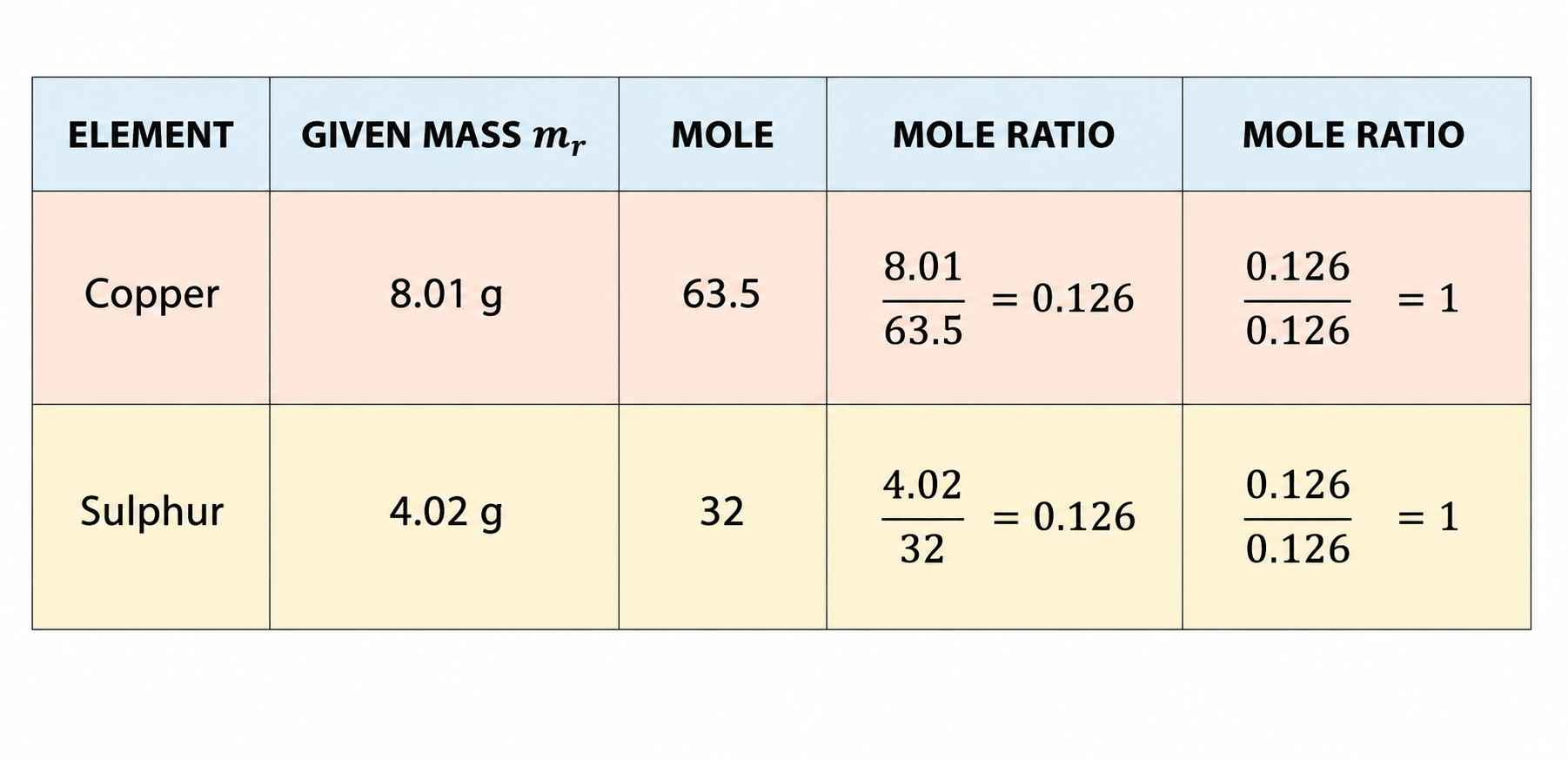
Required Balanced Equation 1 Cu + 1S → 1CuS or Cu + S → CuS
REMEMBER
Concentration of Solutions
Foundation & Higher
Type 1
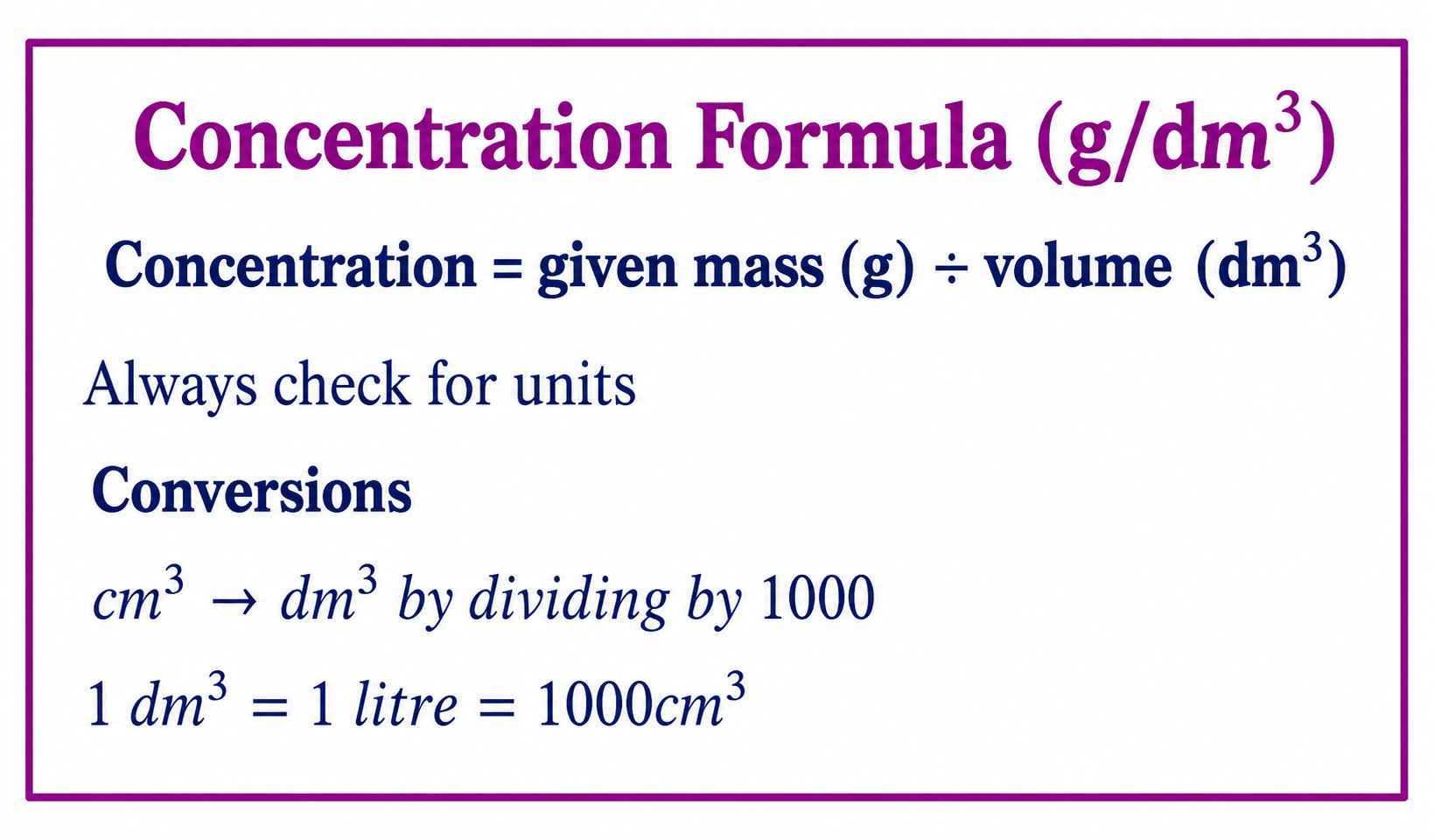
AQA also expects students to apply moles to solutions, particularly for titration and concentration-based questions.
Type 2
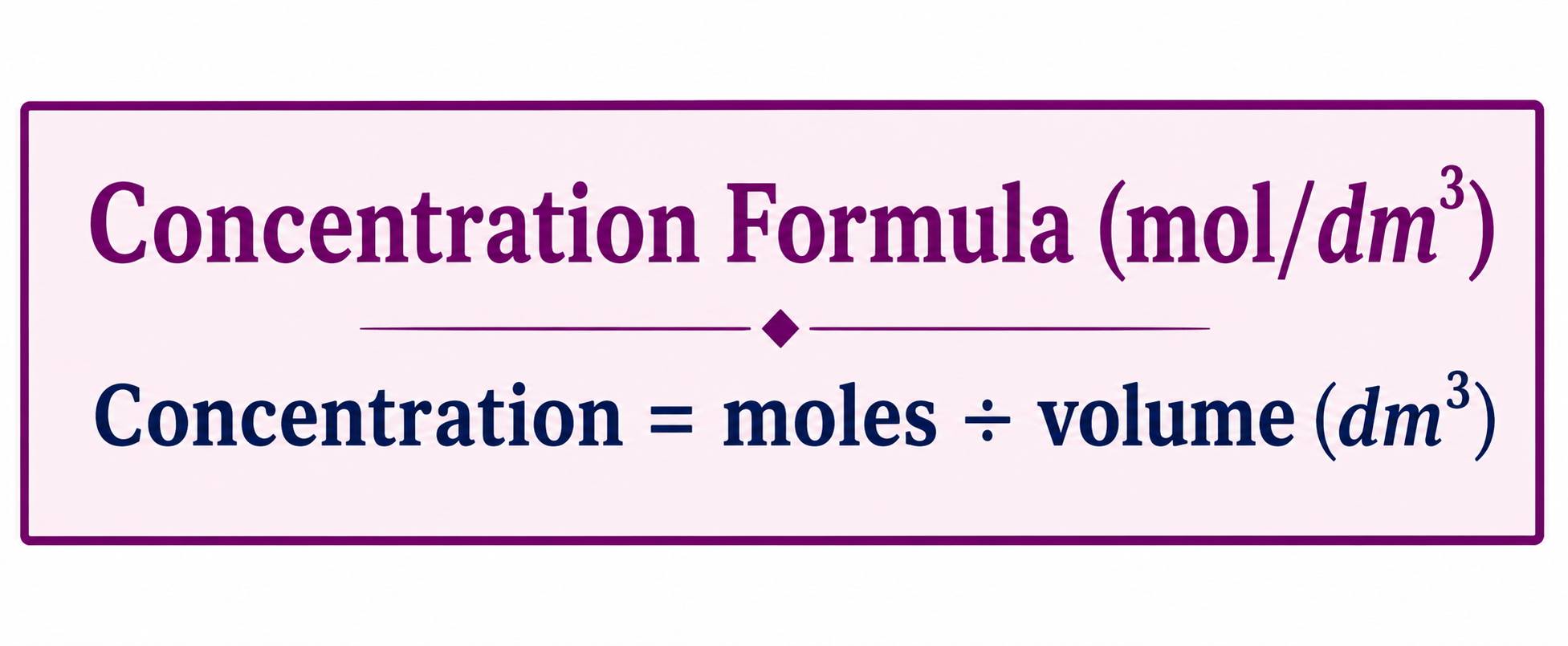
Example 15: How many moles of HCl are in 25 cm³ of a 2 mol/dm³ solution?
Solution –
Step 1) Convert volume to dm³ = 25 ÷ 1000 = 0.025 dm³
Step 2) Apply the formula Moles = 2 × 0.025 = 0.05 mol
Required moles of HCl = 0.05mol
This single conversion step is responsible for more lost marks than almost any other part of the moles topic, simply because students forget to divide by 1000 before plugging numbers into the formula. It is one of the first things our GCSE Chemistry tutors check for when reviewing a student’s work
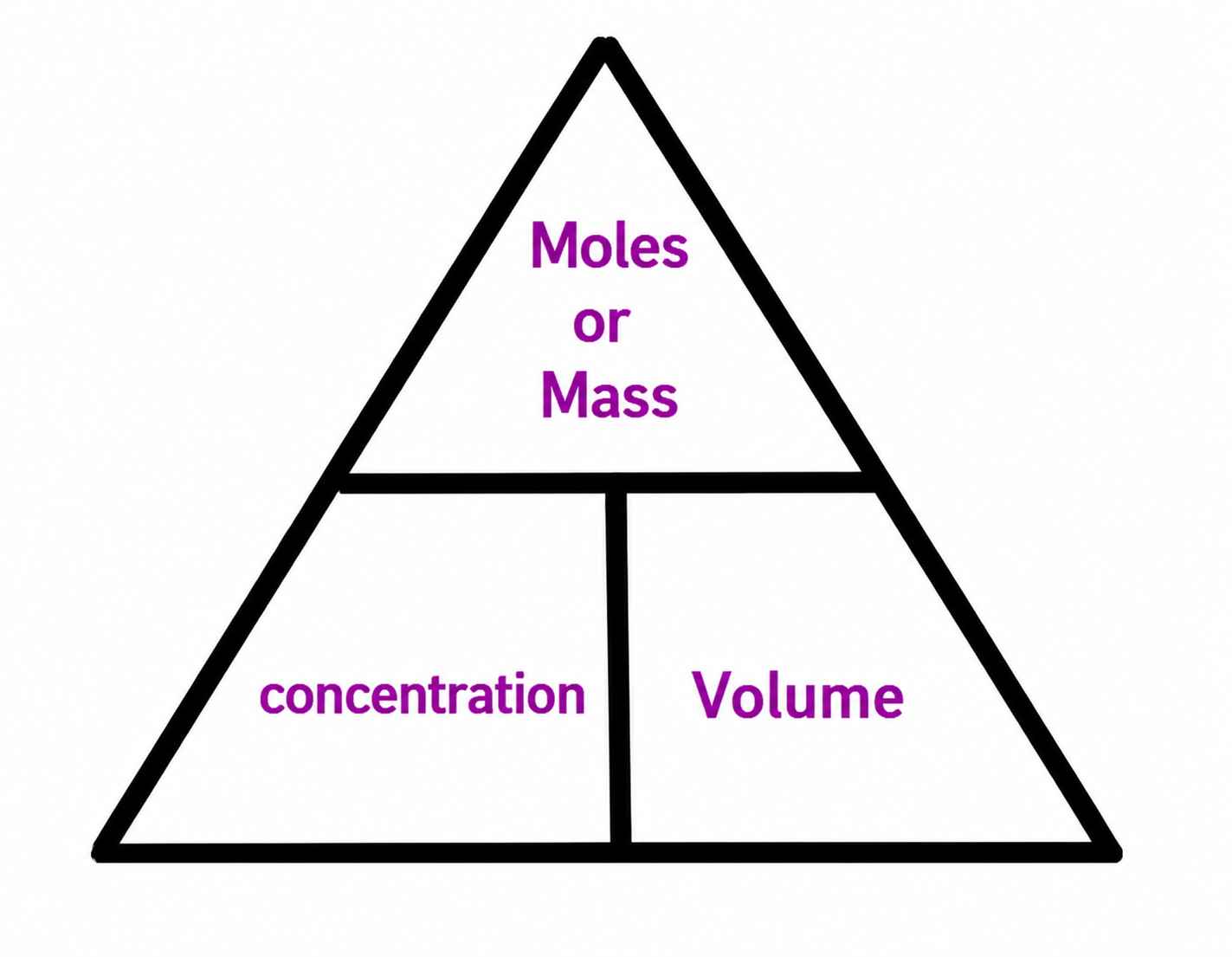
Concentration Triangle
Percentage Yield & Atom Economy
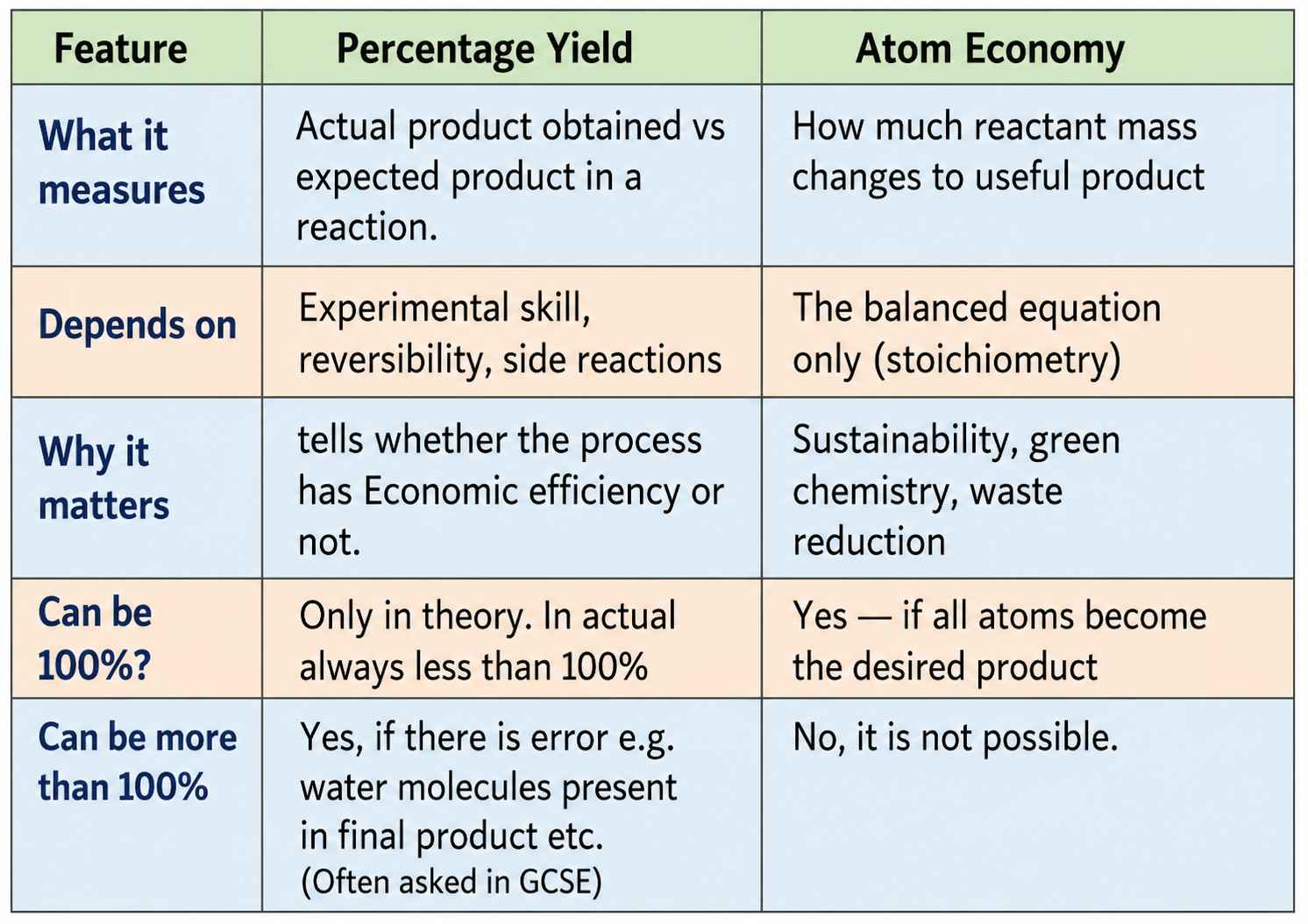
Percentage yield tells you how much product you actually made compared with how much you expected to make.
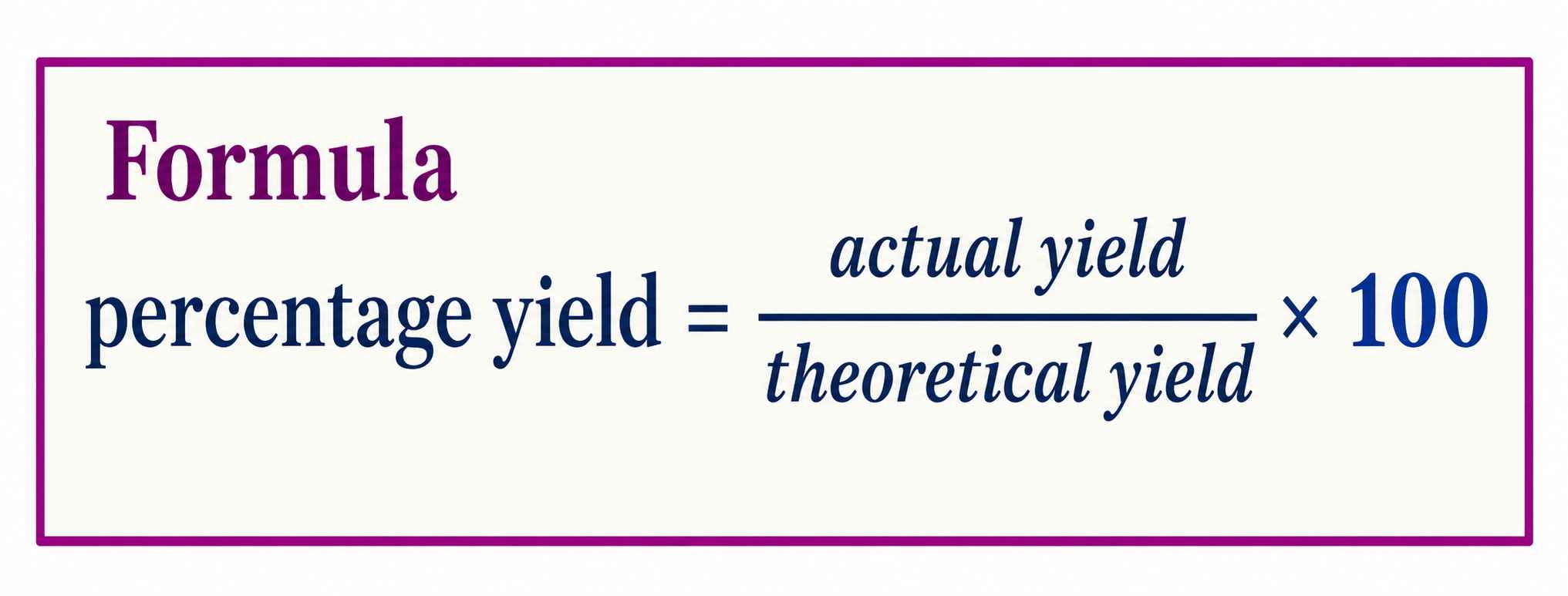
Actual yield = The one we actually get when the reaction is done.
Theoretical yield = It is the calculated amount in the notebook.
REMEMBER (Important for GCSE)
The percentage yield is always less than 100% because:
- The reaction may be incomplete.
- The reaction may be reversible.
- Some product may be lost during filtering, transferring, or purification.
Gas Volumes at RTP (Chemistry Only, HT)
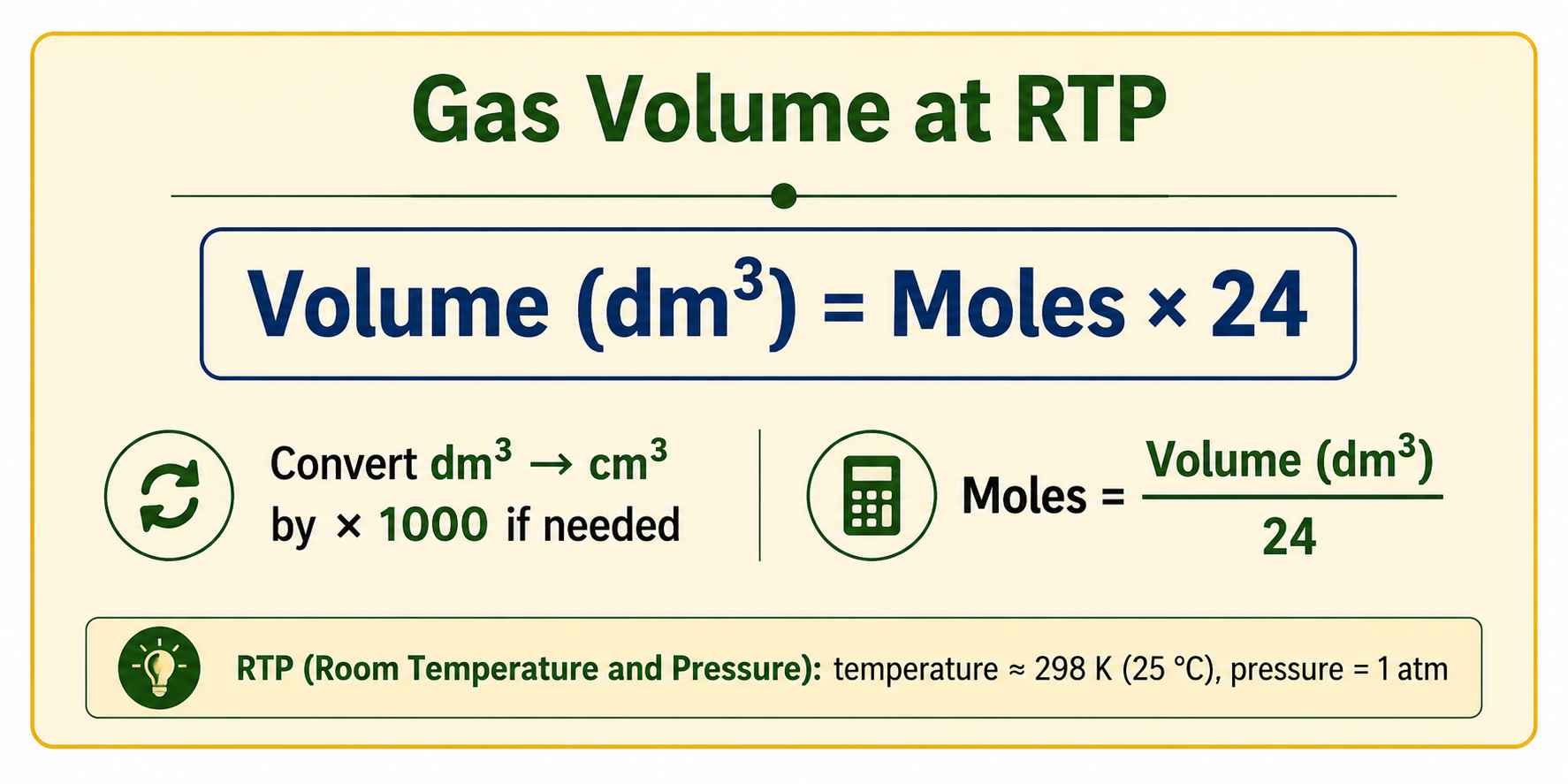
At room temperature and pressure (RTP), 1 mole of any gas occupies 24dm3.
Example 19: 0.40 g of methane were fully reacted with steam to form carbon dioxide and hydrogen.
Calculate the maximum volume of hydrogen in dm³, measured at room temperature and pressure, that could be made in this reaction. (IMP)
CH₄(g) + 2H₂O(g) → 4H₂(g) + CO₂(g)
(Relative formula mass: CH₄ = 16; 1 mole of any gas at room temperature and pressure occupies 24 dm³.)
Solution –
STEP 1) Underline the elements given to you & find the moles for the element whose mass is given.
Mol of CH4 = given mass ÷Mᵣ
= 0.4 ÷ 16
=0.025 mol
STEP 2) Compare the mol ratio of both elements from balanced equation
1 mol of CH4 makes → 4 mole of H2
0.025 mol of CH4 → 0.025 ×4 = 0.1 mol of H2
STEP 3) Find the volume of H2 gas
Volume = mole÷ 24
= 0.1
Volume of H2 = 2.4dm3
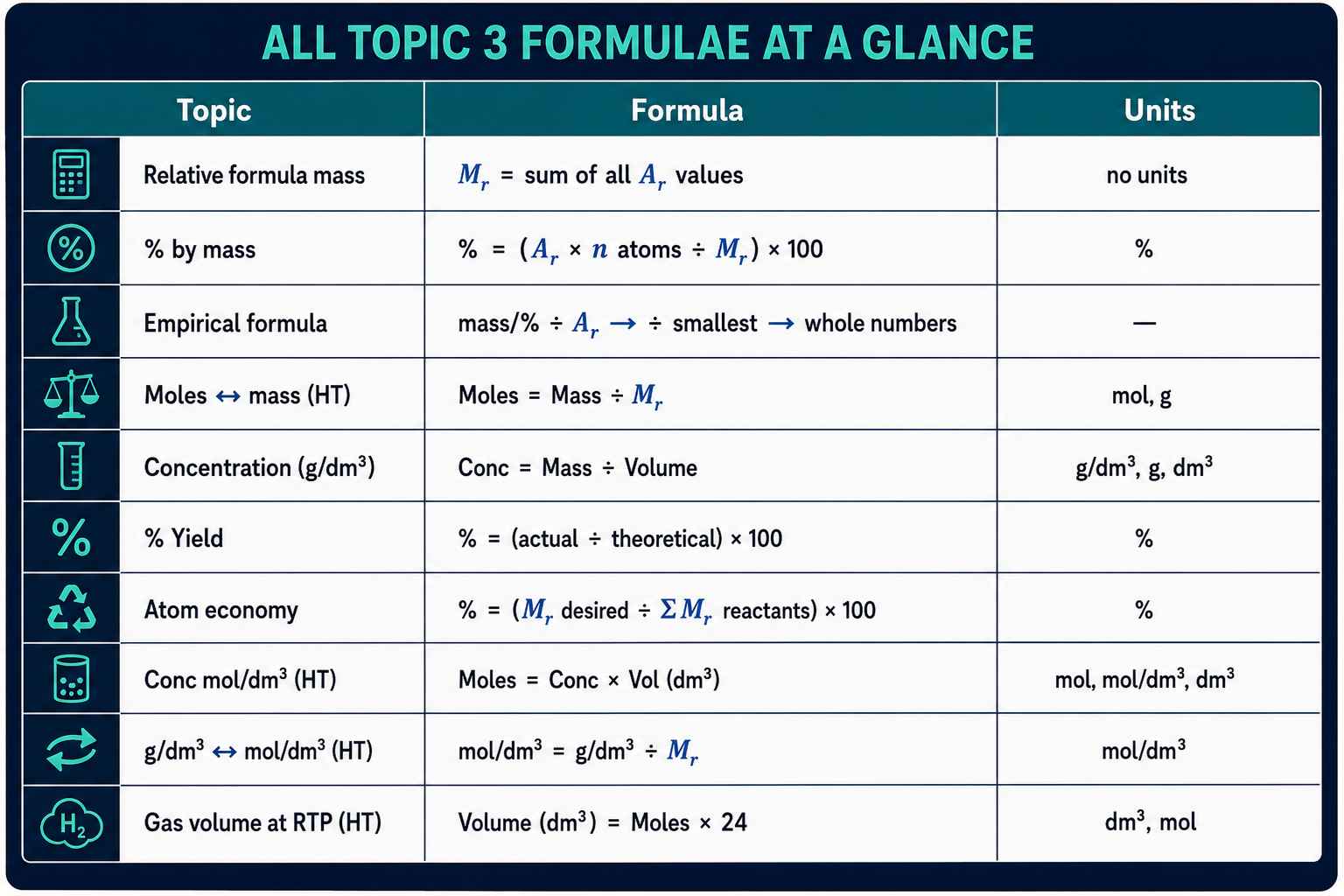
Moles Formula Sheet— GCSE CHEMISTRY
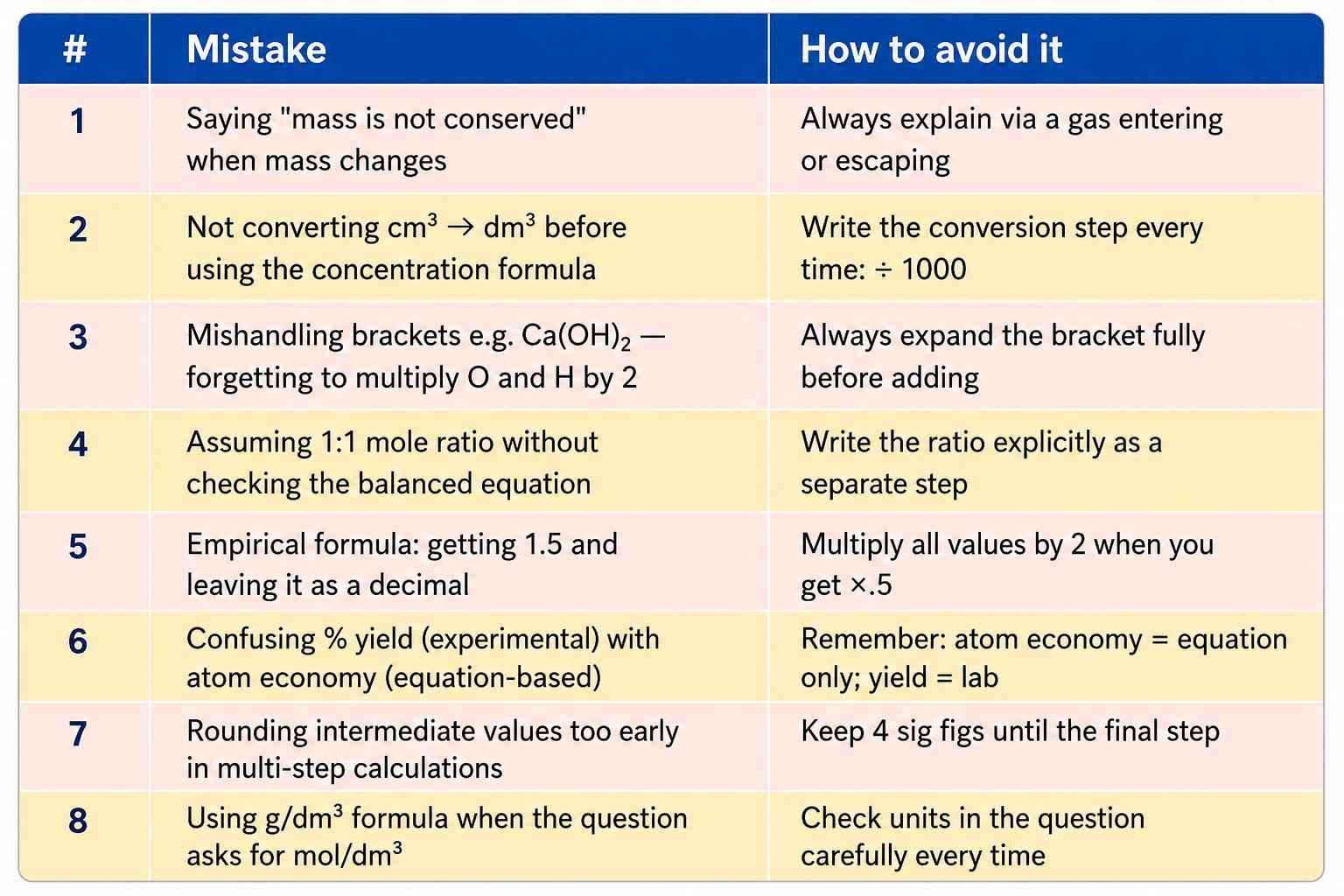
Common Mistakes Students Make with Moles
Based on patterns we see across hundreds of tutoring sessions, here are the errors that come up again and again:
DOWNLAOD – CHEAT SHEET GCSE MOLES
How to Calculate Concentration GCSE Chemistry
How to Revise Moles Effectively for AQA GCSE Chemistry
Moles is one of the highest-value topics in AQA GCSE Chemistry because it isn’t tested once — it resurfaces across reacting masses, percentage yield, concentration, and titration questions on both Paper 1 and Paper 2. Getting comfortable with GCSE chemistry moles calculations early pays off across the whole specification, not just one topic.
Here’s a step-by-step approach to revising moles that actually works
- Master Mr calculations first.Before attempting any moles formula GCSE chemistry questions, get fast and accurate at calculating Mr . If you cannot calculate relative formula mass quickly and accurately, every moles question afterwards becomes harder than it needs to be.
- Practise the formula triangle until it’s automatic. Even though AQA provides the formula, instant recall under time pressure makes a real difference.
- Work through AQA Past Papers specifically filtered for moles and reacting mass questions. AQA’s question style is consistent year on year, and pattern recognition is one of the most effective revision tools available.
- Always show your working. AQA awards method marks even when the final answer is wrong, so a clearly laid out calculation can rescue marks that would otherwise be lost to a simple arithmetic slip.
- Get feedback on your working, not just your answers. It is very common for a student to get the right final number while using a method that will fail on a slightly different question. A GCSE Chemistry tutor reviewing your working line by line catches this early.
Frequently Asked Questions
Is the moles formula given in the AQA GCSE Chemistry exam?
Yes. AQA provides the moles formula (moles = mass ÷ Mr) on the exam paper itself, along with the periodic table. However, students still need to know how to rearrange it and when to apply it, since the paper does not tell you which version of the formula to use for a given question.
Why do I need a balanced equation to do moles calculations?
A balanced equation tells you the ratio in which substances react and are produced. Without using this ratio correctly, a mass or moles calculation involving a chemical reaction will almost always be wrong, even if the basic moles formula has been applied accurately.
What is the difference between Mr and Ar? Ar (relative atomic mass) refers to a single element, such as carbon having an Ar of 12. Mr (relative formula mass) refers to a whole compound or molecule, calculated by adding up the Ar values of every atom present, such as CO₂ having an Mr of 44.
Do I need to memorise the Avogadro constant? You should know that one mole of any substance contains 6.02 × 10²³ particles, as this underpins the whole topic conceptually. However, most AQA calculation questions at GCSE level focus on mass, moles, and concentration rather than requiring you to use the Avogadro constant directly in a calculation.
How much of the AQA Chemistry exam is based on moles? Moles calculations do not appear as one single question worth a fixed number of marks. Instead, the skill is examined repeatedly across reacting masses, percentage yield, concentration, and titration questions throughout both Paper 1 and Paper 2, which is why it is considered one of the highest-value topics to master thoroughly.
Final Thoughts
Moles is a topic that rewards a methodical, step-by-step approach far more than it rewards memorisation. Once the underlying logic — that moles are simply a way of counting particles by weighing them — clicks into place, the formulas stop feeling like rules to memorise and start feeling like tools you reach for naturally.
If you are finding moles calculations difficult, or you want a tutor to walk through past paper questions with you and pinpoint exactly where marks are being lost, our experienced GCSE Chemistry tutors at Bright Mind Tutors specialise in exactly this kind of focused, exam-oriented support. Many of our chemistry tutors hold postgraduate qualifications from institutions including IIT Delhi and IIT Madras, and have years of experience helping AQA, Edexcel, and OCR students turn their weakest topics into their strongest.
Book a free trial lesson today and see how much clearer moles calculations can become with the right guidance.