
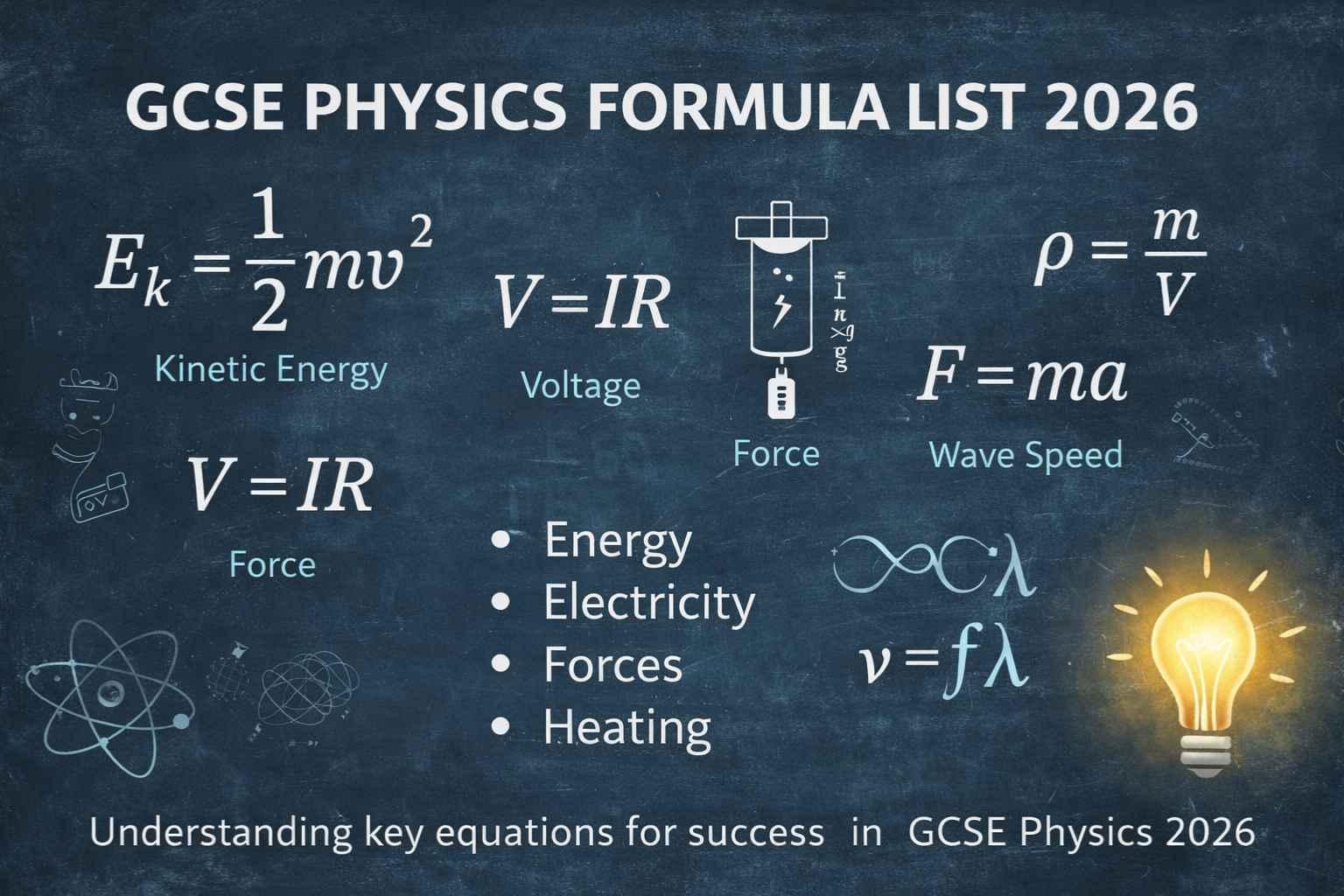
Preparing for GCSE Physics in 2026 can feel overwhelming, especially when you look at the full formula list. There are equations for energy, electricity, forces, heating, waves, density, and more. At first glance, it may seem like a random collection of rules that must be memorised.
However, the truth is very different.
Most GCSE Physics formulas are connected. They represent relationships between quantities in the physical world. When you begin to understand those relationships instead of memorising blindly, Physics becomes structured and logical rather than confusing.
This guide is designed for students following major UK exam boards such as AQA, Edexcel and OCR. The core formulas are largely the same across these boards, even if question wording differs slightly.
In this blog, you will learn what each major formula means, how examiners use them in questions, and how to avoid the mistakes that cost students valuable marks.
Why the GCSE Physics Formula List Looks Hard (But Isn’t)
Students often panic when they see the full formula sheet because it appears long. But many equations follow patterns. Energy equations are related to motion. Electricity equations are built around one central relationship. Forces equations describe how motion changes.
For example, energy stored at height using mgh can convert into kinetic energy using ½mv². Voltage, current, and resistance are linked by V = IR. Force and acceleration are directly proportional in F = ma.
Once you see these patterns, formulas stop feeling random.
Energy Formulas and How They Are Tested
Energy is one of the most frequently examined topics in GCSE Physics. It appears in standalone questions and also connects with motion and electricity.
The most important energy equations include:
Kinetic Energy: Ek = ½mv²
Gravitational Potential Energy: Ep = mgh
Work Done: W = Fs
Power: P = E/t
Efficiency = (useful output ÷ total input) × 100
Kinetic energy depends on mass and velocity, but velocity is squared. That detail is crucial. If velocity doubles, kinetic energy becomes four times greater. This is why speed has such a large impact in stopping distance and collision questions.
Gravitational potential energy depends on height. When an object is lifted higher, it stores more energy. Examiners often combine mgh and ½mv² in conservation of energy questions. You may be asked to calculate the energy at the top of a slope and then find the velocity at the bottom.
Power introduces time into energy transfer. Two machines may use the same energy, but the one that transfers it faster has greater power.
Efficiency questions are usually structured clearly. You are given total input energy and useful output energy, and you calculate a percentage. Many students lose marks simply because they forget to multiply by 100.
Electricity Equations Explained Clearly
Electricity is another high-mark topic in GCSE Physics 2026. It often involves multi-step calculations.
The central equation in electricity is:
V = IR
From this relationship, you can rearrange to find current or resistance. Voltage represents energy per unit charge. Current measures how much charge flows per second. Resistance controls how difficult it is for charge to flow.
Electrical power is calculated using:
P = IV
In Higher Tier exams, you may also use alternative forms such as P = I²R or P = V²/R.
Electricity questions are rarely one-step. For example, you may first calculate resistance, then use that value to calculate power, and finally calculate energy transferred over time. Logical progression between formulas is essential.
Students who practise linking equations together perform much better than those who memorise them in isolation.
Heating, Density and the Particle Model
Heating questions often appear as 5–6 mark structured problems.
Specific heat capacity is calculated using:
E = mcΔT
The key part of this formula is ΔT, which means temperature change. If temperature rises from 20°C to 70°C, the change is 50°C. Using the final temperature instead of the temperature change is one of the most common mistakes.
Specific latent heat uses:
E = mL
This equation applies during changes of state such as melting or boiling. During these processes, temperature does not change, but energy is still transferred. This concept is often tested in longer explanation questions.
Density is calculated using mass divided by volume. Unit conversion is especially important here, particularly when converting between centimetres cubed and metres cubed.
Forces and Motion: The Logical Core of Physics
Forces and motion equations describe how objects move and interact.
Speed is calculated using v = d/t.
Acceleration is calculated using a = (v − u)/t.
Force is calculated using F = ma.
Momentum is calculated using p = mv.
Force causes acceleration. Mass resists acceleration. Momentum is conserved in collisions.
Examiners frequently design collision questions where you must calculate total momentum before and after impact. These questions reward careful substitution and strong algebra skills.
The Biggest Formula Mistakes Students Make
Many students lose marks because of small, avoidable errors. Forgetting to convert grams into kilograms is extremely common. Most physics equations require mass in kilograms. Substituting grams directly can make answers 1000 times too large. Another frequent mistake is forgetting to square velocity in kinetic energy calculations. That small squared symbol changes the entire result. Students also confuse temperature change with final temperature in heating questions. Missing units in the final answer can cost marks even if the number is correct. Finally, rounding too early in multi-step calculations reduces accuracy. It is better to keep full calculator values until the final step. Avoiding these mistakes alone can significantly improve your grade.
How to Revise the GCSE Physics Formula List for 2026
The most effective way to revise formulas is through application, not repetition. Revise by topic rather than randomly. Focus on energy one day, electricity the next. This builds structured understanding.Solve calculation questions daily. Even five questions per day builds automatic confidence. Practise rearranging equations regularly, especially if you are Higher Tier. Algebra skills directly impact your Physics performance. Learn units alongside formulas. Units help reinforce understanding and reduce mistakes. Finally, practise under timed conditions. Knowing the formula is not enough; you must apply it efficiently under exam pressure.
Final Thoughts
The GCSE Physics Formula List 2026 is not just a list of equations to memorise. It is a system that explains how energy transfers, how electricity works, how forces change motion, and how heating affects particles something every good gcse physics tutor focuses on when building strong conceptual understanding. When you understand how these formulas connect, Physics becomes logical instead of intimidating. And when Physics becomes logical, your exam performance becomes predictable. Master the relationships, practise consistently, avoid common mistakes, and treat formulas as tools rather than obstacles. That is how you turn the GCSE Physics formula list into your strongest scoring advantage.