

The rate of photosynthesis required practical is one of the most important experiments in GCSE Biology. It is frequently examined and forms a key part of understanding how plants producefood and how environmental factors affect their growth. Students are expected not only to know the theory behind photosynthesis but also to confidently explain the method, identify variables, interpret results, and evaluate the experiment. This complete GCSE Biology guide explains the experiment clearly, including the light intensity investigation, limiting factors, expected results, and exam tips to help you secure high marks.
What is Rate of Photosynthesis Required Practical ?
Photosynthesis is the process by which plants use light energy to convert carbon dioxide and water into glucose and oxygen. This process takes place in the chloroplasts of plant cells, where chlorophyll absorbs light energy. The word equation for photosynthesis is: carbon dioxide + water → glucose + oxygen.
The rate of photosynthesis refers to how fast this reaction occurs. In practical terms, it measures how quickly oxygen is produced. In the GCSE required practical, this is usually measured by counting oxygen bubbles released from pondweed or by collecting oxygen in a gas syringe. When the rate is high, more oxygen bubbles are produced per minute. When the rate is low, fewer bubbles are observed. The required practical investigates how one key environmental factor → light intensity affects how fast photosynthesis occurs.
The Aim of the Rate of Photosynthesis Required Practical
The aim of the rate of photosynthesis required practical is to investigate how light intensity affects the rate of photosynthesis in aquatic plants such as Elodea (pondweed). Light is essential because it provides the energy needed for the reaction. By changing the distance between a lamp and the plant, students can observe how light intensity influences oxygen production.
How to Carry Out Light Intensity Experiment
The standard method used in GCSE Biology required practicals for photosynthesis is as follows:
-
Place a piece of Elodea (pondweed) into a beaker filled with water.
-
Add sodium hydrogencarbonate to the water. This dissolves to release carbon dioxide, ensuring CO₂ does not become a limiting factor.
-
Position a lamp at a set distance from the plant (e.g. 10 cm).
-
Let the plant adjust to the new environment for 2–3 minutes.
-
Count the number of bubbles produced in 1 minute and record the observations.
-
Move the lamp to greater distances (e.g. 20 cm, 30 cm, 40 cm) and repeat steps 4 and 5 at all distances.
-
Repeat each distance 3 times and calculate the mean number of bubbles.
Examiner Tip
- Many students forget to mention sodium hydrogen carbonate when explaining how carbon dioxide concentration is controlled in the experiment. This is a very common mark-losing mistake, so it should always be included when writing about control variables.
- When asked to identify a control variable and explain how it is controlled, first name the variable clearly and then explain how it is kept constant during the experiment. This helps show scientific understanding and improves accuracy in exam answers.
Identifying Variables
Independent Variable
- The independent variable is the distance of the lamp from the plant. As the distance increases, light intensity decreases because the lamp moves farther away from the plant.
Dependent Variable
- The dependent variable is the number of oxygen bubbles produced per minute, representing the rate of photosynthesis. More bubbles produced means a faster rate of photosynthesis.
Control Variables
- Control variables must remain constant throughout the experiment. These include temperature, carbon dioxide concentration, type of plant, and volume of water. Keeping these constant ensures the experiment is fair and reliable, and scientific language should be used clearly when describing them.
Why Light Intensity Affects the Rate of Photosynthesis
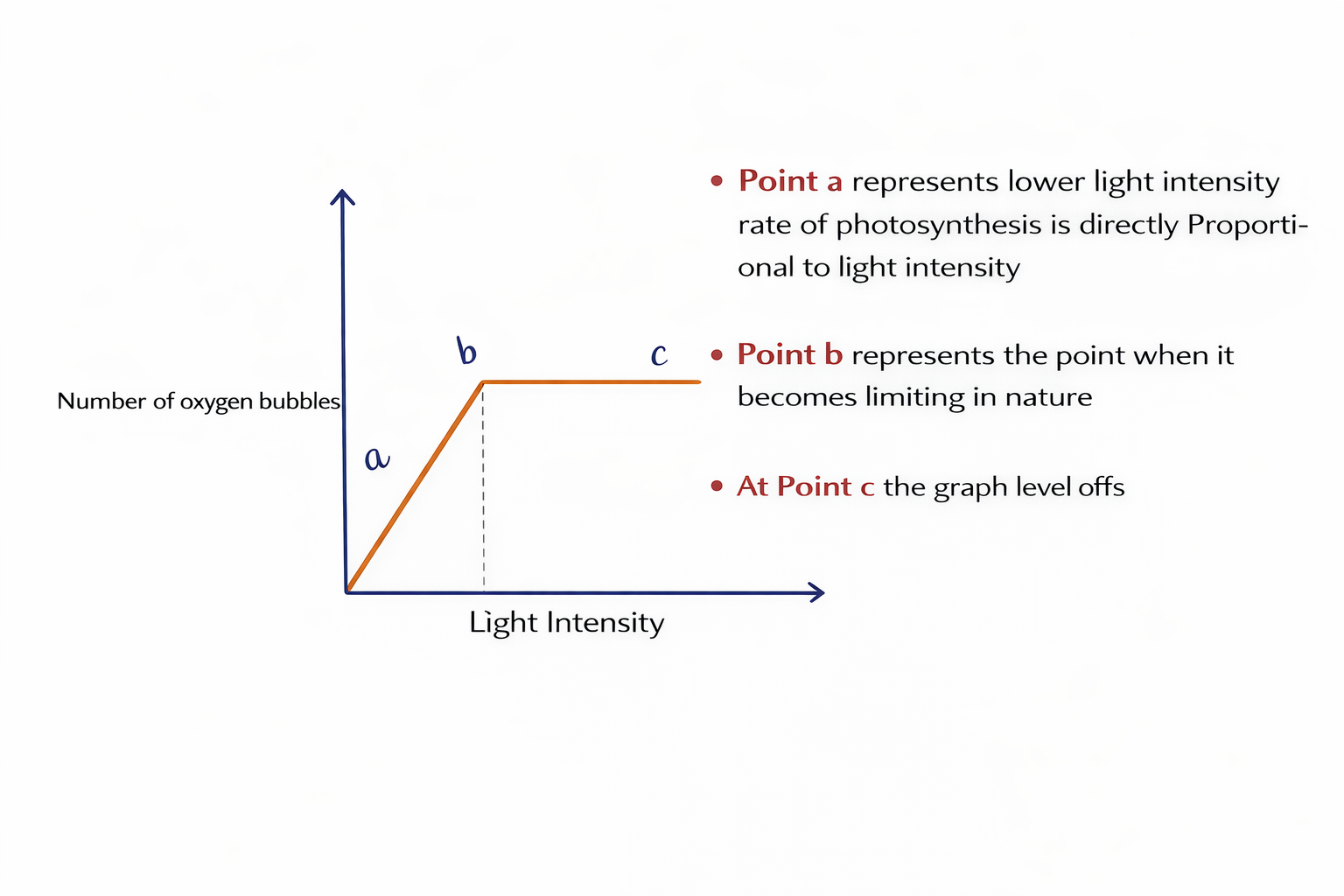
Light provides the energy required for photosynthesis. When light intensity increases, more energy is absorbed by chlorophyll, and the reaction speeds up.However, this increase only continues to a certain point. Eventually, the graph levels off becauseanother factor becomes limiting and rate stops increasing even if you add more light .
Understanding Limiting Factors: Important for Higher Marks
Three main limiting factors in photosynthesis are:
-
Light Intensity
If light intensity is low, increasing it will increase the rate.
-
Temperature
If temperature is too low, enzyme activity slows down. If too high, enzymes get denatured.
-
Carbon Dioxide Concentration
Download Past Year Question Paper